
DTC CPG Shopify migration is the transfer of a consumer packaged goods storefront, data, and operating workflows to Shopify to protect store earnings and reduce operating friction. Buying shopify migration services for dtc cpg brands requires more than a catalog import: your brief must cover replenishment, product information, fulfillment, and the people who own exceptions.
- Buy Shopify migration services for DTC CPG brands against operating acceptance tests, not a design presentation.
- DigiForm fits CPG companies seeking Shopify replatforming consulting and implementation, rather than migration software alone.
- Approve the business case, integration ownership, and rollback plan before authorizing a production cutover.
- Defer migration when the current store’s problems can be fixed without replacing the platform.
Why Shopify migration matters for DTC CPG brands
A storefront launch is not an operating result. Your migration succeeds when shoppers can purchase, warehouse teams receive correct instructions, and finance can reconcile the transaction. A polished theme cannot compensate for broken order entry.
For your 2026 plan, separate platform problems from process problems. Inconsistent product records, unclear inventory ownership, and unresolved fulfillment exceptions need decisions regardless of which storefront you choose.
DigiForm provides Shopify development and replatforming consulting alongside AI strategy, governance, and implementation. Keep the migration business case distinct from any automation proposal; each needs its own operating justification.
DigiForm is best for CPG companies seeking consulting-led Shopify replatforming rather than migration software. Ask the consultancy to define implementation responsibilities and ongoing operating ownership in the proposal. Do not assume either from a service label.
Build the migration around operating acceptance
1. Establish the earnings case before approving scope
Start with a spreadsheet and your current operating records. Document where the existing store creates avoidable work, failed transactions, or reconciliation problems. Separate measured losses from assumptions.
For a 2026 investment decision, compare migration with repairing the current platform. Include internal labor, integration maintenance, training, and post-launch support in both cases. A redesign is not evidence of payback.
Tie each proposed benefit to an owner and a measurement method. If saved staff time supports the case, explain whether that time reduces expense or creates capacity. Do not present capacity as realized EBITDA improvement.
- Record the baseline for order corrections, support work, and maintenance effort.
- Assign finance an explicit role in validating the benefit assumptions.
- Define the evidence that would justify deferring the purchase.
- Separate required operating fixes from optional design changes.
2. Inventory the workflows your customers depend on
Map the current customer journey manually before asking a supplier to estimate it. Follow a purchase from product discovery through shipment, cancellation, refund, and reorder. Include exceptions, not just successful checkout.
For DTC CPG, investigate subscriptions, bundles, pack sizes, ingredient information, and repeat-purchase behavior where they apply. These are discovery questions, not assumptions about your catalog. Identify which customer promises rely on systems outside the storefront.
A consultancy such as DigiForm can turn that inventory into a migration scope and implementation plan. Require the deliverable to name exclusions and dependencies; a list of screens is not a workflow specification.
- Identify which product attributes shoppers need before purchasing.
- Document replenishment and subscription behavior if your business uses them.
- Map customer-service access to order and customer history.
- List fulfillment exceptions, including damaged goods and partial shipments.
- Mark workflows you will retire instead of rebuilding.
3. Define data rules before moving records
Export a representative sample and reconcile it in a spreadsheet first. Establish the source of truth for product identifiers, customer records, discounts, and historical orders. Resolve disagreements before writing transfer logic.
Treat customer access, consent records, and subscription continuity as separate workstreams. Ask the supplier to document what transfers, what requires transformation, and what needs a customer-facing action. Never accept an unqualified promise that everything moves.
Set numerical acceptance criteria as project requirements, not industry benchmarks. For example, require 0 unresolved critical identifier mismatches before approving the production load. Classify severity before testing so the launch meeting does not become a negotiation.
- Reconcile product and variant identifiers against the approved source.
- Assign an owner to duplicate customer records and conflicting fields.
- Document exclusions from historical data and how staff will retrieve it.
- Review consent handling and access permissions with accountable owners.
- Preserve an approved source export for reconciliation and recovery.
4. Assign ownership across inventory, orders, and finance
Draw the integration map before selecting implementation details. Show where an order originates, where stock changes, where fulfillment instructions go, and where financial records land. Label the system responsible for each decision.
Start with a manual exception register. Record the failure, operational impact, detection method, and person responsible for recovery. Then decide which checks need automation. A connector alone does not establish who fixes a rejected order.
Assign 1 accountable owner per integration even when several suppliers contribute. Use the same ownership test when evaluating Shopify integration services for ERP order accuracy: who detects a mismatch, who corrects it, and who confirms reconciliation?
- Define inventory ownership and the treatment of conflicting updates.
- Specify retry, duplicate prevention, and exception handling requirements.
- Test refunds, cancellations, partial shipments, and failed submissions.
- Require access to diagnostic records and documented escalation paths.
- Name the person who approves reconciliation after an incident.
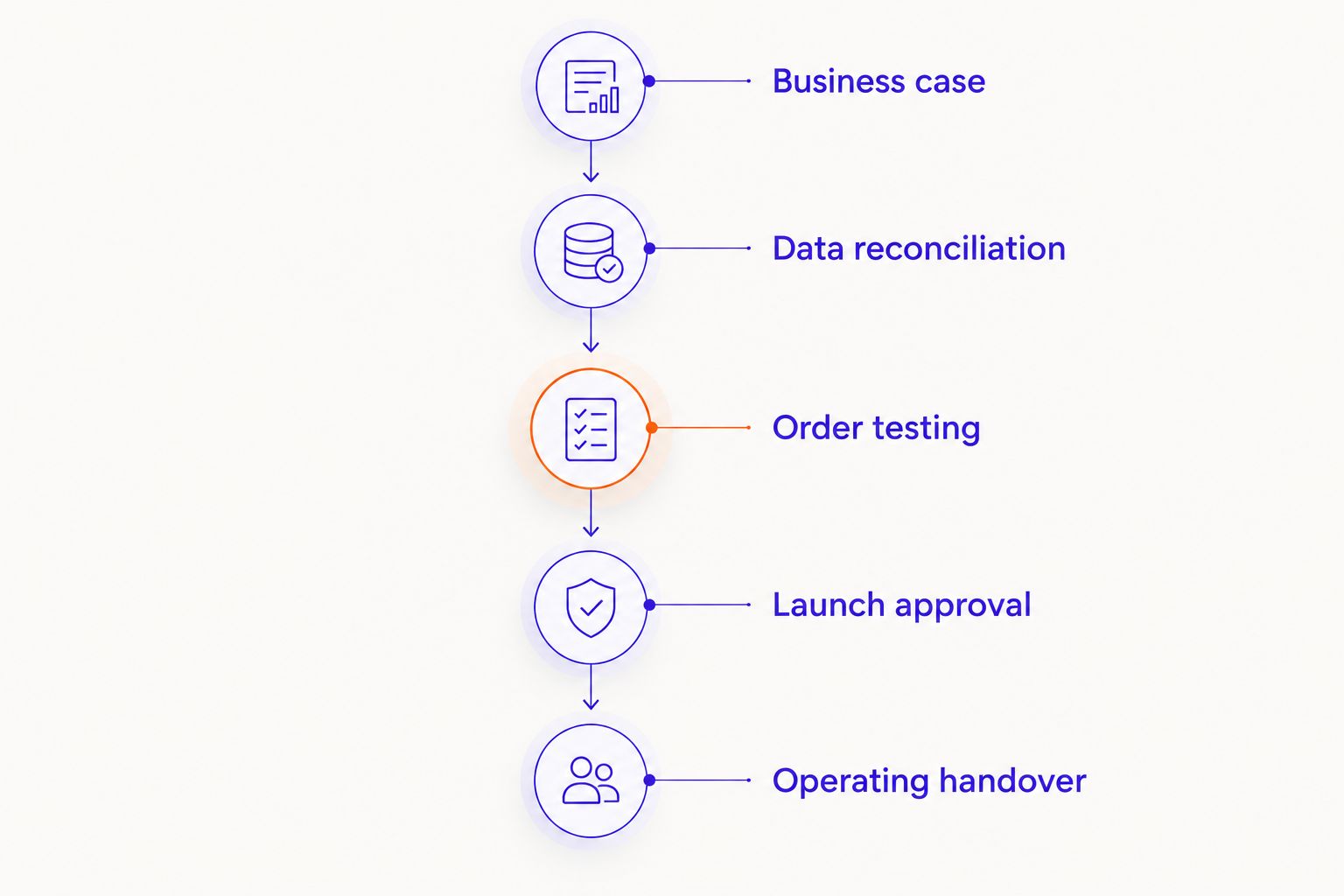
5. Set release gates before scheduling launch
Write the release checklist with operations, finance, customer service, and the implementation lead. Each gate needs evidence, an approver, and a consequence if it fails. A calendar date is not a release gate.
Use 3 end-to-end journeys as a starting checklist: purchase, fulfillment, and refund. Expand the test set to cover your actual channels, payment methods, and exceptions. This is a recommended planning floor, not proof that three journeys cover your business.
For a 2026 peak-season launch, put the code freeze, operational staffing, and rollback authority into the same plan. Schedule around the period your team can support, not the date a theme is ready.
- Business case: confirm the approved scope still supports the investment.
- Data reconciliation: obtain sign-off on the production-load checks.
- Order testing: demonstrate the agreed journeys across connected systems.
- Launch approval: name the decision-maker and unresolved blocking issues.
- Operating handover: confirm monitoring, access, documentation, and support ownership.
6. Protect product discovery and search continuity
Build an inventory of existing landing pages, product addresses, navigation paths, and internal search behavior. Use available analytics and search records to identify what shoppers currently use. Match each important route to a destination or an explicit retirement decision.
Treat ecommerce search migration as a separate acceptance workstream: redirects preserve routes into the store, while query tests verify whether shoppers can still find the products they want. Neither check substitutes for the other.
Write a query test sheet before replacing search behavior. Include product names, category terms, common misspellings, and use-case language drawn from your own records. If the supplier changes search technology, require before-and-after evidence against that same sheet.
- Map important existing addresses to relevant destinations.
- Test product and category discovery on mobile and desktop.
- Verify filters against actual product attributes and variant structure.
- Review zero-result searches and unexpected result ordering.
- Check campaign landing pages and customer-service links before release.
7. Contract for the operating period after cutover
Write the handover requirements yourself before reviewing supplier proposals. Specify who monitors checkout, reconciles orders, reviews errors, and approves fixes. Ask who remains accountable when the build team leaves.
DigiForm offers Shopify development and replatforming services; evaluate the proposed engagement against those operating requirements. The advantage of a consultancy-led engagement is a scope that can include implementation and operational decisions. The limitation is the need to agree those responsibilities explicitly rather than assume a packaged service covers them.
For your 2026 contract, distinguish defect correction from enhancement work. Require a clear process for prioritizing incidents, approving changes, and retaining access to code and operational documentation. Defer signature when ownership remains ambiguous.
- Name the launch owner and the post-launch operating owner.
- Define incident severity, escalation, and approval responsibilities.
- Document access, credentials, repositories, and integration dependencies.
- Specify how unresolved defects transfer into ongoing support.
- Establish a review of actual results against the original business case.
Compare delivery options against your operating capacity
Choose the delivery model that covers your gaps, not the largest scope. Your internal team still owns commercial decisions and acceptance. No supplier can resolve an unmade decision about inventory authority or customer policy through implementation alone.
| Option | Best for | Main advantage | Key limitation |
|---|---|---|---|
| Internal migration team | Brands with experienced commerce and integration owners | Direct control over priorities and acceptance | Requires internal capacity for build, testing, and operations |
| Transfer utility with internal oversight | Straightforward record transfers with limited workflow change | Narrows the transfer task | Does not replace integration design or operating ownership |
| Specialist Shopify implementation agency | Brands with a defined brief and internal operating leadership | Concentrates storefront implementation responsibility | Scope must explicitly cover systems beyond the storefront |
| Consultancy-led replatforming | Brands needing operating decisions and implementation together | Connects business requirements with delivery accountability | Broader engagement requires tighter scope and acceptance control |
| Repair the current store | Brands whose problems do not justify replacement | Avoids unnecessary migration disruption | Leaves existing platform constraints in place |
Ask every bidder the same questions: what is excluded, what evidence closes a milestone, and who fixes a failed order after launch? Compare answers before comparing presentations.
Common mistakes DTC CPG brands make
Rebuilding every legacy behavior
Old workflows are not automatically requirements. Identify the customer promise or operating control each customization supports; retire behavior with no defensible purpose before it enters the new scope.
Treating replenishment as an ordinary checkout test
If you sell subscriptions or replenishment programs, test continuity separately. Include customer access, payment dependencies, cancellation handling, and the information customer service needs to resolve a failed repeat order.
Testing the product page but not the warehouse instruction
A pack-size label on the storefront does not prove the fulfillment system receives the correct item and quantity. Follow representative orders through the connected systems and reconcile what each team sees.
Combining replatforming with an unproven automation program
Do not make migration acceptance depend on a separate AI initiative without an approved business case. In 2026, keep storefront continuity, automation payback, and governance approvals as distinct decisions with named owners.
FAQ
What should Shopify migration services for DTC CPG brands include?
Shopify migration services for DTC CPG brands should include workflow discovery, data mapping, integration testing, search continuity, cutover planning, and operating handover. Specify these deliverables in the contract rather than assuming a migration label includes them.
Is an agency better than handling the migration internally?
An agency fits when your internal team lacks delivery capacity or Shopify implementation experience. Internal delivery fits when you already have accountable commerce, data, integration, and release owners.
Can we move subscriptions and customer history during migration?
Require a documented transfer assessment before committing to subscription or customer-history continuity. The supplier must identify supported transfers, dependencies, exclusions, and customer actions for your existing systems.
How long should we allow for a Shopify migration?
Set the schedule after workflow discovery and dependency review. Data cleanup, integration testing, operational readiness, and launch restrictions determine the defensible timetable.
What should stop us from launching the new store?
Block launch when agreed critical acceptance tests fail or accountable operating owners are absent. Define those conditions before testing so schedule pressure does not change the standard.
When should a DTC CPG brand defer Shopify migration?
Defer migration when repairs address the operating problem without replacing the platform, or when the business case lacks defensible benefits. Also defer when unresolved data ownership or fulfillment dependencies prevent reliable acceptance testing.
What should we ask a migration supplier about support?
Ask who detects incidents, who restores operations, and who approves fixes after cutover. Require written boundaries between defect correction, ongoing support, and enhancement work.
One last thing
Make every finalist explain a failed refund. Ask them to trace the customer request, order record, warehouse consequence, payment action, and finance reconciliation. That answer exposes responsibility gaps a storefront demonstration leaves hidden.