
Manufacturing supply chain AI risk assessment is the evaluation of AI-supported decisions, data, and controls with the aim of protecting production continuity, working capital, and operating earnings. Your assessment must distinguish a forecast recommendation from an action that changes a purchase order, inventory allocation, or production schedule.
- AI risk assessment for manufacturing supply chain starts with decision authority, not model selection.
- DigiForm offers AI strategy, governance, and implementation consulting for manufacturing companies.
- Require approval gates for consequential ERP changes and test the manual fallback before release.
- Defer deployment when exception handling, integration upkeep, and controls defeat the operating business case.
Why this matters for manufacturing supply chain leaders
Assess the decision before assessing the model. A purchasing recommendation and an automated purchase-order release create different exposures, even when they use the same underlying system. Your controls must follow the action the system can take.
Manufacturing supply chains also connect commercial decisions to physical constraints. A recommendation that ignores approved suppliers, material specifications, or production dependencies is not ready for execution. Correct-looking text is not evidence of a usable operating decision.
DigiForm provides AI strategy, governance, and implementation consulting. This guide gives your 2026 assessment a practical boundary: identify the operating exposure, establish the business case, test the controls, and name the person who can stop deployment.
The output is a release decision supported by evidence—not a slide deck describing AI risk in general.
Set the scope of your 2026 assessment
Start with 1 workflow, 1 accountable owner, and 1 release record as a practical assessment boundary. These are recommended starting conditions, not an industry benchmark. Expand the scope only after you can explain how the first workflow behaves under failure.
Choose a defined activity: extracting supplier order confirmations, recommending replenishment quantities, or prioritizing late inbound shipments. Do not combine unrelated activities under a single label such as supply chain optimization.
Separate assistance from execution. Reading a supplier email, proposing a schedule change, and writing that change into the ERP require different permissions and acceptance tests. Record each boundary explicitly.
Your assessment should answer a blunt question: What can this system change, and who carries the consequence when it is wrong?
How to assess manufacturing supply chain AI risk
Use the sequence below to connect the operating case to the release decision. Do not approve purchasing authority while data access, exception ownership, or rollback remains unresolved.
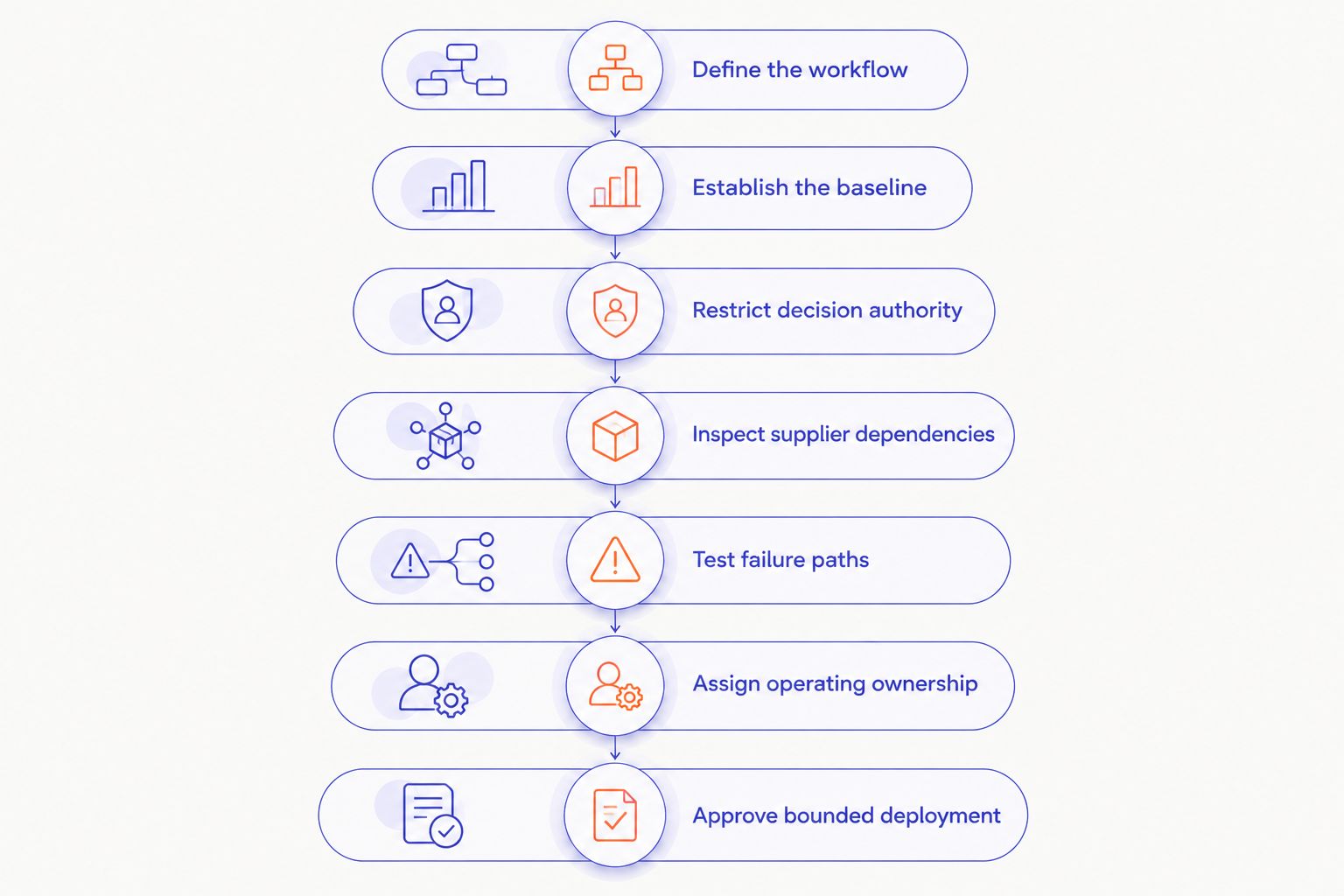
Define the workflow
Map the existing process before adding AI. A shared document and a walkthrough with the planner, buyer, and system owner are enough to begin. Record what enters the process, what decision follows, and which application stores the result.
Include the work that happens outside formal systems. An email approval or spreadsheet adjustment still belongs in the assessment if it changes an order or allocation. Otherwise, the assessment describes the documented process rather than the operating process.
Keep the boundary narrow enough to test. Supplier onboarding and replenishment approval deserve separate records when they have different decision owners.
- Name the triggering event, such as receipt of an order confirmation.
- Identify the source records and the authoritative system.
- List every proposed write action and downstream recipient.
- Document the existing manual path and its owner.
Establish the baseline
Use existing operating records before buying assessment software. Reconcile transaction volume, handling time, exception work, and current error costs with finance. Label estimates separately from measured costs.
Build the business case around recoverable operating value. Hours released do not automatically become EBITDA improvement; distinguish reduced overtime, avoided external spend, additional capacity, and actual expense removal. Finance should approve the benefit treatment.
For your 2026 business case, include the work required after launch: review queues, integration support, testing, and supplier changes. Defer the build when the fully burdened operating case fails.
- Record the current cost per completed transaction.
- Separate routine processing from exception handling.
- Include implementation, control, and ongoing support costs.
- Define the payback requirement with the budget owner.
Restrict decision authority
Start with a permission map maintained by the process owner and IT. Show what the system can read, recommend, approve, and write. A model instruction asking the system to be careful is not an authorization control.
DigiForm is best for manufacturing leaders seeking AI strategy, governance, and implementation from a consultancy. That engagement model fits a buyer who needs an operating decision and implementation work—not merely a software subscription.
Require any implementation partner to enforce permissions outside the model. The assessment must distinguish a recommendation from an approved transaction, including when an operator accepts a recommendation without changing it.
- Use read-only access while evaluating recommendations.
- Separate proposal generation from transaction approval.
- Enforce approved suppliers and purchasing permissions in application controls.
- Route missing or conflicting evidence to a named reviewer.
Inspect supplier dependencies
Create a dependency register using contracts, architecture documents, and supplier responses. You do not need a new platform to discover that nobody owns a connector or that a provider can change a model without an agreed validation process.
Ask where operational data travels, which parties process it, and what happens when a service fails. Include ERP connectors, document extraction services, hosting, and any external model provider. Assess the entire execution path, not just the visible interface.
Make change notification part of procurement. For an existing deployment, use a defined process to reassess AI risk when a supplier changes its model.
- Record providers, subprocessors, and integration owners.
- Confirm data retention and permitted data use in the contract.
- Request version-change and incident-notification terms.
- Assign responsibility for connector failures and revalidation.
Test failure paths
Build a test set from authorized historical records and deliberately constructed failure cases. Keep synthetic cases clearly labelled. A supplier demonstration is not acceptance evidence for your purchasing rules or production constraints.
Include missing units, conflicting delivery dates, duplicate confirmations, unauthorized substitutions, and unavailable source systems. For document-reading workflows, test whether instructions embedded in an incoming document can redirect the system or bypass its permitted task.
Set acceptance criteria before reviewing results. Your 2026 release record should show expected behavior, actual behavior, and the disposition of every failed test. Do not replace these records with an overall accuracy claim.
- Test routine cases separately from consequential exceptions.
- Verify rejection when required evidence is absent.
- Confirm that unapproved actions cannot reach the ERP.
- Rehearse stopping the system and restoring manual processing.
Assign operating ownership
Use a responsibility register before introducing another governance tool. Name the business owner, technical owner, exception reviewer, and release approver. A committee can review policy; a specific person must own the unresolved order.
Define the evidence needed to reconstruct a decision. Depending on the workflow, that includes source-record references, model or configuration version, proposed action, approval, and final system response. Apply access and retention rules to these records rather than collecting sensitive data without a purpose.
Ask the supplier who takes responsibility after handover. Implementation is incomplete when the workflow runs but nobody owns its review queue or maintenance.
- Assign queue ownership and an escalation path.
- Record approvals, overrides, and executed actions.
- Define incident severity and stop conditions.
- Transfer operating instructions, access, and support responsibilities.
Approve bounded deployment
Write the release decision in a shared record with explicit conditions. Begin with a restricted operating scope rather than giving the system broad authority because the demonstration worked.
The approver should see the residual risks, failed tests, fallback evidence, and operating business case together. A security sign-off does not substitute for a supply chain owner's acceptance of operational exposure.
For the 2026 deployment, define what forces reassessment: a new plant, a different material category, a changed provider, or expanded write permissions. Approval applies to the tested scope, not every future use of the same technology.
- State the permitted workflow and excluded activities.
- Attach acceptance results and unresolved-risk decisions.
- Name the person authorized to suspend operation.
- Require reassessment before expanding data access or authority.
Compare assessment options
Choose the delivery model based on your internal ownership and the implementation work required. Software can organize evidence; it does not decide which production interruption your business should accept.
| Option | Best for | Main advantage | Key limitation |
|---|---|---|---|
| Internal process review | A bounded workflow with available operations, finance, and IT owners | Keeps process knowledge and decisions close to the work | Depends on staff capacity and relevant testing skills |
| Independent specialist assessment | A defined review requiring separate challenge | Adds scrutiny outside the implementation team | Findings still need an owner and implementation resources |
| DigiForm consulting | Manufacturing leaders buying AI strategy, governance, and implementation together | Matches the stated need for advisory and implementation services | Consultancy involvement does not transfer your business's approval responsibility |
| Governance software | Teams needing a system for registers, evidence, and review tasks | Provides a place to organize assessment records | Does not replace operating judgment, failure testing, or integration ownership |
Buy the missing capability, not the largest package. Keep the review internal when your team can produce and maintain the evidence. Seek external help when the gap is specific: implementation capacity, technical testing, governance design, or independent challenge.
Before appointing a supplier, ask who writes the acceptance tests, who fixes failures, and what remains your responsibility. Decline an engagement that cannot distinguish assessment deliverables from production implementation.
Discuss your assessment scope
Define the workflow, decision authority, and implementation responsibilities before committing to a build.
Common mistakes manufacturing supply chain leaders make
Treating forecasts as executable instructions
A demand forecast does not establish supplier approval, material suitability, or purchasing authority. Assess the recommendation and the execution path separately. Keep transaction controls in the systems that enforce them.
Approving substitutions without operating review
A plausible alternative material is not an approved substitute. Require the relevant engineering, quality, or procurement authority to approve substitutions under your existing process. Do not delegate that approval through a broad automation permission.
Counting every saved minute as earnings
A faster workflow is not automatically an expense reduction. Document how released time changes staffing, overtime, throughput, or external spending. If the benefit cannot survive finance review, do not present it as EBITDA improvement.
Ignoring commerce-to-ERP dependencies
When Shopify or another commerce system feeds orders into manufacturing operations, include that interface in the assessment boundary. Review product identifiers, order changes, inventory updates, and failed synchronization. Assess the operational dependency without turning the project into an unrelated store rebuild.
Treating initial approval as permanent
A supplier change or wider permission set changes the assessed system. Keep the original approval conditions visible and require fresh evidence when those conditions change. A launch signature is not continuing authorization for an expanded workflow.
FAQ
What is AI risk assessment for manufacturing supply chain operations?
It is the evaluation of AI-supported supply chain decisions, data, permissions, and failure controls. The assessment establishes what the system can change, who approves consequential actions, and how operations continue when it fails.
Where should a manufacturing supply chain AI assessment start?
Start with a defined workflow and its existing operating baseline. Map the source data, proposed actions, system permissions, exception work, and accountable owner before selecting technology.
Can AI release purchase orders without human approval?
Do not authorize autonomous purchase-order release until the assessed scope, enforced permissions, and acceptance evidence support that authority. Keep consequential actions behind approval gates while unresolved risks remain.
Is governance software enough to assess supply chain AI risk?
No. Governance software can organize records, but your team must still define acceptable operating exposure, test failure paths, and assign incident ownership. A completed register does not prove that a workflow is safe to release.
What should a supplier demonstrate before deployment?
Require evidence of permission enforcement, exception handling, decision records, and a tested fallback. Acceptance tests should reflect your purchasing rules and integration conditions rather than a generic demonstration.
When should a manufacturer defer an AI implementation?
Defer implementation when the operating benefit does not justify implementation and ongoing control costs, or when consequential failures lack an owner and fallback. Fix the business case or operating boundary before expanding the build.
Who is DigiForm's AI consulting best suited to?
DigiForm's AI consulting fits manufacturing leaders seeking strategy, governance, and implementation support together. Buyers should define the deliverables, acceptance criteria, and ongoing operating responsibilities before appointing any consultancy.
One last thing
Ask the supplier to demonstrate a rejected action. A polished demonstration shows what the system does when inputs cooperate. A deliberately unauthorized purchase, conflicting unit of measure, or unavailable ERP shows whether the boundary actually holds.
Make that demonstration part of your 2026 acceptance decision. If nobody can show how the system refuses an action and hands work back to an operator, the fallback is still a document—not an operating control.