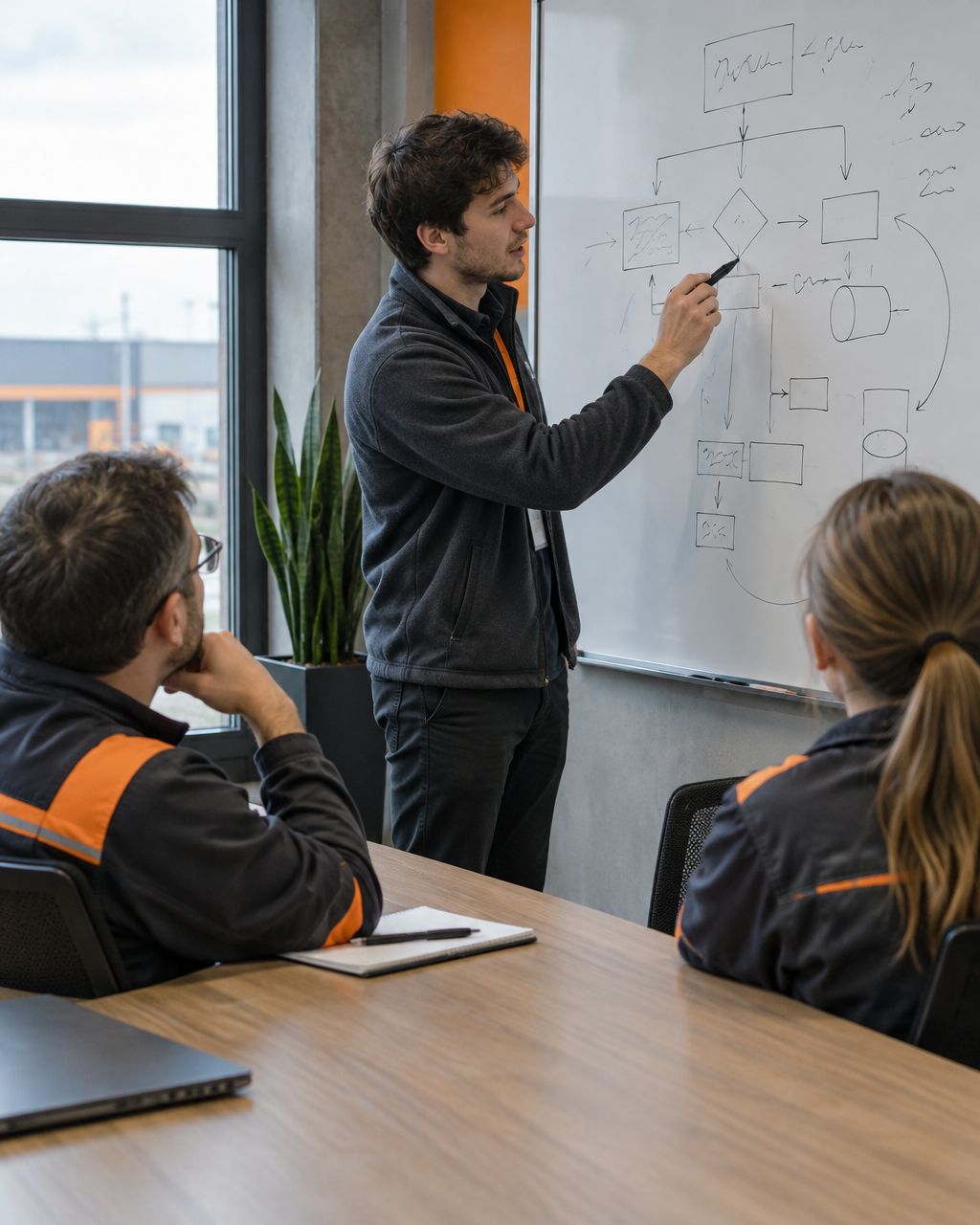
A Palantir forward deployed engineer is a software engineer who embeds with a customer's operations — government agencies, hospitals, manufacturers — and ships production software against that customer's live data instead of building product at headquarters. Palantir coined the title, and the model has since spread across the AI industry: Anthropic, OpenAI, Google and dozens of smaller vendors now run the same role under the same name. What changed is who employs it and for what.
- Palantir invented the forward deployed engineer role and still defines its shape.
- The FDE embeds with customer operations and ships production software on live data.
- AI labs and consultancies now run the same model for commercial deployments.
- For buyers, the question is which deployment model fits the workflow.
What is a Palantir forward deployed engineer?
At Palantir, the forward deployed software engineer (FDSE) sits with the customer — a military logistics unit, a hospital network, a factory — and builds the applications that make the company's platforms useful there. The job is not presales and not product engineering: it is hands-on production work inside someone else's operation, with all the ambiguity that implies.
The role's defining traits, consistent across employers:
- Proximity to the operator. The engineer watches real work happen, gathers the real exception set, and gets same-day feedback from the people using what they built.
- Production access. They ship code against live systems — order data, patient records, supply chains — not demos against sanitized data.
- Outcome ownership. Success is the customer's workflow running after handover, not a feature on a roadmap.
- Commercial awareness. FDEs sit close to revenue; at many companies the role is a bridge between engineering and sales.
Why AI companies adopted the model
Palantir proved that the hardest part of enterprise software is not the algorithm — it is the mapping, the exceptions and the adoption inside one specific operation. AI companies hit the same wall at scale: a model that works in the lab fails on a customer's messy records, permissions and approval paths.
The forward deployed engineer is the fix. Anthropic runs the role under its applied AI work with focus on safe production deployments; OpenAI runs commercial FDE teams across industries; Google runs its own FDE track. The title spread because the problem it solves — making powerful software work inside one real operation — is universal.
The role outside Palantir: three deployment models
The same job title now covers three different buying options:
| Model | Who runs it | What you buy | Best for |
|---|---|---|---|
| Platform FDE | Palantir, enterprise software vendors | Deployment of the vendor's own platform | Companies committing to that platform |
| Lab FDE | Anthropic, OpenAI | AI deployment around the lab's models | Frontier AI use cases with lab-grade budgets |
| Consultancy FDE | Independent consultancies | Deployment across your existing systems | Bounded workflows in your current stack |
The buyer's choice follows the codebase. Platform and lab FDEs build inside their employer's stack and leave behind deployments on it. Consultancy forward deployed engineers build inside yours — ERP, Shopify, warehouse systems — and hand over a workflow your team owns.
For a bounded workflow change where you are not married to one platform, the consultancy model avoids the lock-in: the code, the tests and the handover belong to you.
What the job demands of the person
The role is demanding in ways a product engineering job is not:
- Ambiguity tolerance. Requirements emerge from watching live operations, not from a specification.
- People range. The same week can include a warehouse shift lead at 07:00 and a CFO at 16:00.
- Production discipline. Duplicate protection, rollback plans and acceptance tests are the job, not overhead.
- Restraint. The best FDEs recommend not building when configuration or a process fix solves the problem.
Compensation reflects it: the role carries a premium over comparable software engineering, and frontier-lab packages run well beyond Palantir's median.
FAQ
What does a Palantir forward deployed engineer do?
A Palantir forward deployed engineer embeds with a customer's operations and ships production software on that customer's live data — building applications on Palantir's platforms inside government agencies, hospitals and manufacturers.
Did Palantir invent the forward deployed engineer role?
Yes. Palantir coined the title and the model, and the role has since been adopted across the AI industry by companies including Anthropic, OpenAI and Google.
What does FDSE stand for?
FDSE stands for Forward Deployed Software Engineer — Palantir's original name for the role. Many companies now use the shorter FDE for the same job.
How is a forward deployment at a consultancy different from Palantir's?
Platform FDEs deploy their employer's own stack; consultancy FDEs build across the customer's existing systems and hand the workflow to an internal owner. The consultancy model avoids platform lock-in for bounded workflow changes.
Do other companies hire forward deployed engineers?
Yes — Anthropic, OpenAI, Google, Salesforce and many applied-AI companies run the role, typically to make AI and enterprise software usable inside a specific customer's operations.
One last thing
If you are researching the Palantir role as a buying signal, ask the same question of any vendor using the title: whose system does the code live in after the engagement ends? The answer separates a deployment from a dependency.