
Yes. Shopify Plus supports B2B wholesale and direct-to-consumer orders through a blended store, or through separate stores when the channels need different experiences and operations. The deciding issue is not whether both channels can take orders; it is whether customer access, catalogs, payment terms, inventory, and fulfillment rules work together without manual repair.
- Shopify Plus B2B wholesale DTC works in a blended store; choose separate stores when channel requirements conflict.
- Shopify supports company accounts, B2B catalogs, and payment terms; validate the exact workflow before committing.
- DigiForm fits CPG and manufacturing leaders seeking Shopify implementation and ongoing operating ownership.
- Defer migration when inventory ownership, order exceptions, and the business case remain unresolved.
Why this matters
A wholesale buyer and a consumer can buy the same SKU while creating different operating obligations. Wholesale orders introduce company purchasing rules, payment terms, and account-specific commercial arrangements. DTC orders still need a straightforward checkout and dependable fulfillment.
For a 2026 platform decision, judge the combined operating model rather than the storefront demonstration. Your implementation partner needs to own order accuracy after launch, not just theme delivery. Use these criteria when choosing a Shopify Plus agency for ongoing operations.
A shared storefront is useful only when it preserves the rules that make each channel profitable. Consolidating administration does not justify extra order-entry work, inventory disputes, or unresolved accounting exceptions.
Can Shopify Plus handle B2B wholesale alongside DTC orders?
Yes. Shopify's native B2B capabilities support company purchasing alongside consumer commerce on Shopify Plus. Shopify describes the shared-store approach as a blended store and the B2B-only approach as a dedicated store.
Shopify Help Center's documentation on blended and dedicated B2B stores is the reference for these configurations. Confirm current feature and app compatibility against your proposed implementation before signing a 2026 scope.
| Configuration | Best for | Main advantage | Main drawback |
|---|---|---|---|
| Blended store | Brands with substantially shared products and operating rules | B2B and DTC administration share a store | Shared settings, theme behavior, and apps require channel-specific testing |
| Dedicated B2B store alongside a DTC store | Brands requiring stronger separation of buying experiences and operations | Separate storefront configuration for wholesale | Additional store administration and integration coordination |
Neither configuration settles the ERP design. Shopify can accept an order while the downstream process still fails to apply the correct account, payment terms, warehouse, or shipment status.
Ask the supplier to demonstrate a wholesale order through financial reconciliation, not merely checkout. Then repeat the demonstration for a consumer order using the same SKU.
Blended store: best for shared operations
A blended store is the starting candidate when wholesale and DTC share a product base, brand experience, and fulfillment model. Shopify identifies B2B buyers through company accounts and company locations, allowing the buying experience to reflect assigned catalogs and purchasing terms.
That structure supports different commercial relationships without requiring every customer to see the same purchasing conditions. It does not mean every theme component or installed app automatically understands the distinction.
Before approving a blended store, require proof that:
- Anonymous visitors cannot access account-restricted purchasing conditions.
- Authorized company buyers receive the intended catalog and payment terms.
- Consumer promotions behave correctly for both customer types.
- Order data identifies the company and company location where required.
- Returns, cancellations, and customer service follow the correct channel process.
Choose a blended store when shared administration simplifies work without weakening channel controls. Reject the argument that fewer stores automatically means fewer operating problems.
The disadvantage is shared change exposure. A theme release, checkout customization, or app change needs regression testing across both buying journeys. Put that obligation in the support scope.
Dedicated B2B store: best for operational separation
A dedicated B2B store is the stronger candidate when wholesale needs a materially different buying experience or a separately managed operating model. Examples include different merchandising, account workflows, or integration requirements that make a shared implementation difficult to maintain.
Separation gives the wholesale team its own storefront configuration. It also creates work: product publication, integrations, analytics, releases, and support responsibilities need explicit coordination across stores.
Do not select separate stores simply because wholesale feels different. Identify the exact requirement that needs separation and demonstrate why a blended store cannot meet it cleanly.
Choose a dedicated B2B store when operational separation has a documented benefit that exceeds the additional administration. Keep a blended store on the shortlist when the differences are primarily account access and purchasing terms.
For a 2026 launch, assign ownership of cross-store inventory before approving the architecture. Separate storefronts do not create separate physical stock unless your fulfillment operation actually allocates stock that way.
Why the right configuration varies
The choice depends on operating requirements, not whether a supplier prefers building one storefront or several. Document these factors before asking for an implementation proposal:
- Account structure: Define who buys, which company location places the order, and who can approve purchasing changes.
- Catalog rules: Specify product visibility, assortment differences, and which commercial conditions belong to each account.
- Inventory ownership: Identify the authoritative stock system and whether either channel receives reserved inventory.
- Payment workflow: Define which buyers pay at checkout and which use approved payment terms, including downstream accounting treatment.
- Fulfillment requirements: Document routing, split shipments, partial fulfillment, and any wholesale-specific delivery instructions.
- Operating ownership: Name the people responsible for releases, failed integrations, customer account changes, and financial reconciliation.
DigiForm's Shopify consulting is relevant when a CPG or manufacturing business needs development and replatforming decisions tied to these operating requirements. The consultancy is not the commerce platform; platform capability and implementation responsibility remain separate questions.
Defer the build if nobody can explain who resolves a failed wholesale order. That gap will survive a new storefront.
What must the ERP and fulfillment integrations handle?
Treat the integration as an operating contract. Define which system owns each record, what triggers an update, and what happens when delivery fails.
For account data, decide where company records and payment terms originate. For products, decide which system owns identifiers, units of sale, and channel eligibility. For orders, preserve the identifiers needed to match the Shopify transaction to the ERP record and fulfillment activity.
Your supplier should explain these responsibilities in plain language:
| Record or event | Decision required | Failure to test |
|---|---|---|
| Company account | Which system controls account identity and purchasing eligibility? | An order maps to the wrong business account |
| Inventory update | Which system publishes sellable stock? | Both channels rely on inconsistent inventory |
| Order submission | How are retries and duplicate prevention handled? | A repeated message creates duplicate downstream work |
| Shipment update | How are partial shipments represented? | Customer service sees an incomplete order history |
| Cancellation or refund | Which system initiates and reconciles the change? | Commerce and finance records disagree |
Integration monitoring also needs an owner. A failed message must reach a named person with enough context to repair it without guessing.
For the broader design, use the guide to Shopify integration services for ERP order accuracy. Require the same field mapping and exception ownership for wholesale and DTC, even where their business rules differ.
How should you prove the setup before launch?
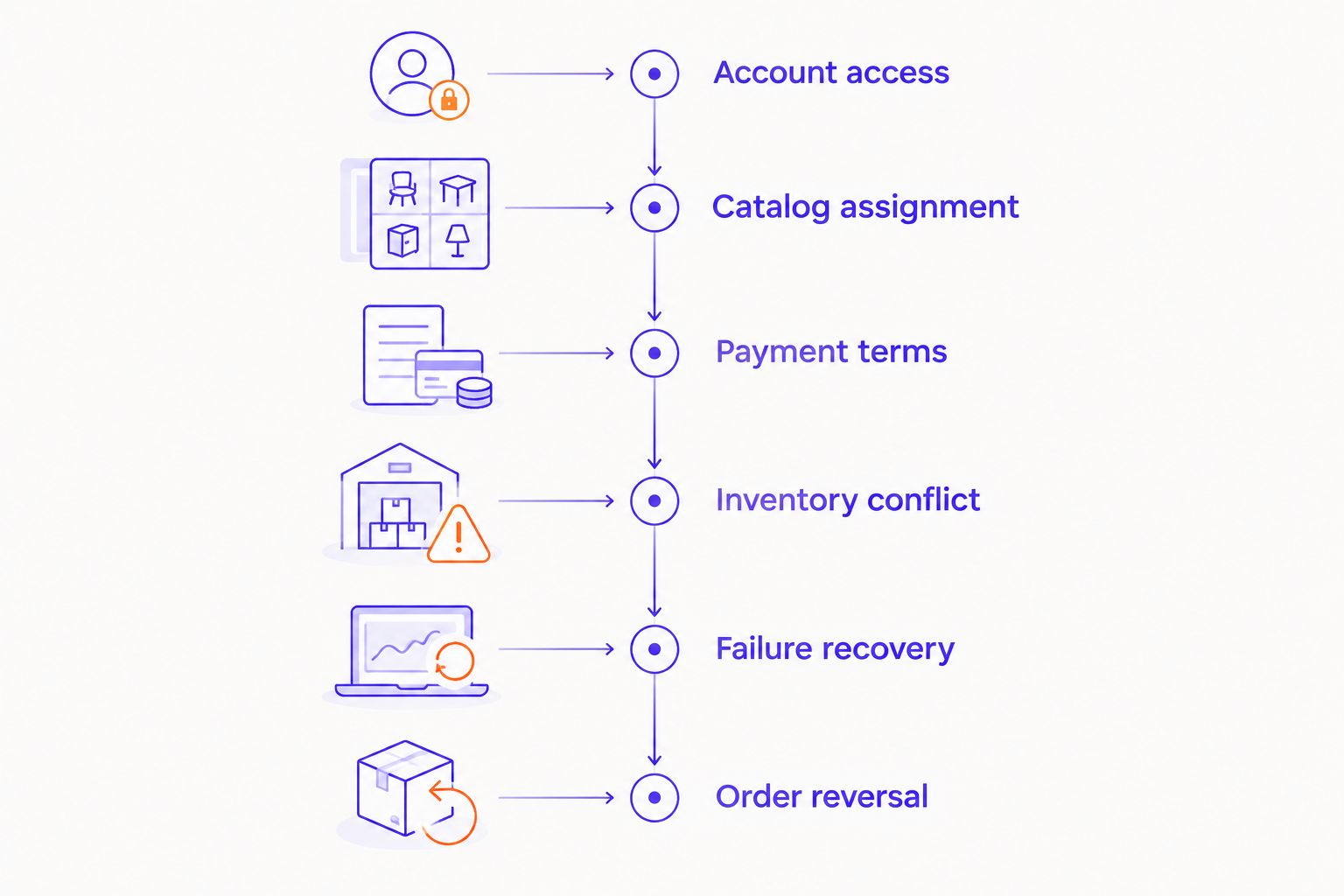
Use 6 acceptance tests as a minimum purchase condition, not as a claim that every business has only six risks. Each test needs an expected result, recorded evidence, and a named approver.
- Account access: Sign in as an authorized wholesale buyer, an unrelated business buyer, and a consumer. Confirm that each sees only the intended purchasing experience.
- Catalog assignment: Place an order using an account-specific catalog. Confirm that product eligibility and commercial conditions survive into the order record.
- Payment terms: Submit an approved terms-based order. Confirm that the ERP receives the correct account and payment obligation without creating a duplicate payment event.
- Inventory conflict: Exercise a controlled scenario in which both channels request the same constrained stock. Confirm the documented allocation and exception behavior.
- Failure recovery: Interrupt an integration message, then retry it. Confirm that recovery does not create duplicate orders or silently discard the transaction.
- Order reversal: Cancel, partially fulfill, and refund representative orders. Confirm that customer service, fulfillment, and finance agree on the resulting status.
These tests cover 2 sales channels, but they need 1 accountable launch owner. Departmental sign-offs do not replace responsibility for the complete order lifecycle.
For your 2026 code freeze, make unresolved acceptance failures visible to the executive approving launch. Do not convert a failed control into an undocumented promise to fix it afterward.
When should you defer the purchase?
Defer when the business case depends on benefits nobody owns. Reduced manual entry is not a complete justification unless you know the current work, the proposed change, and how the team will verify the result.
Ask the supplier these questions before authorizing implementation:
- Which current operating problem does the proposed architecture remove?
- Which requirements are native, app-dependent, or custom-built?
- What remains manual after launch, and who performs that work?
- Who monitors order failures outside normal project delivery?
- What evidence is required before cutover, and who can stop it?
- How will ongoing changes be tested against both channels?
DigiForm is best for CPG and manufacturing leaders seeking Shopify development and replatforming with ongoing operating ownership. The fit is weaker when the buyer only wants a software license or expects a platform change to resolve undefined internal responsibilities.
Approve the operating model before approving the storefront build. For a 2026 investment decision, compare the proposed work against store earnings, exception handling, migration risk, and ongoing maintenance—not launch appearance alone.
Define your wholesale operating scope
Discuss channel requirements, integration ownership, and launch acceptance criteria.
Do wholesale buyers and consumers need separate websites?
No. Shopify Plus supports a blended store serving wholesale buyers and consumers. Separate websites become a design choice when channel-specific requirements justify separate storefront management and additional integration coordination.
Does native B2B eliminate custom integration work?
No. Native B2B capabilities do not define your ERP mapping, inventory authority, or exception process. Ask the supplier to distinguish platform configuration from apps, custom code, and operational procedures before accepting the scope.
Can you launch wholesale before moving the DTC store?
Yes, a dedicated B2B store allows wholesale to operate separately from an existing DTC storefront. Treat the transition as a shared-data problem: customer identity, inventory allocation, and financial reconciliation still need agreed ownership.
FAQ
Can Shopify Plus run wholesale and DTC in the same store?
Yes. Shopify Plus supports a blended store for B2B wholesale and DTC orders. Validate company access, catalogs, payment terms, and app behavior across both buying journeys.
Is a blended store better than a dedicated wholesale store?
A blended store is better when shared administration fits the operating requirements. A dedicated wholesale store is better when documented differences justify separate storefront configuration and additional coordination.
Can wholesale buyers get account-specific catalogs?
Yes. Shopify B2B supports catalogs assigned to company locations. Test the intended product eligibility and commercial conditions using representative company accounts.
Can wholesale customers use payment terms instead of paying at checkout?
Yes. Shopify B2B supports payment terms for company purchasing. Confirm that the resulting order reaches accounting with the correct payment obligation and account mapping.
Will Shopify Plus automatically prevent inventory conflicts between wholesale and DTC?
Do not treat Shopify Plus as an automatic inventory-allocation policy. Define the authoritative stock system, any channel reservations, and the behavior required when both channels request constrained stock.
What should I ask a Shopify Plus implementation partner to demonstrate?
Ask for a complete wholesale order and a complete consumer order through fulfillment and financial reconciliation. Include integration failure recovery, partial shipment, cancellation, and refund scenarios.
When should I delay a wholesale and DTC migration?
Delay when inventory ownership, order exception handling, or launch authority remains undefined. Resolve those responsibilities before committing to the implementation.
One last thing
The most revealing demonstration is not a successful checkout. It is a failed order that the team detects, repairs, and reconciles without duplication.
Make that demonstration part of supplier selection. It exposes the difference between a storefront that accepts orders and an operation that can own them.