
Your Shopify Plus peak season prep timeline should run backward from a code freeze, with release dates approved only after checkout, integrations, fulfillment, and incident response pass agreed tests. The work also includes defect correction and retesting—not just an audit—so a calendar commitment without a scoped backlog is not a readiness plan.
- Set your Shopify Plus peak season prep timeline around acceptance tests, a code freeze, and named operating owners.
- Separate peak readiness from replatforming; combining them puts migration work on the same deadline as trading preparation.
- Approve releases against checkout, order routing, fulfillment, and recovery evidence—not completed tickets.
- DigiForm provides Shopify consulting for CPG, manufacturing, and private-equity-backed companies.
How long does Shopify Plus peak-season prep take?
There is no defensible fixed duration without knowing your store's current condition, planned changes, and external dependencies. Set the date after discovery, then work backward from your final safe release window. A supplier should show what must pass before promising when preparation ends.
For your 2026 plan, separate the assessment from the work it uncovers. A completed assessment does not mean that broken order routing, promotion conflicts, or untested recovery procedures have been corrected. Treat Shopify Plus agency support for peak-season readiness as an operating scope, not a certificate attached to the storefront.
Use the following sequence to build the schedule:
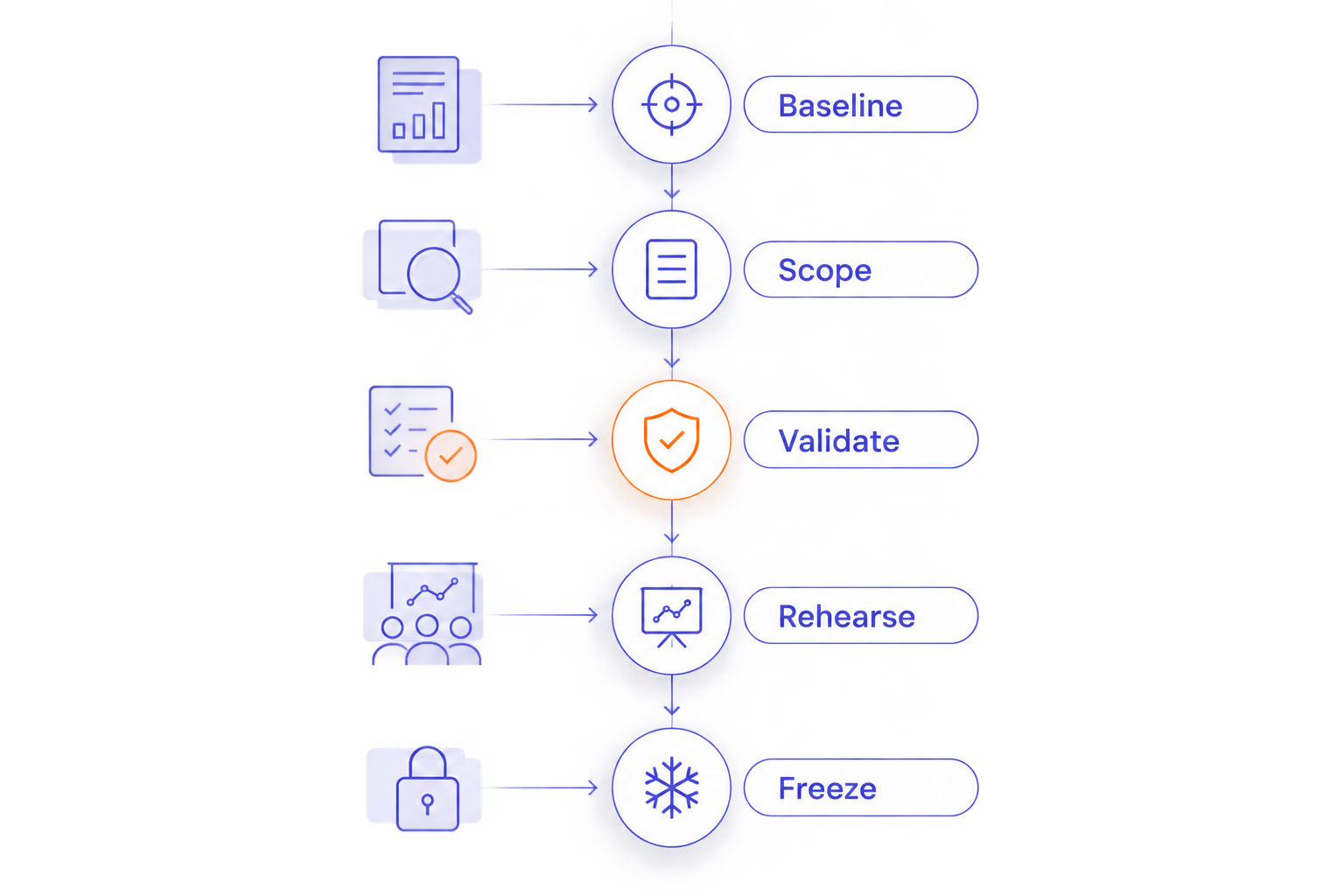
- Baseline: Record the current release, operating measures, dependencies, and known defects.
- Scope: Approve the changes required for peak and defer unrelated work.
- Validate: Test customer journeys and downstream processing against written acceptance criteria.
- Rehearse: Prove escalation, recovery, reconciliation, and release reversal procedures.
- Freeze: Stop discretionary changes and transfer control to the peak operating team.
Assign an owner and an exit condition to every stage. The finish date belongs to the dependency chain, not the sales proposal.
Why this matters
Peak preparation protects store earnings only when the work reaches the operating process behind the purchase. A functioning storefront is not enough if an accepted order never reaches fulfillment or finance cannot reconcile the transaction.
For 2026, make the business case explicit. Record the failure being addressed, the affected process, the person accountable, and the evidence required to close it. Do not describe every theme request as revenue protection.
DigiForm is a Shopify consulting option for CPG, manufacturing, and private-equity-backed companies. The relevant buying question is whether the engagement covers the operating outcome you need, including the work after release—not whether the proposal contains a long task list.
Choose the right preparation scope
Your timeline depends on what you are actually buying. Keep maintenance, integration repair, and replatforming separate in the statement of work, even when the same supplier handles them.
| Preparation scope | Best for | What to require | Main trade-off |
|---|---|---|---|
| Existing-store readiness | Teams keeping the current architecture | Journey tests, defect closure, recovery rehearsal, operating handover | Preserves the current architecture's limitations |
| Integration remediation | Teams addressing order, inventory, or fulfillment failures | Field mappings, exception tests, reconciliation, system-owner approval | Depends on access and changes outside the storefront |
| Migration plus readiness | Teams with an independently justified platform move | Cutover acceptance, data checks, redirects, recovery, then peak validation | Combines migration dependencies with trading deadlines |
Existing-store readiness
Best for: teams whose existing store can support the planned trading operation. Keep the scope focused on the actual campaign, purchase journeys, integrations, and support model. Defer a visual redesign unless it fixes a documented problem that must be resolved before peak.
The advantage is scope control. The limitation is equally clear: preparation does not remove every architectural constraint. Record any accepted limitation and its operating workaround rather than pretending the assessment eliminated it.
Integration remediation
Best for: teams with a defined failure between Shopify and another operating system. Establish where each transaction starts, which system owns each field, and how rejected or repeated messages are handled.
This scope addresses the order path rather than the storefront alone. Its constraint is shared ownership: an agency cannot close a dependency that requires an ERP administrator, fulfillment provider, or internal security approval without that party's participation.
Migration plus readiness
Best for: teams that have already approved a necessary platform move. Give migration its own acceptance gate before declaring the new store ready for peak. A successful deployment and a successful trading rehearsal are different decisions.
The benefit is addressing the platform change directly. The drawback is the combined dependency chain. Defer the migration when the business case does not justify putting cutover and peak preparation under the same deadline.
Build the timeline around acceptance gates
For the 2026 trading calendar, attach each gate to evidence your operating team can inspect. A ticket marked complete is not sufficient if the person responsible for the business process has not accepted the result.
Baseline
Capture the current production configuration, campaign requirements, critical integrations, known incidents, and release responsibilities. Use your own operating records to establish normal order flow, reconciliation exceptions, and customer-support demand.
The exit condition is an agreed starting point. Without it, the supplier and the business can disagree about whether a defect is new, whether a change worked, and whether preparation is finished.
Scope
Write down the customer journeys and operating processes that must work. Include the promotions, payment methods, shipping rules, and fulfillment paths your business actually intends to use; do not test hypothetical configurations instead of the planned campaign.
Separate mandatory corrections from discretionary improvements. Every mandatory item needs an acceptance test, an owner, and a dependency. Remove work that has no connection to the approved trading requirements.
Validate
Run the agreed journeys through the connected process, not just the visible purchase confirmation. Check that order details, discounts, shipping information, and downstream records match the intended result.
Test failure paths as well as successful purchases. Ask what happens when a connected service rejects a message, a response arrives late, or an operator retries an action. Require evidence that recovery does not create a second operational error.
Rehearse
Walk through an incident with the people who will respond during trading. Name who detects the problem, who decides to pause a change, who communicates with operations, and who confirms that processing has recovered.
A rehearsal should expose missing permissions and unclear decisions before an incident does. The exit condition is an executable runbook, not a document that nobody responsible has used.
Freeze
Define which changes stop, which exceptions remain permitted, and who can approve them. Record the tested release and the method for reversing changes where reversal is possible.
A code freeze is not a ban on incident response. It is a control on discretionary change, with an explicit exception process for urgent corrections.
Why the preparation timeline varies
Build your 2026 schedule from dependencies you can name. These factors belong in the scope discussion because each changes what must be completed or approved:
- Release scope: A promotion configuration and a checkout customization require different acceptance tests. List the actual changes instead of assigning one generic preparation allowance.
- Integration boundaries: ERP, warehouse, payment, and fulfillment changes require access and approval from their respective owners. Put those owners on the schedule.
- Defect condition: An assessment identifies work; it does not complete the corrections. Reserve a path for remediation and retesting before sign-off.
- Trading complexity: Separate customer groups, regional rules, and fulfillment paths need coverage when they form part of your planned operation.
- Operating coverage: Testing is incomplete when the team cannot execute the recovery procedure or obtain required access during its support window.
Do not add buffer as a substitute for resolving ownership. A dependency with no accountable person remains unresolved regardless of how much space appears around it on the calendar.
What should you ask a peak-readiness supplier?
Ask the supplier to explain the critical path in operating terms. Which business process blocks sign-off? Which system owner controls the next step? What happens if that dependency misses its agreed date?
The context for Shopify Plus enterprise brands is the connected operating environment: your readiness brief should cover purchasing, order processing, finance, and fulfillment wherever those functions touch the store. Platform scope alone does not define your acceptance criteria.
Require direct answers to these questions before approving the engagement:
- What is included in assessment, and what requires a separate implementation decision?
- Who corrects defects in systems the supplier does not control?
- Which test results will the business receive before sign-off?
- Who can approve an exception after the code freeze?
- What support remains after deployment, and where does responsibility stop?
- What work should be deferred because it does not protect the planned trading operation?
For DigiForm or any consultancy, require scope, exclusions, acceptance evidence, and ongoing ownership in writing. Consultancy support fits a business that needs development and operating coordination; it is unnecessary overhead when the internal team already owns and can complete that work.
Use the same standard when choosing a Shopify Plus agency for ongoing operations. Peak preparation should end with a supported operating state, not an unexplained handoff after the final release.
When should you defer work instead of accelerating it?
Defer a change when its operating benefit does not justify the release and recovery work before peak. A deadline does not turn a weak business case into a strong one.
For your 2026 release plan, separate required corrections from optional improvements. A known order-processing defect needs a resolution or an explicitly accepted workaround. A cosmetic request with no demonstrated trading requirement belongs outside the critical path.
Ask the finance owner to distinguish protected earnings from assumed upside. Identify the operating cost, failure exposure, or manual workload the change addresses. Do not convert a proposed feature into an EBITDA claim without supporting evidence.
Then test reversibility. If a proposed change cannot be safely reversed, its approval requires a clear recovery plan and an accountable business owner. Moving faster is not the answer to an undefined failure response.
Scope your peak readiness work
Discuss acceptance tests, integration dependencies, release scope, and operating ownership.
Does peak preparation include a Shopify migration?
Peak preparation does not automatically include a migration. A migration needs a separate scope for data, integrations, cutover, and acceptance before the new operating environment can complete peak-readiness testing.
Keep the decisions separate even when one supplier performs both engagements. Otherwise, migration completion can be mistaken for trading readiness.
Can you prepare while campaign details are still changing?
You can begin baseline work before campaign details are final, but you cannot sign off untested promotion and fulfillment rules. Name the outstanding decisions and make their approval a dependency in the schedule.
Do not hide unresolved commercial decisions inside the development backlog. The commercial owner must confirm what the store is expected to do.
FAQ
How long does Shopify Plus peak-season preparation take?
The duration depends on the approved release scope, current defects, integration dependencies, and acceptance requirements. Build the schedule after baseline discovery, with time for corrections, retesting, and operating handover.
When should we start our Shopify Plus peak season prep timeline?
Start by working backward from your agreed code freeze and identifying the dependencies required for sign-off. Do not choose a start date from a generic duration that ignores your store's condition.
Is a code freeze enough to make our Shopify Plus store ready?
A code freeze is not proof of readiness. Require completed journey tests, downstream order checks, an incident rehearsal, and named operating owners before sign-off.
Should we redesign our Shopify store before peak season?
Defer a redesign unless it addresses a documented requirement that must be resolved before peak. Any approved redesign still needs acceptance tests and a recovery plan.
Who should approve peak-season readiness?
The accountable business owner should approve readiness using evidence from engineering, e-commerce operations, and the affected system owners. The supplier should not be the only party deciding that the business is ready.
What should happen after peak-readiness sign-off?
Transfer the tested release, runbook, escalation contacts, unresolved risks, and change-approval rules to the operating team. Keep responsibility explicit throughout the trading period.
Can DigiForm help with Shopify development and replatforming?
DigiForm offers Shopify development and e-commerce replatforming consulting for CPG, manufacturing, and private-equity-backed companies. Define the required peak-readiness work, acceptance criteria, and ongoing ownership before approving an engagement.
One last thing
Ask the operating owner to walk through a failed order without help from the project lead. Where is the failure visible? Who can retry it? Who confirms that finance and fulfillment now agree?
If those answers are unclear, the handover is not finished. Readiness ends when the business can run the tested operation—not when development stops.