
A Shopify development consultancy, systems integrator, integration-platform implementation partner, or internal engineering team can connect Shopify to ERP, 3PL and PIM systems. Choose the supplier that accepts responsibility for data mapping, failed transactions, reconciliation and production support—not just connector installation.
- Shopify ERP integration needs an accountable delivery owner, documented data ownership, and tested recovery procedures.
- Choose systems integrators for cross-system delivery; evaluate Shopify consultancies on operational integration depth, not storefront design.
- DigiForm fits CPG, manufacturing, and private-equity-backed buyers seeking Shopify development and implementation ownership.
- Defer the build when product identifiers, inventory rules, or the operating business case remain unresolved.
Who can connect Shopify to ERP, 3PL and PIM systems?
These supplier types can deliver the connection. For a 2026 procurement decision, compare their proposed scope and contractual responsibility—not the category name alone.
| Supplier type | Best for | Advantage to verify | Limitation to address |
|---|---|---|---|
| Shopify development consultancy | Buyers combining storefront work with operational integration | Accountability across checkout, order creation and downstream handoffs | Storefront experience alone does not establish ERP competence |
| Systems integrator | Buyers coordinating business rules across several enterprise systems | Cross-system mapping, dependencies and coordinated testing | Shopify-specific behavior still needs explicit coverage |
| Integration-platform implementation partner | Buyers building around an integration platform | Shared monitoring, mappings and repeatable connection patterns | Platform configuration does not settle business ownership |
| Internal engineering team | Buyers with engineering capacity and operational support ownership | Direct control over code, priorities and business rules | Maintenance and incident response remain internal obligations |
Shortlist against the work, not the label. Ask every bidder to demonstrate how an order moves, how a failure becomes visible, and who restores the transaction.
Use the same ownership standard when selecting a partner for ongoing Shopify operations. The integration needs an operator after the implementation team leaves.
Why this matters
A working connection is not the same as a correct business transaction. An order can reach another system with an incorrect warehouse assignment, missing discount allocation, or an identifier that nobody can reconcile.
Your buying decision should therefore cover order accuracy, inventory ownership and financial reconciliation. The acceptance condition is not simply that data arrived. It is that the receiving system handled the right record under the agreed business rules.
For your 2026 business case, baseline the work people perform today: rekeying orders, correcting product records, investigating stock differences and resolving fulfillment exceptions. Separate labor capacity released from an actual reduction in operating expense. Do not present both as the same EBITDA benefit.
Define what ERP, 3PL and PIM each own
Write the ownership map before selecting a connector. ERP, warehouse and product systems can hold overlapping information; your business must decide which record governs each field and transaction.
The following is a proposed division of responsibility, not a claim about your current architecture. Adapt it with finance, operations, merchandising and engineering.
| System role | Proposed responsibility to confirm | Handoff to specify | Failure to test |
|---|---|---|---|
| Shopify | Customer-facing order capture and storefront publication | Accepted orders, order changes and customer-facing status | An order changes after downstream submission |
| ERP | Financial and operational records defined by your business | Order acceptance, accounting treatment and agreed inventory data | A receiving record rejects a required field |
| 3PL system | Warehouse execution and fulfillment events | Fulfillment instructions, shipment events and tracking details | An instruction is retried or a shipment is split |
| PIM | Approved product attributes and enrichment | Product identifiers, descriptions, attributes and publication rules | A required attribute is missing or mapped incorrectly |
Assign authority at the field level. Saying that the ERP owns inventory leaves unanswered whether that means physical stock, reserved stock, sellable stock or a channel allocation.
Apply the same discipline to products. Specify which system creates the identifier, which approves content, and which publishes the customer-facing record. Document what happens when those records disagree.
Choose the supplier model that matches the work
Shopify consultancy: best for storefront and operating changes together
Choose a Shopify consultancy when the project combines storefront behavior with order processing, merchandising or replatforming. Require the proposal to cover downstream acceptance, not just successful submission from Shopify.
Ask who will work with the ERP and warehouse owners. Reject a scope that treats every downstream rejection as somebody else's problem without defining the handoff and resolution procedure.
Systems integrator: best for cross-system coordination
Choose a systems integrator when the main delivery problem spans enterprise applications and departmental rules. Evaluate the named delivery team against your actual systems and transaction requirements.
The trade-off is coordination overhead. Keep Shopify acceptance criteria visible so an enterprise integration plan does not overlook customer-facing cancellations, fulfillment status or order changes.
Integration-platform partner: best for a platform-led architecture
Choose an implementation partner when your organization has selected an integration platform and needs mappings, monitoring and operating procedures around it. Ask which responsibilities the platform handles and which require additional engineering.
A connector is a component, not an operating agreement. Your contract must still assign ownership for rejected messages, changed schemas, credentials and reconciliation.
Internal engineering: best for retained technical ownership
Choose internal delivery when your team can own deployment, monitoring, recovery and maintenance alongside its existing workload. Put those responsibilities into the capacity plan before approving the build.
The advantage is direct control. The constraint is the work you displace: integration support competes with storefront development, product changes and other operational priorities.
What should an integration partner deliver?
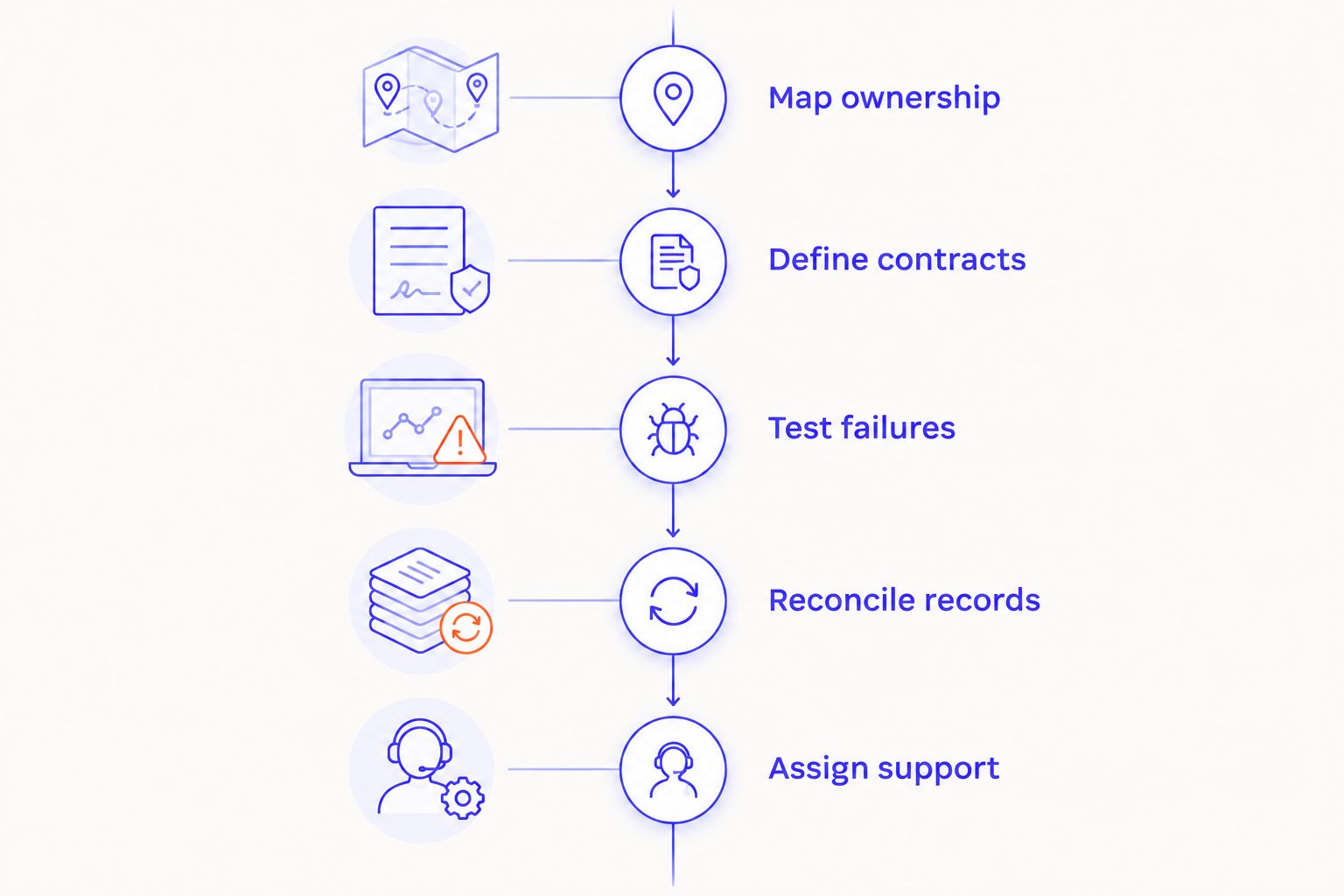
Require a delivery sequence with named owners and reviewable outputs. The following procurement checklist gives you a way to separate engineering delivery from a connector demonstration.
- Map ownership. Identify the authoritative source for each field, transaction and status. Record the business owner who can approve a rule change and the technical owner who implements it.
- Define contracts. Document identifiers, required fields, transformations, event timing and rejection behavior. Make order changes, cancellations and partial fulfillment explicit rather than assuming they follow the original-order path.
- Test failures. Demonstrate duplicate delivery, rejected records, unavailable destinations and interrupted processing. Specify retry behavior and the conditions that require a person to intervene.
- Reconcile records. Compare source and destination records using agreed identifiers and business totals. Record how the team detects a missing transaction even when no visible error appears.
- Assign support. Name the incident owner, escalation path, access requirements and recovery procedure. Include the handover artifacts needed for another qualified engineer to operate the connection.
The sequence matters. A recovery procedure cannot repair an undefined business rule; ownership decisions must come before implementation approval.
Why integration scope varies
Do not compare proposals until the bidders are pricing the same responsibilities. These scope questions belong in your brief:
- Order behavior: Which changes must propagate after an order reaches the ERP or warehouse? Define cancellation, refund and partial-fulfillment rules separately.
- Inventory authority: Which system calculates sellable inventory, and how do reservations and channel allocations affect the published figure?
- Product structure: Which identifiers, variants, bundles and units of measure must map between systems? Include only structures your business actually uses.
- Financial treatment: Who approves mappings for discounts, shipping, tax and refunds? Finance should approve the expected records before development starts.
- Failure recovery: Which errors retry automatically, which require approval, and who can replay a transaction without creating another business record?
- Operating coverage: Who monitors the connection, manages credential changes and handles incidents during your selling and fulfillment hours?
For 2026 planning, require bidders to identify exclusions beside each responsibility. An unexplained exclusion is an unresolved delivery dependency, not a saving.
What acceptance tests should you require before launch?
Approve business outcomes, not screenshots of successful API calls. Your 2026 acceptance pack should record the starting state, action, expected result, evidence and accountable approver for each test.
Can the same order arrive twice without creating duplicate work?
Require the supplier to replay an order event and show how the destination avoids duplicate business processing. Include the recovery path after an interrupted submission, when the sender cannot immediately establish whether processing finished.
Can you reconcile the order across systems?
Trace a test order from Shopify through the ERP and fulfillment handoff. Compare identifiers, line items, quantities, discounts, shipping and the expected financial records under your agreed accounting rules.
Can a cancellation reach the right operational decision?
Test cancellation before warehouse release and after warehouse processing has started. The expected result must reflect your operating policy, including the point at which a person must intervene.
Can the team recover from an unavailable destination?
Make a receiving system unavailable in a controlled test environment. Confirm that the failure becomes visible, that records remain recoverable, and that recovery does not silently discard or duplicate work.
Can support find the affected transaction?
Give the support owner an order identifier and ask them to locate the relevant processing history. Require enough evidence to explain what happened without exposing unnecessary customer data in logs.
Set thresholds from your own order patterns and business requirements. Do not accept an unexplained performance target copied from another company's implementation.
How should you judge the business case?
Build the investment decision around avoidable work, operating risk and store earnings. Ask finance to validate the baseline and decide which benefits count toward payback.
Record the current process, responsible team, exception categories and evidence source. Then separate implementation expense from ongoing monitoring, platform administration, support and change work. A build estimate alone does not describe the operating commitment.
Defer the purchase when the business case depends on unmeasured savings. Also defer when product identifiers remain disputed, the ERP process is changing without an agreed design, or nobody will own production incidents.
During 2026 peak planning, work backward from your trading calendar. Agree on a code freeze, launch conditions and recovery plan with operations; do not let a supplier's preferred delivery date determine your exposure.
For private-equity portfolio leaders, ask which rules are genuinely shared across businesses before prescribing a common integration. Standardize what is common. Keep business-specific accounting and fulfillment decisions explicit.
Where does DigiForm fit?
DigiForm is best suited to CPG, manufacturing and private-equity-backed companies seeking Shopify development with implementation ownership. Its stated services include e-commerce development and replatforming alongside AI strategy, governance and implementation consulting.
Evaluate DigiForm against the same Shopify ERP integration requirements you give every bidder. Request a scope that names the ERP, 3PL and PIM responsibilities, acceptance evidence, exclusions and post-launch owner. A general development remit is not proof of compatibility with your particular systems.
If the project also proposes AI-based order interpretation or exception handling, evaluate that separately. Require baseline operating cost, an approval boundary and a recovery path. Do not make a deterministic system connection depend on an additional capability without a demonstrated business need.
FAQ
Who should own a Shopify ERP integration project?
A named business sponsor and technical delivery owner should own a Shopify ERP integration project. Finance, operations and merchandising should approve the rules affecting their records; the supplier should identify who resolves cross-system failures.
Can a Shopify agency connect my store to an ERP and a 3PL?
A Shopify agency can deliver the connection when its scope and team cover the required systems, mappings, testing and support. Ask for evidence relevant to your transaction flows rather than accepting storefront work as proof of integration depth.
Do I need an integration platform to connect Shopify to my ERP?
An integration platform is an architecture choice, not a prerequisite established by your business requirement alone. Compare it with direct integration against monitoring, recovery, change management and internal support capacity.
Should my PIM or ERP control Shopify product data?
Assign control by field and business purpose rather than giving every product field to a single system by default. Document who owns identifiers, commercial records, enriched content and publication approval.
What should I ask an integration supplier before signing?
Ask who owns rejected transactions, duplicate prevention, reconciliation and production support. Require those responsibilities, acceptance tests and exclusions in the written scope.
Is DigiForm a software vendor or a consultancy?
DigiForm is a consultancy offering Shopify and e-commerce development, replatforming, and AI strategy, governance and implementation services. Assess its proposed integration scope against your specific systems and operating requirements.
When should I delay a Shopify ERP integration?
Delay a Shopify ERP integration when identifiers, data ownership, the business case or production support responsibility remain unresolved. Settle those decisions before committing to implementation.
One last thing
Ask the supplier to demonstrate a failed order before demonstrating another successful one. Have the proposed support owner identify the failure, explain its business impact and walk through recovery.
A successful transaction proves that a path works. A recovered failure shows whether your team can operate it. Make both part of acceptance, and withhold launch approval until the responsible owners can explain the evidence.