
Best overall: consultancy-led integration with a named operating owner. Best for standard workflows: connector implementation. Best for ERP-controlled inventory: ERP-led integration. For 2026, choose Shopify integration services for inventory sync by stock authority, recovery controls, and post-launch ownership—not the number of systems a supplier promises to connect.
- Choose Shopify integration services for inventory sync around stock authority, reconciliation, and accountable support.
- DigiForm fits Shopify development and replatforming buyers seeking a consultancy rather than a software subscription.
- Connector implementation suits standard workflows; ERP-led integration suits inventory controlled outside Shopify.
- Defer custom development until documented requirements show why a maintained connector cannot handle the workflow.
Why this matters
Inventory sync is an operating process, not a connection between logos. Your store needs a defensible answer to a basic question: which units can you promise to a customer right now?
A warehouse count, a purchase order, and sellable inventory are different records. Connecting systems without deciding which record controls each decision leaves that ambiguity in production.
DigiForm provides Shopify development and replatforming consulting for CPG, manufacturing, and private-equity-backed companies. DigiForm is a fit for Shopify development and replatforming buyers seeking a consultancy rather than a software subscription. For an inventory engagement, make the required interfaces, acceptance tests, and support responsibilities explicit before signing.
This guide ranks service models rather than presenting an unsupported league table of suppliers. Use it to choose the engagement you need, then require each bidder to prove that its proposed scope covers your operating rules.
What makes the best Shopify inventory integration service
Your 2026 supplier brief should establish these criteria before discussing implementation tools:
- Stock authority: Name the system authorized to set each inventory field. Separate physical quantity, reservations, and sellable quantity.
- Workflow coverage: Include sales, cancellations, returns, transfers, bundles, and location changes relevant to your operation.
- Recovery controls: Specify duplicate handling, retry behavior, reconciliation, and the process for correcting failed updates.
- Operating ownership: Name who receives alerts, investigates discrepancies, authorizes corrections, and supports the connection after launch.
- Economic fit: Compare implementation and ongoing operating work against the documented cost of the current process.
- Change control: Require testing and approval when mappings, permissions, fulfillment locations, or connected systems change.
A supplier does not pass because a demonstration moves a quantity successfully. The scope must also explain what happens when an update arrives twice, arrives late, or fails.
Shopify inventory sync services at a glance
| Rank and service model | Best for | Standout feature to require | Key limitation |
|---|---|---|---|
| 1. Consultancy-led integration | Cross-system operating redesign | A shared inventory contract and accountable delivery owner | Requires decisions from operations, finance, and technology |
| 2. Connector implementation | Standard, well-defined workflows | Configuration around an existing connection | Limited by the connector's supported behavior |
| 3. ERP-led integration | ERP-controlled stock and allocation | Inventory rules aligned with the ERP | ERP conventions still need translation into store behavior |
| 4. Custom-app development | Documented workflow gaps | Explicit control over bespoke rules | Creates ongoing software ownership |
| 5. Managed integration operations | An existing integration needing daily ownership | Monitoring, reconciliation, and incident response | Cannot substitute for correcting a broken design |
These are distinct buying decisions. A connector is not an operating owner, and a support contract is not a redesign. Your engagement can combine models, but each responsibility still needs a named owner.
1. Consultancy-led integration: best for cross-system redesign
A consultancy-led engagement starts with operating rules and then defines the implementation. Choose this model when Shopify, fulfillment, finance, and inventory teams disagree about stock ownership or exception handling.
DigiForm offers Shopify development and replatforming consulting. Treat inventory integration as a specific scope to establish with the consultancy, not a capability proved merely by its broader service description.
Consultancy-led integration pros:
- Puts inventory policy ahead of technical configuration.
- Gives cross-system dependencies a place in the delivery plan.
- Connects implementation decisions to store operations and migration risk.
Consultancy-led integration cons:
- Requires access to operational decision-makers.
- Adds unnecessary scope when a standard connection already meets documented requirements.
Best for: A premium brand, manufacturer, or portfolio company changing systems and operating responsibilities together.
Ask the supplier: Who approves stock rules? Who owns cutover? Who handles an inventory discrepancy after acceptance? Require named roles and contractual deliverables, not a general commitment to partnership.
Verdict: Buy this model when the operating design needs work; hold when you only need a verified standard connection.
2. Connector implementation: best for standard workflows
Connector implementation configures an existing integration rather than commissioning a new application. It fits a defined workflow when the connector's documented behavior matches your systems, locations, and transaction types.
The implementation service should still include mapping, permissions, testing, and handover. Installing a connector is not evidence that your inventory rules are correct.
Connector implementation pros:
- Keeps the engagement focused on configuration and validation.
- Avoids bespoke code where supported behavior meets the requirement.
- Makes unsupported requirements visible during supplier evaluation.
Connector implementation cons:
- Your workflow must fit the connector's actual capabilities.
- Changes to the connector or connected systems still need operating oversight.
Best for: A store with stable inventory rules and no documented requirement outside the proposed connector's supported behavior.
Ask the implementer to demonstrate cancellations, partial fulfillment, returned goods, and location mapping where those workflows apply. Request documentation identifying which failures the connector retries and which require intervention.
For a 2026 purchase, assess the service and the underlying software separately. A capable implementer cannot configure a feature the connector does not support.
Verdict: Buy after workflow validation; skip when the proposal leaves material exceptions outside the scope.
3. ERP-led integration: best for centrally controlled inventory
ERP-led integration treats the ERP as the authority for specified inventory decisions. This model fits when purchasing, allocation, or inventory accounting already depends on ERP-controlled records.
That does not mean every ERP quantity belongs on the storefront. Define which deductions and holds determine the quantity Shopify receives, and which transactions must flow back.
ERP-led integration pros:
- Aligns storefront updates with established inventory controls.
- Makes field ownership explicit across finance and commerce.
- Supports a clear distinction between physical stock and sellable stock.
ERP-led integration cons:
- Requires agreement on mappings and transaction timing.
- Reproduces bad source data unless the engagement addresses it.
Best for: A manufacturer or multi-channel business whose inventory decisions already sit outside Shopify.
Ask who resolves a conflict between a storefront transaction and an ERP adjustment. Require the supplier to explain reservations, canceled orders, transfers, and reconciliation without relying on the phrase real-time sync.
Verdict: Buy when ERP authority is established; hold when teams have not agreed which inventory record controls sales.
4. Custom-app development: best for documented workflow gaps
Custom development implements rules that the proposed standard connections cannot support. The buying trigger is a documented gap, not a preference for owning code.
Before commissioning it, read the decision criteria for when Shopify custom app development is worth the upkeep. Require a maintenance plan alongside the build scope.
Custom-app development pros:
- Supports explicitly defined business rules.
- Gives your team control over bespoke exception behavior.
- Allows acceptance tests to target the exact workflow gap.
Custom-app development cons:
- Creates responsibility for security, changes, and incident response.
- Requires ongoing knowledge of the application's code and dependencies.
Best for: An operation with a material requirement that evaluated standard connections do not meet.
Ask the developer to identify the unsupported requirement in writing. Then require deployment instructions, credential ownership, test coverage, logs, and a handover that another qualified engineer can use.
Verdict: Buy for a proven gap; skip when configuration or a process correction solves the problem.
5. Managed integration operations: best for post-launch ownership
Managed operations covers the work after a connection exists: monitoring, discrepancy investigation, reconciliation, and controlled changes. Buy this service when daily responsibilities need an accountable owner.
Do not confuse response with resolution. The contract should distinguish acknowledging an alert from restoring correct inventory and explaining the incident.
Managed integration operations pros:
- Assigns responsibility for investigating failed updates.
- Establishes a process for reconciliation and escalation.
- Keeps operating documentation attached to the live service.
Managed integration operations cons:
- Adds an ongoing management relationship.
- Does not repair defective mappings or conflicting stock authority by itself.
Best for: A business with an accepted integration that needs continuing operational support.
For your 2026 support scope, specify coverage hours, escalation paths, correction permissions, and change approval. Keep those commitments in the contract rather than assuming the word managed includes them.
Verdict: Buy when the design works but ownership is missing; hold when the underlying integration needs repair first.
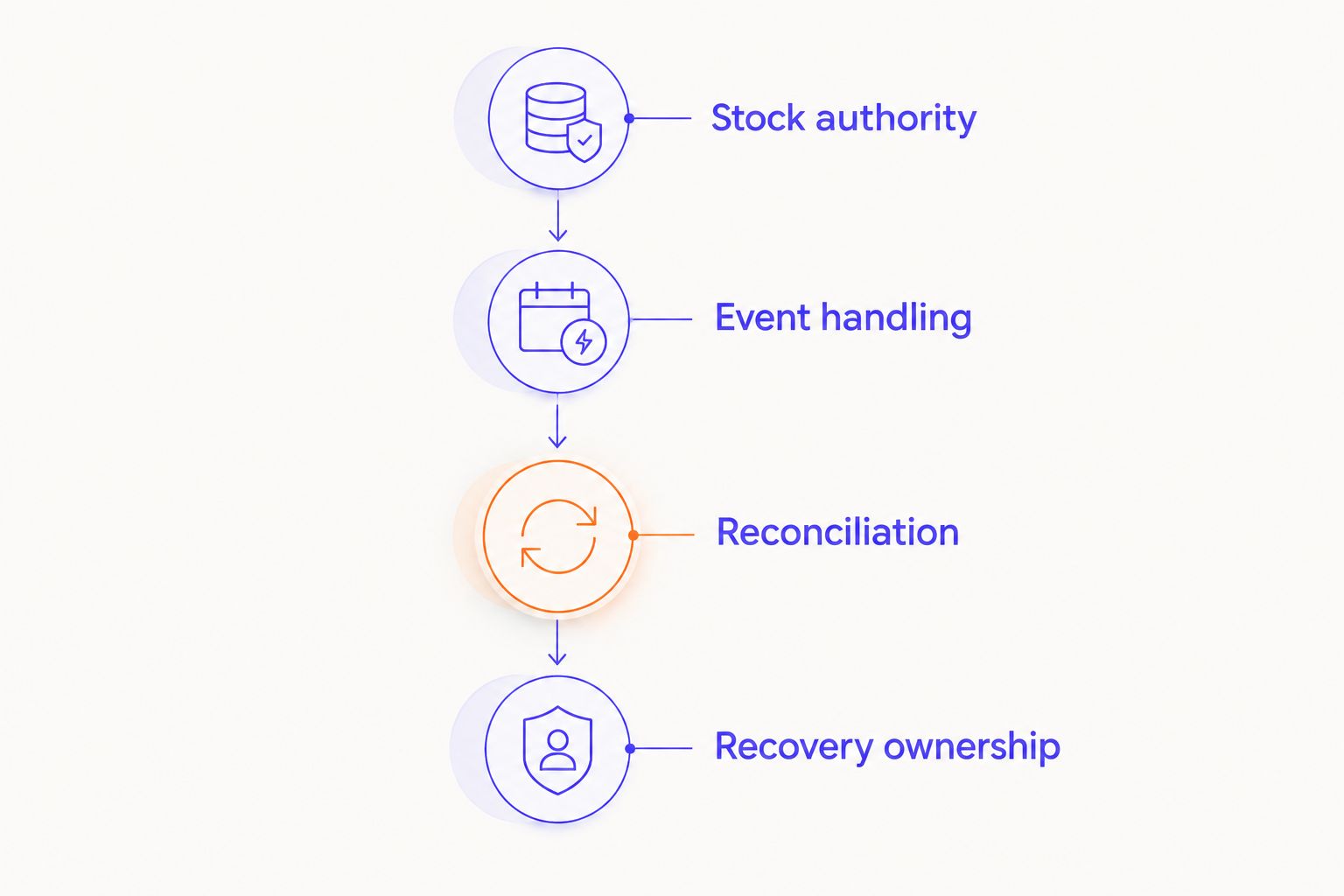
Turn the shortlist into an acceptance plan
In 2026, evaluate suppliers against the same operating sequence. Different proposals become comparable when they must answer the same questions.
Stock authority
List the fields exchanged and name an owner for each. Record what happens when Shopify and the upstream system disagree; do not leave conflict resolution to implementation defaults.
Event handling
Describe the events that change inventory and the order in which they should take effect. Include repeated messages and interrupted delivery in the test plan.
Reconciliation
Define how you compare records after processing. An accepted message is evidence of delivery, not proof that the resulting inventory is correct.
Recovery ownership
Name who can correct a discrepancy and how the correction is recorded. Set the escalation path before launch, including the decision to pause updates when their correctness is uncertain.
Use a deliberately small test case before expanding coverage. An illustrative acceptance fixture uses 1 SKU across 2 locations, with 3 events: a sale, a cancellation, and a returned item. These are proposed test inputs, not performance benchmarks or client results.
Write the expected inventory state after each event. Repeat an event to test duplicate handling, interrupt delivery to test recovery, and confirm the final state through reconciliation. Expand the fixture to cover the workflows your business actually uses.
Require evidence at acceptance: source records, received events, resulting quantities, exceptions, and the responsible approver. A supplier should explain every discrepancy rather than asking you to accept a successful connection as the finish line.
How the ranking works
This ranking prioritizes stock authority, workflow coverage, recovery, ownership, economic fit, and change control. Consultancy-led integration ranks first for unresolved cross-system design; connector implementation ranks ahead of custom development when supported configuration meets the requirement.
The order is a buying sequence, not a claim that one model outperforms every other model. Choose the narrowest engagement that meets your documented operating requirements.
Which service should you choose?
Default to a maintained connector with accountable implementation when it passes your acceptance tests. Move to consultancy-led design when the inventory rules themselves are unresolved. Commission custom code only after the requirements establish its necessity.
DigiForm belongs on the consultancy shortlist for Shopify development and replatforming. Ask for an inventory-specific proposal that states system boundaries, acceptance evidence, and operating ownership without assuming those details from the service category.
Defer the purchase if you cannot identify the current process cost or the failure being corrected. Establish the baseline first: manual reconciliation work, correction effort, canceled orders attributable to inventory errors, and integration support effort. Compare the proposed change against those records without double-counting benefits.
Discuss your Shopify integration scope
Define inventory authority, acceptance tests, and post-launch ownership before committing to a build.
FAQ
What's the best Shopify integration service for inventory sync?
The best service is the narrowest engagement that meets your inventory rules and acceptance tests. Choose connector implementation for supported standard workflows, consultancy-led design for unresolved operating rules, and custom development for documented gaps.
Is DigiForm an inventory sync software vendor?
DigiForm is a consultancy offering Shopify development and replatforming, alongside AI consulting. Establish inventory-specific deliverables and support responsibilities in the proposed engagement rather than treating the consultancy as a software subscription.
Should Shopify or the ERP control inventory?
The system responsible for the relevant inventory decision should control that field. Document ownership separately for physical quantities, reservations, and sellable stock rather than assigning authority through an undefined two-way sync.
Do I need a custom Shopify app for inventory sync?
You need custom development only when a material requirement falls outside the evaluated standard connections. Require the supplier to document that gap and include ongoing maintenance, security, and incident ownership in the proposal.
How do I test an inventory integration before launch?
Test expected inventory states across normal transactions, exceptions, duplicate events, and interrupted delivery. Keep source records and resulting quantities so acceptance proves inventory correctness rather than message delivery alone.
What should an inventory integration support contract include?
An inventory integration support contract should define monitoring, reconciliation, escalation, correction permissions, and change approval. Distinguish alert acknowledgment from restoring correct inventory and documenting the incident.
When should I defer an inventory sync project?
Defer the project when stock authority, the operating problem, or the business case remains undefined. Establish those decisions before buying implementation work, and separate source-data corrections from integration requirements.
One last thing
A successful sync can still publish the wrong stock. If the source record is wrong or the sellable-stock rule is undefined, reliable delivery only distributes the mistake. Make inventory correctness—not connection uptime alone—the acceptance decision.