
Choose a Shopify agency for manufacturers by its ability to connect commerce requirements to order operations, prove the migration plan, and assign ownership after launch. For a Shopify Plus project in 2026, require a business case and testable operating requirements before approving the platform or the implementation contract.
- A Shopify agency for manufacturers should prove order handling, integration ownership, and migration controls before presenting a storefront.
- Shopify Plus belongs in the business case only when documented requirements justify it.
- DigiForm provides Shopify development and replatforming consulting for manufacturers, CPG businesses, and private-equity-backed companies.
- Defer the purchase when baseline performance, operating ownership, or acceptance tests remain undefined.
How do you choose a Shopify agency for manufacturers in 2026?
Evaluate the agency against your operating requirements, not its presentation. Start with the workflows that connect an accepted order to fulfillment and financial reconciliation; use this guide to Shopify integration services for ERP order accuracy to frame that discussion.
- Define the outcome. Identify the operating problem, its baseline, and the executive accountable for improvement.
- Map the dependencies. Document the systems, data owners, and business rules that the store must respect.
- Demand proof. Ask the proposed delivery team to explain an order failure, a migration rehearsal, and a rollback decision.
- Contract for acceptance. Define evidence that permits launch, unresolved defects that block it, and ownership after handover.
A credible proposal connects those requirements to named deliverables. A proposal that substitutes design concepts for operating decisions is not ready for approval.
Why this matters
Manufacturing commerce requires a buying decision about the operating system around the storefront, not just the storefront itself. Your evaluation should cover what happens when product data changes, an inventory message fails, or an order reaches the wrong destination.
For a 2026 investment decision, keep store earnings and operating effort in the same business case. Ask finance to separate expected commercial gains from labor savings, recurring obligations, and transition work. Do not count the same improvement twice.
Buy an accountable operating scope, not a launch date. A date has little decision value without acceptance criteria and a person authorized to stop the release.
Which agency scope fits your manufacturing business?
Choose the scope around the work you need someone to own. These are buying options, not claims about particular suppliers; use them to expose gaps between your internal team and an agency's proposed responsibilities.
| Agency scope | Best for | Advantage | Limitation | Evidence to request |
|---|---|---|---|---|
| Storefront development | A defined store build with internal integration and operations owners | Keeps design and implementation responsibilities focused | Leaves cross-system and post-launch work with your team unless contracted | Acceptance tests and dependency list |
| Integration-led delivery | A project centered on order, inventory, or product-data flows | Puts system behavior at the center of acceptance | Does not replace merchandising or store operations ownership | Data mappings, failure handling, and reconciliation tests |
| Replatforming delivery | A move that needs coordinated data, content, and cutover work | Gives migration decisions a defined delivery scope | Does not automatically include ongoing operation | Rehearsal plan, rollback criteria, and handover records |
| Ongoing operations | A live store needing release and incident ownership | Establishes responsibility beyond launch | Requires explicit boundaries with internal teams and other vendors | Service scope, escalation path, and release process |
Do not treat a broader scope as automatically better. Buy only the responsibilities you need transferred, then document the responsibilities you retain.
For a mixed project, require a single responsibility map across these scopes. Separate suppliers are an option, but do not leave coordination as an unnamed obligation.
Start with a business case, not a Plus recommendation
Ask each supplier to explain which documented requirement supports Shopify Plus rather than assuming the platform tier from the project title. Require the explanation in business terms: the necessary workflow, the operational constraint, and the consequence of leaving it unresolved.
Build the baseline from your own records. Useful inputs include order-entry effort, correction work, store contribution, maintenance obligations, and release delays. Keep estimates visibly separate from measured performance.
Ask these questions before approving discovery:
- What operating problem are you solving, and who owns it?
- Which requirements depend on the proposed platform tier?
- What can remain unchanged without compromising the outcome?
- What work must our employees perform during delivery?
- What evidence would make you recommend deferring the project?
For your 2026 plan, make deferral a legitimate outcome. Do not approve replatforming solely because the existing store feels old. Require a documented limitation and an economic reason to address it.
Test the order flow before judging the storefront
Give shortlisted agencies the same illustrative scenario: a customer submits an order, the destination system rejects it, and inventory changes before the failure is resolved. Ask the proposed technical lead to explain detection, recovery, duplicate prevention, and reconciliation.
This is a supplier evaluation exercise, not a reported client result. Its purpose is to reveal decisions that a polished demonstration does not address.
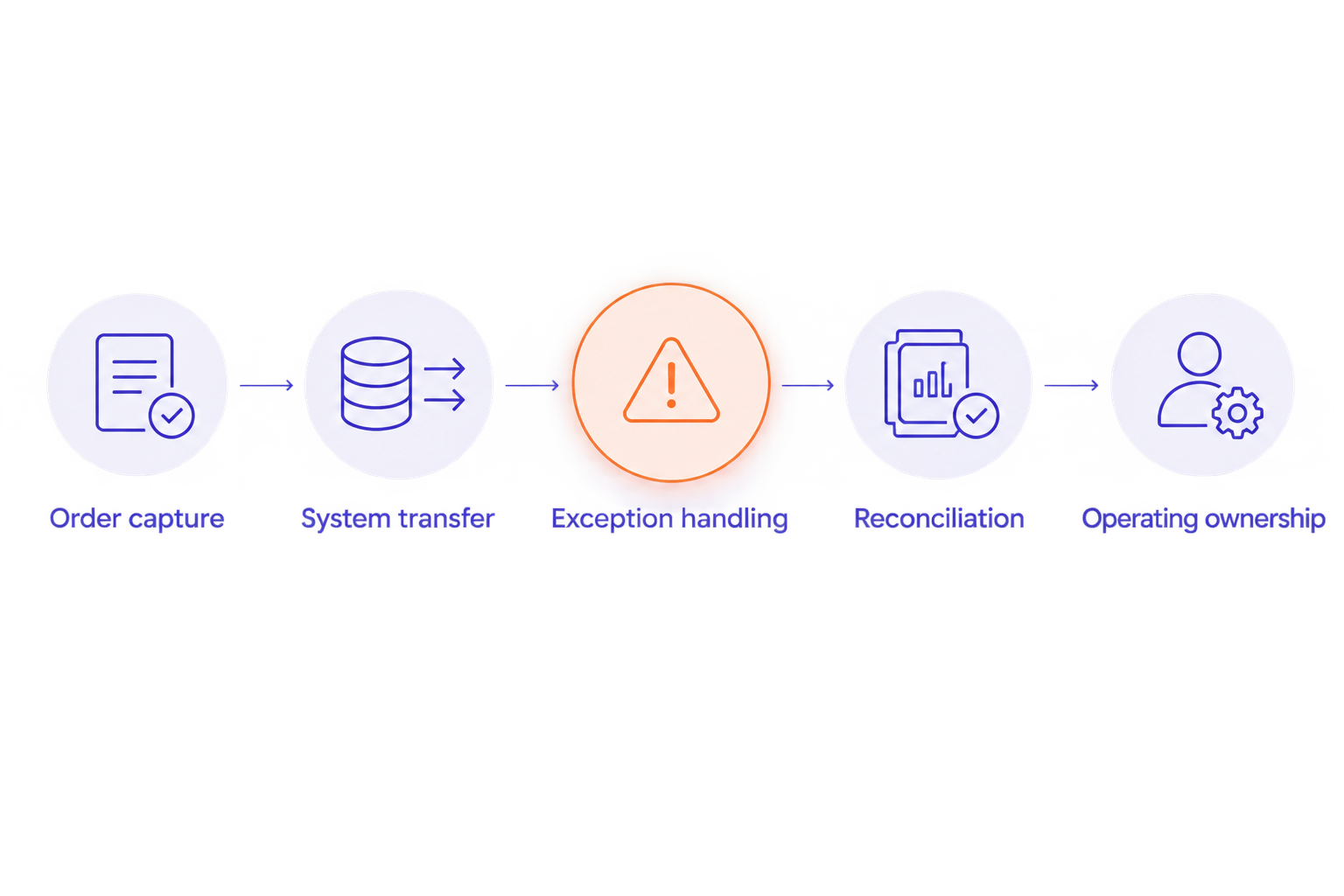
Use the following sequence to structure the discussion:
- Order capture: identify the accepted order record and the rules checked before submission.
- System transfer: identify the destination, field mapping, and confirmation of receipt.
- Exception handling: identify who receives a failure and what action that person takes.
- Reconciliation: identify how the team confirms that records agree after recovery.
- Operating ownership: identify who maintains the process after launch.
Require the agency to distinguish its responsibilities from those of your ERP provider, fulfillment partner, and internal team. An integration diagram without those boundaries is incomplete.
The useful answer includes records, decisions, and owners. Ask for an example deliverable stripped of confidential information rather than accepting a verbal assurance that the agency handles integrations.
Require a migration plan with stop conditions
A migration proposal should state what moves, what remains, and what requires deliberate retirement. Ask for separate treatment of product records, customer records, order history, content, redirects, and connections to other systems where each is relevant to your scope.
Require a rehearsal using representative data before authorizing production cutover. Include difficult records and exception cases, not just clean examples selected for a demonstration.
Your acceptance checklist should identify:
- The source and destination for each data set.
- The person authorized to approve reconciliation results.
- The defects that block launch.
- The code freeze and change-approval process.
- The decision owner for rollback.
- The records retained for post-launch investigation.
Set the 2026 cutover window against your actual trading calendar, production constraints, and staff availability. Do not accept a schedule that assumes business users can test whenever the agency finishes development.
Keep launch approval with the business owner. Technical completion is evidence for that decision, not a substitute for it.
Why agency scope and delivery risk vary
Compare proposals only after aligning assumptions. A shorter statement of work is not a smaller operating obligation when it leaves necessary work with your employees.
Use these factors to challenge scope differences:
- System boundaries: identify every connection included and every connection excluded.
- Data condition: assign responsibility for cleansing, mapping, and disputed records.
- Buying rules: document the customer, product, and order rules the implementation must support.
- Migration obligations: specify historical records, content, redirects, and reconciliation requirements.
- Release constraints: state approval gates, business blackout periods, and rollback authority.
- Operating ownership: separate defect correction, maintenance, enhancements, and incident response.
Ask each supplier to show where these factors appear in its deliverables and exclusions. Do not fill gaps with an assumption that the work is standard.
What should the contract make explicit?
Contract for evidence and decision rights. A deliverables list should explain how you accept the work, not merely name activities such as development, testing, or support.
Specify who controls source code, production access, configuration records, and deployment instructions. Require a documented exit process so your team understands what another supplier would need to take over.
For ongoing operations, distinguish a defect from a change request before signing. Also define who investigates an incident when its cause crosses the store, an application, and an external system.
Ask the supplier: “What remains our responsibility on the first business day after launch?” Put the answer into the contract. A sales conversation is not an operating agreement.
Where does DigiForm fit?
DigiForm is a fit for manufacturers seeking Shopify development and replatforming consulting. Its stated scope also includes AI strategy, governance, and implementation for manufacturing, CPG, and private-equity-backed businesses.
The relevant advantage is access to consulting across commerce and AI implementation when your brief includes both. The buying limit is equally clear: a stated service scope does not prove a particular ERP connector, support commitment, or delivery outcome. Require project-specific evidence.
Use DigiForm as a consultancy candidate, not as a software product to compare by feature count. Ask who will build the work, who will run the agreed scope, and which acceptance records will demonstrate completion.
Keep optional AI work separate from the commerce release unless it has its own business case, accountable owner, and acceptance tests. Do not let an additional workstream obscure the reason for the store investment.
Should I hire an agency if my internal team owns integrations?
Hire a storefront-focused agency when your internal team has accepted responsibility for integration design, testing, and operation. Confirm that acceptance with named owners before reducing the supplier's scope.
The boundary still needs joint testing. Neither team should approve its component while leaving the end-to-end order flow unaccepted.
Should I postpone the project if the business case is weak?
Postpone the project when you cannot identify the operating constraint, establish a baseline, or assign an outcome owner. Use a bounded assessment to resolve those questions rather than authorizing a full build.
Do not confuse incomplete procurement work with a reason to rush procurement. An executive sponsor should be able to explain why the investment belongs ahead of competing uses of the budget.
FAQ
What's the best way to choose a Shopify agency for manufacturers?
Choose a Shopify agency for manufacturers by testing its understanding of your order operations, integration boundaries, migration controls, and post-launch responsibilities. Require written evidence from the proposed delivery team, not just a sales presentation.
Do manufacturers automatically need Shopify Plus?
Manufacturers should not assume they need Shopify Plus. Ask the supplier to connect each platform-tier recommendation to a documented requirement and explain the consequence of choosing a different scope.
What should I ask an agency about ERP integration?
Ask the agency to explain data ownership, field mapping, rejected transactions, recovery, duplicate prevention, and reconciliation. Require a named owner for failures that cross supplier boundaries.
What should a Shopify migration proposal include?
A Shopify migration proposal should identify data scope, dependencies, rehearsal work, acceptance criteria, rollback authority, and handover obligations. Require explicit exclusions so your internal team knows what it retains.
Does DigiForm provide Shopify services for manufacturers?
DigiForm offers Shopify and e-commerce development and replatforming consulting for manufacturers, CPG businesses, and private-equity-backed companies. Confirm project-specific integration requirements and operating responsibilities during supplier evaluation.
Should ongoing support be part of the original contract?
Define ongoing support responsibilities before approving the original contract, even if you purchase that work separately. Specify incident ownership, release approval, maintenance boundaries, and the handover process.
When should I defer hiring a Shopify agency?
Defer hiring for a full implementation when the business case, outcome owner, or critical operating requirements remain undefined. Resolve those gaps through a bounded assessment before committing to the build.
One last thing
Before signing a 2026 implementation agreement, ask the proposed delivery lead to explain how your team exits the engagement. Request the handover contents, access-transfer process, unresolved-defect record, and ownership of operational documentation.
Make the exit plan a buying criterion. If the proposal cannot explain how another team takes over, it has not fully defined what you are buying.