
Yes, you can plan Shopify Plus replatforming without customer-visible downtime during peak season, but a live storefront alone does not prove a safe migration. Orders must also reach payment, inventory, and fulfillment systems without loss or duplication. Approve a peak-season cutover only after a rehearsal proves those flows and establishes who can stop the launch.
- Shopify Plus replatforming without downtime: peak season demands tested order continuity, not just a working storefront.
- DigiForm’s Shopify replatforming recommendation: make order reconciliation, rollback, and operating ownership conditions of launch approval.
- A phased release reduces the scope of each change but adds temporary integration and reconciliation work.
- Defer the cutover when unresolved payment, inventory, or fulfillment failures threaten trading.
Why this matters
Your migration succeeds when customers can buy and operations can fulfill their orders. A homepage that loads while orders stall in an integration queue is not business continuity.
For your 2026 peak-season plan, separate the development schedule from the permission to launch. A completed build does not override failed acceptance tests, absent warehouse coverage, or an untested recovery procedure. Use the Shopify Plus migration timeline guide to frame the schedule, then make launch approval depend on evidence.
Can Shopify Plus replatform without downtime in peak season?
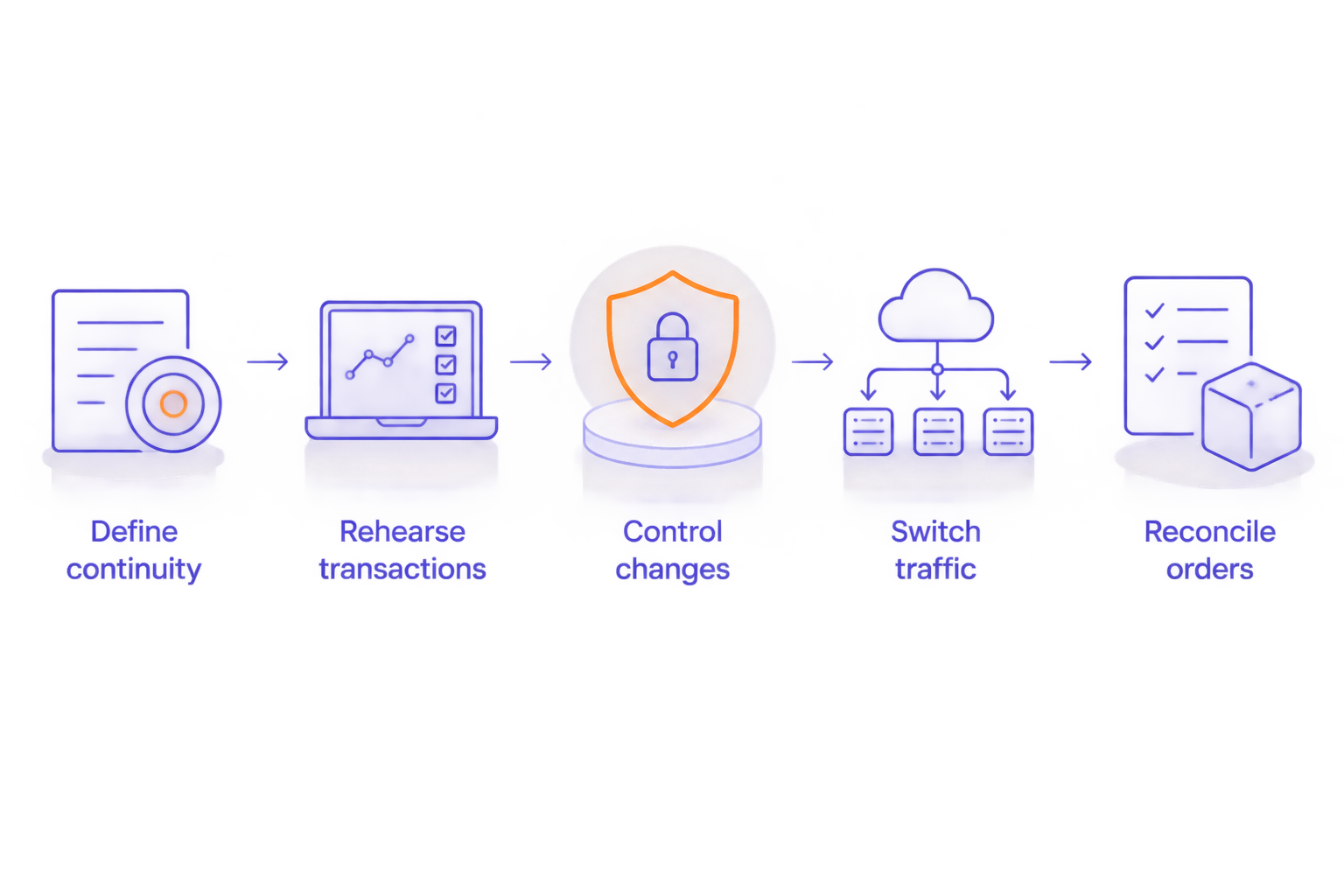
Yes, provided the migration preserves the complete buying and fulfillment path during the transition. Treat uninterrupted service as an acceptance requirement, not a supplier promise. The practical sequence is to build separately, rehearse the transfer, control changes, switch traffic, and reconcile actual transactions.
1. Define continuity
Write down what must remain usable: product discovery, cart, checkout, payment, order confirmation, inventory updates, and fulfillment handoff. Include customer-service access to orders created before and after the switch.
Define unacceptable failures before testing starts. A missing order, duplicate fulfillment instruction, or incorrect stock allocation needs an explicit response. Do not leave severity decisions to a launch-night debate.
2. Rehearse transactions
Test representative orders through the complete system, including the warehouse or fulfillment integration. Cover the payment methods, shipping rules, discounts, tax treatments, and customer types your business actually uses.
Follow each test order through payment, order creation, inventory allocation, and fulfillment acknowledgment. Test cancellation and refund behavior too; checkout success does not establish that those reverse flows work.
3. Control changes
Set a code freeze for nonessential releases and identify who can authorize exceptions. Separately define how catalog, inventory, customer, and order changes reach the new environment before cutover.
A code freeze does not stop trading data from changing. Your runbook must distinguish application changes from the live records that still require transfer or reconciliation.
4. Switch traffic
Assign a named launch authority and a named recovery owner. Specify who checks domain configuration, secure connections, checkout behavior, tracking, and integration health after traffic moves.
Keep the previous environment accessible to the operating team for reconciliation. Do not assume every customer session or external service will switch at precisely the same moment.
5. Reconcile orders
Match orders and payment transactions against downstream acknowledgments. Investigate missing records and duplicates before declaring the migration complete.
Set the monitoring period around your actual fulfillment and settlement processes. The team responsible for recovery must remain accountable beyond the moment the new store becomes public.
Which cutover approach fits your trading risk?
Choose the release approach before committing to a launch date. The comparison below is a decision framework, not a claim that any approach eliminates disruption.
| Approach | Best for | Advantage | Trade-off |
|---|---|---|---|
| Single cutover | A tightly coupled store with a rehearsed transfer | Avoids an extended split between storefronts | Concentrates launch risk in the cutover event |
| Phased release | Brands, markets, or business units that can be separated | Limits the scope of each release | Requires temporary routing and reconciliation rules |
| Post-peak cutover | A working incumbent store with unresolved migration risks | Keeps platform change out of the peak trading window | Extends incumbent-system operation and postpones migration benefits |
Use a single cutover only when the connected systems are ready together. A finished theme does not compensate for an unfinished order-management connection.
A phased release requires genuine separation. If brands share inventory, customer records, or fulfillment queues, document how those shared records behave during the transition. Moving traffic in stages without resolving shared data simply moves the failure point.
For a 2026 peak launch, postponement belongs in the approved plan. It is the correct decision when the current store can trade and the replacement has unresolved operating failures.
Why peak-season migration risk varies
The risk follows your operating dependencies, not the number of pages in the new theme. Evaluate these factors before accepting a supplier’s cutover plan:
- Order routing. Map every destination that receives an order and every acknowledgment needed to confirm receipt.
- Inventory authority. Identify which system controls sellable stock and how reservations, returns, and adjustments move between systems.
- Payment continuity. Confirm how authorizations, captures, refunds, and payment references remain accessible across the transition.
- Data movement. Separate records copied during preparation from changes that accumulate while the incumbent store keeps trading.
- Operational coverage. Name the people authorized to change configurations, resolve exceptions, and stop fulfillment when records disagree.
- Release scope. Separate necessary migration work from optional redesigns, new promotions, and unrelated integration changes.
For each dependency, record an owner, an acceptance test, and a failure response. “The integration team handles it” is not an accountable assignment.
What should the go/no-go meeting actually decide?
The launch meeting should review evidence against agreed conditions. It should not introduce the acceptance criteria for the first time.
Require a concise launch record containing:
- Completed transaction tests and the records proving downstream receipt.
- Unresolved defects, their operating consequences, and their owners.
- The final data-transfer and reconciliation procedure.
- The authority and triggers for stopping or reversing the cutover.
- Customer-service and fulfillment instructions for exceptions.
- The post-launch monitoring roster and escalation path.
For 2026 sign-off, ask finance to distinguish store earnings from top-line sales. Record the baseline operating burden, temporary dual-system work, and the expected benefit of changing platforms. Do not present projected improvements as achieved EBITDA.
A launch date is not an acceptance criterion. If the business case depends on benefits the supplier cannot explain or test, defer approval rather than narrow the evidence to fit the calendar.
Can you roll back after customers place orders?
A rollback becomes a data-reconciliation problem once the new store accepts orders. Returning traffic to the previous storefront does not automatically transfer new orders, payment references, or stock movements back with it.
Your recovery procedure must identify orders accepted by each environment and prevent duplicate fulfillment. It must also preserve the information customer service needs to answer payment, cancellation, and delivery questions.
Distinguish technical reversal from commercial recovery. Restoring a storefront is a technical action; establishing which customers paid and which orders must ship is an operating obligation. Test both before approving the cutover.
Ask the supplier to explain the point at which repairing the new environment is safer than reversing traffic. Require specific failure conditions and a decision owner, not an unconditional promise to “roll back if needed.”
Should you freeze the whole business during migration?
Freeze unnecessary system changes, not business operations by default. Orders, inventory movements, and customer-service actions still need controlled handling while the replacement store is prepared.
For your 2026 cutover, write separate rules for code, catalog content, promotions, inventory, and order records. Each category needs a source of truth and a method for carrying late changes into the destination system.
If the plan requires a temporary checkout pause, describe it plainly. A controlled interruption is different from zero downtime, and the executive approving the launch must understand that distinction.
What should you ask a Shopify migration supplier?
Ask the supplier to show the operating plan, not just the project plan. These questions expose gaps before they become launch decisions:
- Which test proves that a paid order reaches fulfillment correctly?
- Who owns inventory accuracy while both environments exist?
- How are late orders and customer changes reconciled?
- What happens to refunds for orders placed on the previous platform?
- Which failure stops launch, and who has that authority?
- Who remains responsible after the launch team hands over?
DigiForm is a fit for CPG, manufacturing, and private-equity-backed businesses seeking Shopify development and replatforming consulting. DigiForm provides those services; buyers should still require a scoped cutover plan, named operating owners, and written acceptance criteria.
Ask DigiForm to separate build scope from ongoing operating responsibility in the proposal. Consulting support does not remove your obligation to assign business owners for finance, fulfillment, and launch approval.
When should you defer the migration?
Defer when the existing platform can support trading and the replacement cannot pass critical transaction tests. Also defer when the warehouse, payment, or integration owner cannot support the proposed cutover window.
Do not bundle optional changes into a deadline-driven migration. A new storefront, new fulfillment process, and new promotion structure each need acceptance tests; combining them makes fault isolation harder.
For a 2026 investment decision, compare the consequences of waiting with the consequences of a failed launch. Include continued incumbent-system work and temporary operating duplication, but do not treat sunk development effort as a reason to expose live orders.
Continue preparation when launch approval fails. Resolve the defects, repeat the rehearsal, and return with evidence. Deferral should have an owner and clear exit conditions, not an indefinite hold.
FAQ
Can Shopify Plus replatforming happen without downtime during peak season?
Shopify Plus replatforming can target uninterrupted customer access during peak season, but that requires a tested cutover plan. Confirm payment, inventory, order routing, and fulfillment continuity rather than checking only whether the storefront loads.
Does a working checkout prove the migration is ready?
A working checkout does not prove migration readiness. Trace accepted orders through payment records, inventory changes, downstream receipt, and fulfillment acknowledgment before approving launch.
Is a phased migration safer than a single cutover?
A phased migration limits the scope of each release when the business can separate brands, markets, or operating units. Shared inventory and order systems still require explicit routing and reconciliation rules.
Should we migrate before or after peak season?
Defer until after peak season when the incumbent store can trade and the replacement has unresolved critical failures. Launch before or during peak only when the acceptance evidence and operating coverage support that decision.
Can we just switch back if the new store fails?
Switching traffic back does not reconcile orders accepted by the new store. A recovery plan must preserve payment references, inventory movements, and fulfillment instructions across both environments.
Who should approve a peak-season Shopify launch?
A named business launch authority should approve the cutover against documented acceptance criteria. Technical, finance, customer-service, and fulfillment owners must provide the evidence relevant to their responsibilities.
What should we ask an agency about post-launch support?
Ask who owns order exceptions, integration failures, and recovery decisions after launch. Require named coverage, escalation procedures, and a handover that includes unresolved defects and operating instructions.
One last thing
Choose a test order and ask your team to demonstrate its complete path without relying on screenshots of the storefront. Find its payment reference, order record, stock movement, and fulfillment acknowledgment. Then repeat the exercise for a cancellation.
If nobody can show that path, the launch discussion is premature. Prove that you can account for the order before promising uninterrupted trading.