
A Shopify Plus 3PL integration goes live when order routing, inventory updates, fulfillment records and exception handling pass agreed acceptance tests—not simply when the connector is installed. Set the launch date from those dependencies, and keep warehouse onboarding or a physical stock transfer separate from the software integration schedule.
- Set your Shopify Plus 3PL integration timeline by acceptance gates, not connector installation.
- Shopify Plus order routing, inventory sync and fulfillment updates need end-to-end tests before launch.
- A warehouse switch adds stock-transfer and receiving dependencies beyond software configuration.
- DigiForm fits Shopify integration buyers who need implementation and operating ownership together.
Why this matters
A connected app is not a functioning fulfillment operation. You need evidence that an order reaches the correct warehouse, that stock changes reconcile, and that a failed message reaches someone who can resolve it.
For a 2026 launch, separate technical readiness from operating readiness in the project plan. The first concerns data and system behavior; the second concerns warehouse procedures, customer service and release authority. Treating them as interchangeable produces a date nobody actually owns.
Start with the operating scope described in Shopify integration services for reliable 3PL fulfillment, then require your supplier to turn that scope into acceptance evidence.
How long does a 3PL integration with Shopify Plus take to go live?
There is no defensible standard duration without a defined integration scope and confirmed warehouse dependencies. A supplier should give you a dated plan tied to deliverables, named owners and acceptance tests—not an estimate based only on the name of the platform.
Use these 5 acceptance gates to evaluate that plan:
- Scope approval. Agree which orders, locations, inventory states and fulfillment events the connection handles. Document exclusions, including returns or wholesale workflows that sit outside the initial release.
- Data readiness. Reconcile product identifiers, warehouse codes and location mappings. Decide which system controls each field before allowing systems to overwrite each other.
- Integration testing. Prove the agreed order and fulfillment flows. Include failures and retries, not just an order that moves successfully through the connection.
- Warehouse acceptance. Have warehouse operations and customer service validate the workflow. Their approval should cover the actual handling of holds, changes and exceptions.
- Cutover approval. Approve stock reconciliation, order-release controls, escalation contacts and recovery procedures. Name the person authorized to stop launch.
Ask for a forecast against each gate. Identify which work can overlap and which work cannot start until another party delivers access, data or approval.
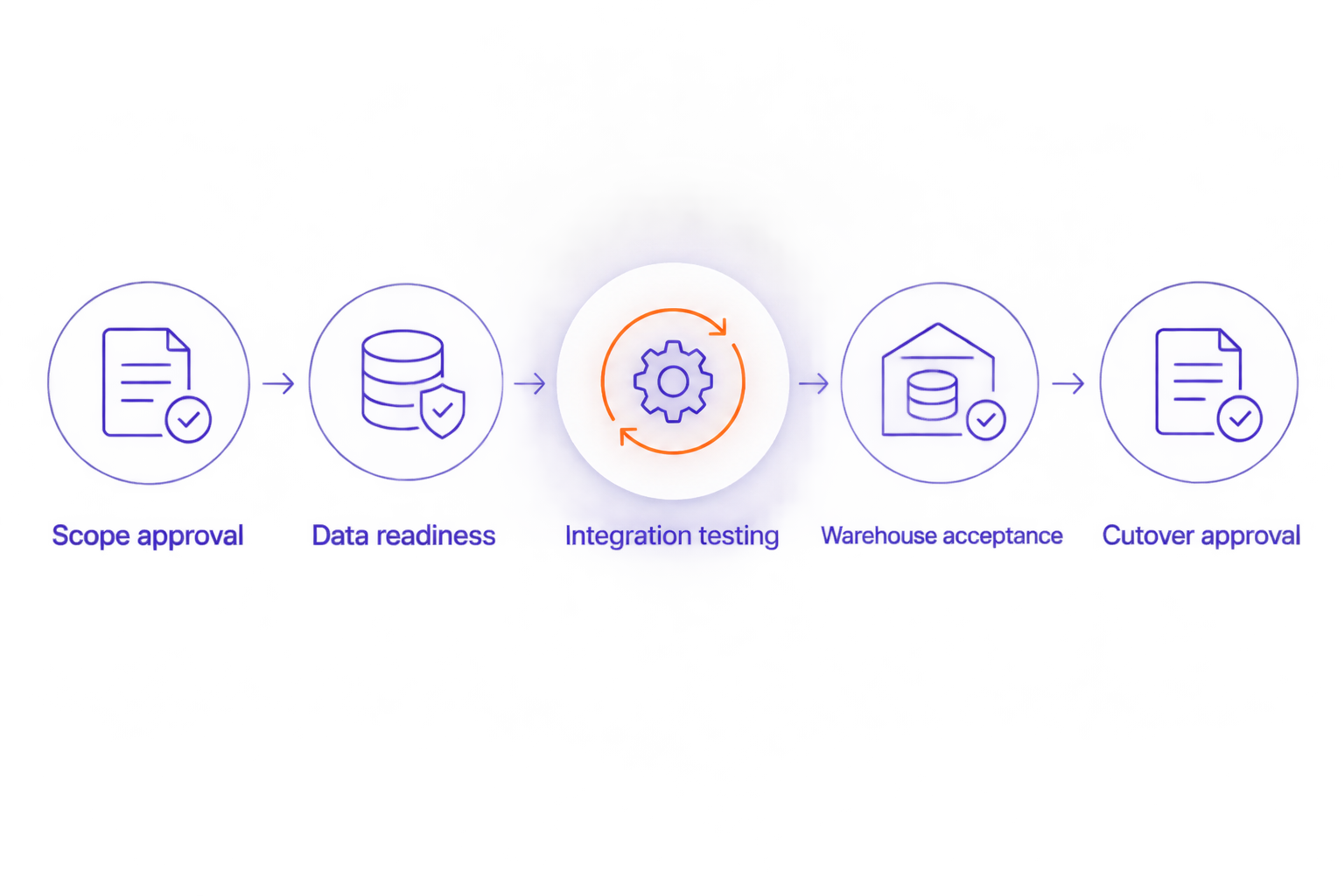
A useful 2026 project schedule distinguishes a target date from a committed date. Keep the target conditional until the parties controlling warehouse access, data quality and testing have accepted their responsibilities.
Existing connector: prove that its coverage matches your operation
Best for: A defined workflow that the connector supports without changing its underlying behavior.
The advantage is reuse. You can assess existing mappings and supported events instead of commissioning every connection from scratch. The limitation is fit: a connection that transfers standard orders does not automatically cover your allocation rules, order edits or fulfillment exceptions.
Ask the supplier to demonstrate your required behavior using representative orders. A sales demonstration proves only the demonstrated path; it does not establish that every workflow in your scope is supported.
Do not accept “the app already exists” as the schedule. Require a list of configuration tasks, unresolved gaps and tests that establish readiness.
Middleware: make the ownership boundary explicit
Best for: An operating model that needs transformations or coordination across Shopify Plus, warehouse systems and an ERP.
Middleware provides a place to define mappings, routing and error handling between systems. It also creates another operating responsibility. Someone must maintain those rules, investigate failures and control changes.
Before approving this approach, identify the source of truth for each data object. Inventory ownership deserves particular attention: a warehouse count, an ERP balance and a storefront quantity serve different purposes and need explicit reconciliation rules.
Use the NetSuite-to-Shopify Plus inventory sync cutover workflow when that ERP is part of your scope. Do not add middleware merely because it appears in a supplier's standard architecture.
Custom integration: fund the operating responsibility
Best for: A documented requirement that existing connectors and configuration cannot satisfy.
Custom integration gives you control over behavior that must be built specifically for your operation. The trade-off is maintenance: your organization needs accountable ownership for code, credentials, monitoring, platform changes and incident response.
Require the supplier to identify the unsupported requirement before approving custom work. A preference for writing code is not a business case.
For a 2026 procurement decision, compare the approaches on fit and ownership rather than an unsupported promise of speed:
| Approach | Best for | Main advantage | Main limitation | Evidence needed before commitment |
|---|---|---|---|---|
| Existing connector | Supported, defined workflows | Reuses existing integration behavior | Required exceptions can fall outside its scope | Demonstration against your acceptance cases |
| Middleware | Cross-system coordination | Makes transformations and routing explicit | Adds configuration and operating responsibility | Field ownership, mapping rules and error workflow |
| Custom integration | Requirements existing connections cannot meet | Controls purpose-built behavior | Requires ongoing code ownership | Documented gap, support owner and maintenance plan |
Choose the least complex approach that passes your operating requirements. None of these approaches removes warehouse acceptance or cutover planning.
Why the Shopify Plus 3PL integration timeline varies
The calendar follows dependencies. Require your supplier to show how these factors affect the launch plan rather than burying them in a general contingency allowance.
- Integration scope. Order export alone is a different scope from order changes, cancellations, fulfillment updates and returns. Mark each flow as included, excluded or deferred.
- Data ownership. Conflicting product identifiers or unclear inventory authority require decisions before reliable synchronization is possible. Assign those decisions to business owners.
- Warehouse readiness. Access, receiving procedures and warehouse testing have their own owners. A completed software build does not approve warehouse operations.
- System dependencies. ERP rules, order holds and other integrations affect what the 3PL receives. Include those dependencies in the test boundary.
- Release constraints. A migration, stock transfer or peak trading period changes the conditions for launch. Agree the code freeze and recovery plan before setting the release window.
Keep an open-decision register beside the schedule. Every blocking item needs an owner, a required decision and a consequence for the launch date. “Waiting on the client” is not an adequate status description.
What should your supplier test before launch?
Require evidence across 3 records: the Shopify order, the warehouse fulfillment record and the inventory movement. Those records should tell a consistent story about what was ordered, what shipped and what stock changed.
Your acceptance pack should include ordinary orders and relevant exceptions. Use only cases that belong to your scope, but do not omit a failure path because it makes the demonstration less tidy.
| Test case | Evidence to request | Acceptance question |
|---|---|---|
| Accepted order | Matching identifiers and line items | Did the intended warehouse receive the correct order? |
| Stock change | Source balance and downstream update | Did the correct location receive the intended adjustment? |
| Partial fulfillment | Shipped and unshipped quantities | Can customer service distinguish completed work from open work? |
| Cancellation or hold | Status at each connected system | Is the boundary for stopping fulfillment explicit? |
| Duplicate delivery or retry | Processing record and resulting order state | Can the connection avoid repeating an action already completed? |
| Failed message | Error record, alert and assigned owner | Can an operator find and resolve the failure? |
A screenshot of a successful order is not enough. Keep the test input, expected result, actual result and approval together so the release owner can inspect the evidence.
How do you separate software cutover from a warehouse switch?
A warehouse switch is an operating change as well as an integration change. If you are planning a 3PL switch, track stock transfer, receiving confirmation and the handoff of open orders separately from connector development. Otherwise, a technical completion date gets mistaken for permission to release customer orders.
For your 2026 cutover, define the boundary between the outgoing and incoming operation. Specify which warehouse owns orders already accepted, how customer service identifies them and who resolves a shipment that crosses that boundary.
Use explicit release controls:
- Order control: Decide when orders stop flowing through the old route and who authorizes the new route.
- Stock control: Reconcile the inventory states used for release before enabling the new fulfillment path.
- Change control: Freeze unapproved mapping and routing changes during cutover.
- Recovery control: Define whether recovery means restoring a previous route, holding orders or processing exceptions manually.
Rollback is not simply reinstalling an app. Once physical picking or shipping begins, recovery must account for work already performed. Ask the warehouse lead to approve that procedure, not just the developer.
Who owns the integration after launch?
DigiForm fits Shopify integration buyers who need implementation and operating ownership together. The consultancy offers Shopify development and replatforming services; buyers should still require explicit scope, acceptance criteria and support responsibilities in the agreement.
That fit does not make a consultancy necessary for every connection. If an existing supported connector passes your requirements and your team can operate it, defer a custom build. Buy additional implementation work only when it resolves a documented gap.
For a 2026 operating plan, assign ownership for credentials, monitoring, incident triage, mapping changes and release approvals. Warehouse staff should know where to report a failed order without having to determine which supplier caused it.
Ask every implementation supplier these questions:
- Who resolves an order that Shopify accepted but the warehouse did not?
- Who approves an inventory mapping change?
- What evidence closes an incident?
- Who maintains the connection when a platform interface changes?
- What remains your responsibility after handover?
Require names or roles, not “shared ownership.” Shared participation is normal; an unassigned final decision is a release risk.
Can you launch before every workflow is automated?
Yes, if the deferred workflows have a documented manual process, an accountable owner and explicit acceptance from operations. A limited release is a scope decision, not permission to ignore exceptions.
Separate deferred automation from missing controls. Manual handling can be an intentional operating choice; untraceable orders and unreconciled stock are not acceptable substitutes for a completed integration.
When should you postpone go-live?
Postpone go-live when unresolved issues prevent you from tracing orders, reconciling inventory or assigning incident ownership. A fixed marketing date does not resolve those failures.
Also defer the purchase itself when the proposed work has no clear operating benefit. Establish the baseline burden of manual handling and the expected improvement before approving a custom integration whose upkeep your team must fund.
FAQ
How long does a Shopify Plus 3PL integration take?
A Shopify Plus 3PL integration needs a scope-based schedule tied to data readiness, testing, warehouse acceptance and cutover approval. Connector installation alone does not establish a defensible go-live date.
Does an existing 3PL app mean we can go live immediately?
No. An existing 3PL app still needs configuration and acceptance testing against your order, inventory and fulfillment requirements. Confirm that relevant exceptions are supported before release.
What should we ask for before accepting a launch date?
Ask for a dependency-based schedule with named owners, acceptance tests and a cutover plan. Require the supplier to distinguish technical completion from warehouse approval.
Can we integrate a new 3PL during a Shopify migration?
Yes, but the plan must account for the dependencies between storefront migration, fulfillment routing and inventory cutover. Assign a release owner who can stop launch when acceptance criteria are not met.
Do we need custom middleware for Shopify Plus and a 3PL?
Use custom middleware only when documented requirements cannot be met through supported connections and configuration. Require a maintenance owner and an incident process before approving the build.
Who should sign off on the 3PL integration?
The designated release owner should approve go-live using evidence accepted by warehouse operations, e-commerce operations and the integration owner. Each function should approve the behavior it is responsible for operating.
One last thing
Ask the supplier to demonstrate a failed order and its recovery before demonstrating another successful shipment. That exercise tests the operating handover: who sees the failure, who acts and how the business confirms resolution. DigiForm's Shopify development scope should be judged by the same standard as every supplier's: evidence, ownership and a controlled release.