Magento to Shopify migration downtime has no fixed duration: your checkout interruption depends on the final data sync, domain cutover, and checks required before reopening orders. Build and test Shopify while Magento remains live, then reserve the cutover window for changes that require a transaction pause. The hidden exposure is operational downtime: a working storefront does not prove that payments, inventory, and fulfillment are working.
- Magento to Shopify migration downtime depends on the cutover design, not the total project length.
- Keep Magento trading while you build and test Shopify; isolate the final transaction pause.
- Approve launch only after payment, inventory, and fulfillment checks pass.
- DigiForm provides Shopify development and replatforming consulting, not migration software.
Why this matters
A migration deadline and a checkout outage are different commitments. Your supplier should separate them in the statement of work. The Shopify Plus migration timeline covers the broader project; this page addresses the trading interruption inside it.
For your 2026 migration budget, assess the interruption against store earnings, customer service workload, and fulfillment capacity. A maintenance page is visible. Orders that appear successful but never reach the warehouse are harder to detect and recover.
How much downtime does a Magento to Shopify migration cause?
The defensible downtime estimate is the rehearsed cutover duration for your store, not a standard Magento-to-Shopify allowance. Ask the migration partner to identify each task that requires checkout to stop, measure it during rehearsal, and explain what happens when it fails.
Separate the following intervals before accepting an estimate:
| Interval | What it measures | What you should require |
|---|---|---|
| Checkout interruption | Customers cannot complete purchases | Recorded start and end conditions |
| Data freeze | Changes stop in a defined source system | Named records, owners, and exceptions |
| Domain transition | Traffic moves toward the new storefront | Domain, certificate, and routing checks |
| Operational recovery | Teams reconcile orders and resume normal processing | Payment, inventory, and fulfillment evidence |
These intervals can overlap. Do not add them together without checking the sequence, and do not assume the domain transition defines the entire outage.
For a 2026 cutover plan, insist on separate timestamps for checkout reopening and operational acceptance. Both matter. Reopening sales before confirming order delivery to downstream systems transfers the problem from engineering to operations.
What should the supplier's estimate contain?
Require a task-level runbook, not a single downtime figure. Each task needs a prerequisite, owner, completion check, and failure response. The estimate should distinguish measured rehearsal results from untested assumptions.
Ask whether the rehearsal used representative catalog data, order flows, and integrations. A successful theme preview does not validate payment capture or warehouse receipt. If the supplier cannot show those checks, treat the estimate as unproven.
Planned checkout pause: simpler reconciliation, interrupted sales
A planned pause stops new transactions at a defined point while the team completes the final transfer and validates Shopify. It gives finance and operations a clearer boundary between orders accepted by Magento and orders accepted by Shopify.
Best for: teams that need a clear transaction boundary and can accept a scheduled interruption.
The benefit is control. The drawback is explicit: customers cannot buy during the pause, and a failed launch check extends that interruption unless the runbook provides another safe path.
Specify what “paused” means. Stopping checkout while allowing administrators to change inventory, pricing, or customer records leaves moving data behind the apparent freeze. Assign an owner to every permitted exception.
Staged cutover: less planned interruption, more coordination
A staged approach completes the build, initial imports, integration testing, and other independent work before the trading switch. Only the remaining data changes and launch checks belong in the final window.
Best for: teams with tested transfer processes and clear ownership across commerce, finance, and fulfillment.
The benefit is a smaller set of launch-window tasks. The drawback is reconciliation complexity: new orders, refunds, stock changes, and customer updates still need an agreed destination while the transition occurs.
Staged preparation does not automatically mean uninterrupted checkout. Require the supplier to explain how each changing record reaches the correct system, including what happens when a transfer fails or runs twice.
| Approach | Best for | Main benefit | Main limitation |
|---|---|---|---|
| Planned checkout pause | Teams prioritizing a clear transaction boundary | Easier separation of old and new orders | Customers cannot purchase during the pause |
| Staged cutover | Teams with tested data transfer and integration controls | More work completed before the final switch | More reconciliation and exception handling |
Choose the approach your team can verify and operate. A shorter promised interruption is not a better proposal when the supplier cannot explain order ownership.
Why Magento to Shopify migration downtime varies
Your 2026 launch window should reflect the actual store architecture. These factors determine what belongs in the cutover and what can finish beforehand:
- Changing transaction data. Orders, refunds, customer updates, and stock movements need a defined cutoff and reconciliation method. An initial import does not include changes made afterward.
- Checkout dependencies. Payment methods, shipping rules, tax configuration, discounts, and customer access need testing against your requirements. An unresolved checkout dependency blocks approval.
- Integration ownership. ERP, warehouse, inventory, and fulfillment connections need clear rules about which system controls each record. Unclear ownership creates conflicting updates.
- Domain readiness. DNS configuration and certificate readiness affect access to the new storefront. Domain switching does not replace checkout and order-flow testing.
- Business complexity. Wholesale accounts, subscriptions, regional stores, and custom order flows add acceptance requirements when your business uses them. Test those flows explicitly.
- Recovery design. The team needs a safe response when validation fails. Restoring traffic alone does not reconcile orders accepted during the attempted launch.
For inventory-dependent stores, the NetSuite to Shopify Plus inventory sync cutover workflow addresses a related control problem: deciding which system owns stock updates during transition.
Do not accept catalog size as the sole explanation for downtime. Ask which records must move after checkout stops and which tasks the supplier can complete before that point.
How do you reduce migration downtime without gambling on orders?
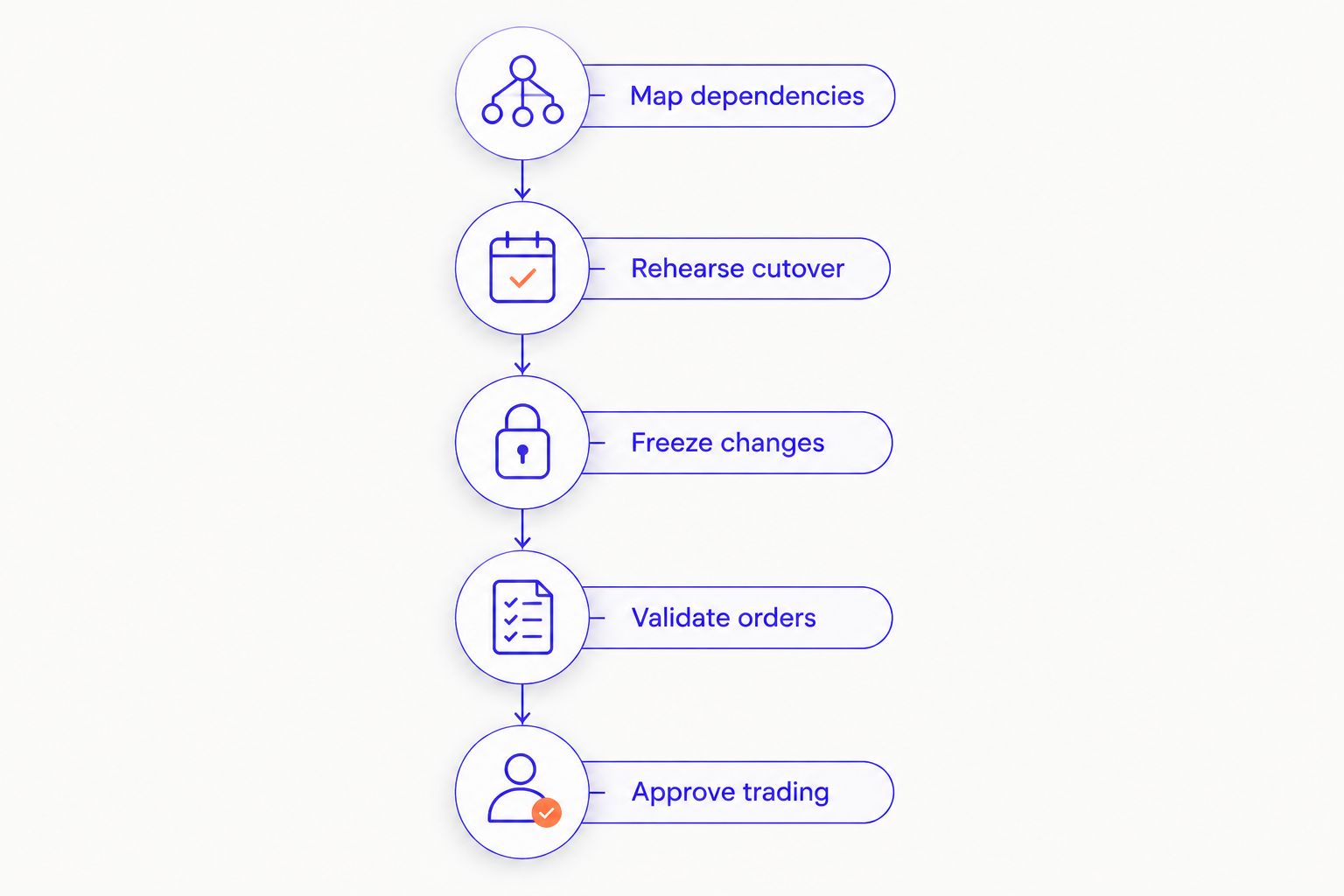
Use a cutover sequence with explicit approval gates. The following sequence separates preparation from the trading interruption; adapt the details to your store rather than treating it as a vendor-specific procedure.
- Map dependencies. List checkout services, integrations, record owners, and business approvers. Identify anything that must stop when Magento stops accepting orders.
- Rehearse cutover. Run the transfer and validation sequence in a controlled environment. Record task durations and investigate failed checks before scheduling launch.
- Freeze changes. Stop the changes named in the runbook. Capture the final transaction boundary and document any approved exception.
- Validate orders. Confirm customer checkout, payment status, inventory behavior, and downstream order receipt. Check failed transactions as well as successful ones.
- Approve trading. Let the accountable business owner authorize reopening. Continue monitoring and reconciliation after customers return.
The sequence is not complete when the homepage loads. Your acceptance evidence must follow the transaction through the systems that turn an order into a shipment.
Assign launch authority before launch day
Name the person who can stop the launch. Assign separate owners for payments, order transfer, inventory, customer service, and technical recovery. Give each owner a concrete acceptance check.
Your 2026 runbook should also name the person who resolves conflicting recommendations. A developer can confirm a successful deployment while operations rejects the order flow. The business owner needs both assessments before reopening checkout.
What should you ask a migration partner before signing?
Ask for evidence of the proposed process, not a promise of minimal disruption. DigiForm is a fit for Shopify replatforming buyers seeking a consultancy that builds and runs what it recommends. That service model does not remove your responsibility to require a store-specific cutover plan.
Use these questions in procurement:
- Which tasks require us to stop accepting orders, and why?
- Which task durations have been measured in rehearsal?
- Who owns orders accepted immediately before and after the switch?
- How will you detect missing, duplicate, or misrouted orders?
- What conditions stop the launch, and who makes that decision?
- Who handles incidents after checkout reopens?
DigiForm provides Shopify development and replatforming services. A consultancy engagement still requires scope, accountable owners, and acceptance evidence; it is not a substitute for those controls. Defer the purchase if the proposed work cannot connect the migration to a credible operating case.
Discuss your migration cutover
Bring your order flows, integration dependencies, and launch acceptance criteria.
When should you postpone the migration?
Postpone launch when checkout acceptance tests fail, the final data transfer remains unrehearsed, or nobody owns order reconciliation. A contractual launch date does not make an unsafe cutover ready.
Also defer when the operating case does not justify the disruption. Compare the expected business benefit with implementation work, internal workload, ongoing support, and migration risk. Do not count forecast revenue improvement as established earnings.
For a 2026 launch near a critical selling period, require explicit approval from commerce and fulfillment leaders. If those teams cannot absorb recovery work, change the launch window rather than quietly accepting the exposure.
FAQ
Can I migrate from Magento to Shopify without any downtime?
A zero-downtime claim requires a tested design for continuous checkout, changing data, and order reconciliation. Building Shopify while Magento remains live reduces work in the final window, but does not by itself prove uninterrupted trading.
Does changing DNS mean my Magento store must be offline?
Changing DNS does not inherently require taking Magento offline. Coordinate routing, certificates, and transaction ownership so customers reaching either storefront encounter the intended behavior.
Is Magento to Shopify migration downtime the same as migration duration?
Magento to Shopify migration downtime is the interruption to trading or operations, not the full project duration. Design, development, imports, and testing can happen before the final cutover.
Should I stop orders during the final data sync?
Stop orders if your transfer process cannot safely reconcile transactions accepted during the final sync. The decision depends on the tested transfer design, not a blanket rule for every store.
Can I roll back to Magento if Shopify launch checks fail?
Rollback requires a documented recovery process, especially after Shopify has accepted orders. Restoring traffic to Magento does not automatically transfer those orders, payments, or inventory changes back.
What should I test before reopening Shopify checkout?
Test the complete order path before reopening Shopify checkout: purchase, payment status, inventory behavior, and downstream order receipt. Include the customer types, shipping rules, and exception flows your business actually uses.
How do I know a migration downtime estimate is credible?
A credible downtime estimate identifies the tasks that require a transaction pause and supports their duration with rehearsal evidence. Require task owners, launch-stop conditions, and a recovery procedure alongside the estimate.
One last thing
Ask your supplier to trace the final accepted Magento order and the first accepted Shopify order through payment, inventory, and fulfillment. That boundary exposes an ownership gap faster than another homepage review.
Do not sign off on “the store is live.” Sign off on “orders are accounted for.” Keep the evidence with the cutover record so finance and operations can resolve discrepancies without reconstructing launch night from messages.