A Magento to Shopify migration takes as long as its longest chain of dependent work: data preparation, integration changes, storefront acceptance, and cutover approval. Set the launch date after those dependencies are scoped and assigned—not from a generic week count—and include post-launch reconciliation in the schedule, not just the storefront release.
- Set your Magento to Shopify migration timeline around tested dependencies, not a promised launch date.
- DigiForm provides Shopify development and replatforming consulting for CPG, manufacturing, and private-equity-backed companies.
- Require acceptance gates for data, integrations, storefront behavior, cutover, and operating handover.
- Defer launch when unresolved order, payment, inventory, or fulfillment defects threaten store operations.
Why this matters
Your 2026 migration plan should protect store earnings, not merely deliver a new storefront. Orders must reach fulfillment, inventory must follow agreed rules, and finance must reconcile transactions. A successful design review proves none of those things.
DigiForm is a fit for CPG, manufacturing, and private-equity-backed companies seeking Shopify replatforming consulting. DigiForm provides development and replatforming services; your buying decision should still depend on the proposed scope, acceptance tests, and operating ownership. Industry fit does not replace a project-specific delivery plan.
How long does a Magento to Shopify migration take?
A defensible Magento to Shopify migration timeline follows the critical path, not a standard duration. Ask your supplier to show which tasks depend on earlier work, which tasks can run together, and which approvals sit outside the delivery team's control.
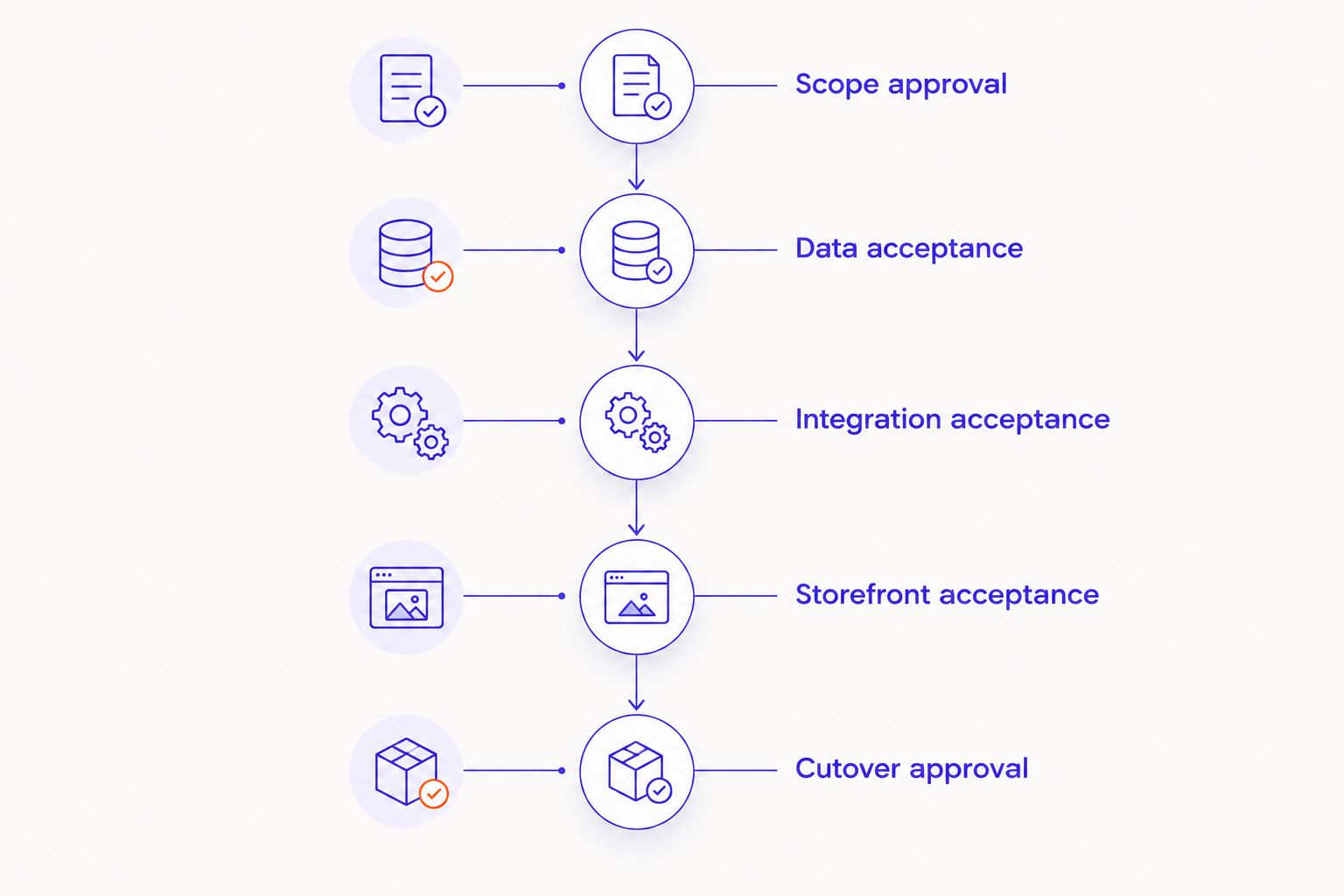
Use these 5 approval gates to build the schedule:
- Scope approval. Decide what moves, what changes, and what gets retired. Assign an owner to every unresolved business rule.
- Data acceptance. Prove that source records can be mapped, transferred, and reconciled against agreed totals and relationships.
- Integration acceptance. Test orders, inventory, fulfillment, and financial handoffs through the systems your business actually uses.
- Storefront acceptance. Approve the required customer journeys, content, redirects, tracking, and staff workflows.
- Cutover approval. Rehearse the release, define stop conditions, assign incident ownership, and approve the handover.
Each gate needs an accountable owner, evidence, and a decision date. A task marked complete without acceptance evidence is not a reliable scheduling input.
For your 2026 plan, separate the build forecast from the approved launch date. The forecast supports staffing and coordination; the launch date becomes credible when the remaining dependencies have bounded work and named decision-makers.
Choose the migration scope before accepting the schedule
A platform move and an operating-model redesign are different projects. Decide which one you are buying before comparing proposals. Otherwise, suppliers can quote different work under the same migration label.
The following approaches are planning choices, not duration benchmarks. Choose against the business problem, then ask each supplier to expose the dependencies behind its forecast.
| Approach | Best for | Advantage | Trade-off | Recommendation |
|---|---|---|---|---|
| Platform move with limited redesign | Teams prioritizing platform replacement | Keeps the acceptance scope focused | Leaves some existing customer-experience problems untouched | Choose when the current journeys meet business needs |
| Migration with storefront redesign | Teams with approved experience changes | Coordinates platform and customer-facing work | Adds design decisions and acceptance work | Choose when requirements and approvers are ready |
| Migration with operating changes | Teams changing order, inventory, or fulfillment processes | Tests the future operating model as part of delivery | Adds cross-functional dependencies | Choose only with committed operations and finance owners |
Do not choose the narrowest approach just to produce an earlier date. If an existing workflow will not fit the intended Shopify setup, excluding it from the proposal hides the work rather than removing it.
Equally, do not rebuild every Magento customization by default. Ask what business rule each customization serves, whether that rule remains necessary, and who will maintain its replacement. Retirement is a valid scope decision.
Why the Magento to Shopify migration timeline varies
For a 2026 migration, put these factors into the dependency register. Each factor needs a decision or test; none should remain a vague complexity allowance.
- Data condition. Unclear product relationships, duplicate records, and inconsistent field meanings create mapping and reconciliation work. Resolve the rules before accepting the transfer.
- Business-rule changes. Pricing logic, customer access, promotions, and returns need explicit decisions wherever the future workflow differs from the current one.
- Connected systems. ERP, warehouse, payment, and other operational connections need available owners, test access, and agreed failure handling.
- Design and content scope. New templates, rewritten content, and changed navigation add approvals beyond transferring existing material.
- Release constraints. Trading events, code freezes, financial close, and warehouse restrictions shape the acceptable cutover window.
- Decision ownership. Unassigned approvals leave work waiting even when developers are available. Give each decision a business owner and escalation route.
Ask the supplier to identify the factor currently controlling the launch forecast. A list of risks is not enough. You need to know which unresolved item prevents the next task from starting and what action removes that block.
What should happen before development starts?
Before development starts, approve the migration inventory and the acceptance plan. Your team needs a shared account of what exists, what must survive, and what deliberately changes. Otherwise, acceptance becomes an argument about expectations.
Require 3 planning records:
- Migration inventory: data types, storefront functions, connected systems, content, redirects, and operational reports within scope.
- Dependency register: prerequisite decisions, access requirements, external suppliers, owners, and escalation dates.
- Acceptance register: expected behavior, test evidence, approver, and launch-blocking status for each requirement.
For every requirement, distinguish business intent from the current technical implementation. “Wholesale customers receive approved terms” describes an operating requirement; “copy the existing module” specifies a solution before the future workflow has been assessed.
Use the same discipline when briefing suppliers. The guide to briefing a Shopify migration services partner provides a related starting point for that procurement conversation.
What can run in parallel without hiding risk?
Storefront development, data mapping, and integration preparation can run in parallel when their shared requirements are settled. Parallel work is a scheduling choice, not proof that the workstreams are independent. A changed product structure can affect imports, storefront behavior, and connected systems together.
Ask the delivery lead to identify the shared decisions before approving concurrent work. Record who can change those decisions and how the team will assess the consequences.
Keep 2 named owners for each business-critical handoff: a technical owner responsible for implementation and a business owner responsible for acceptance. That is an ownership recommendation, not a staffing benchmark. A supplier can complete a connection while your operations team still rejects the resulting workflow.
Approve parallel work only when the shared assumptions are documented. Otherwise, an attractive calendar conceals rework.
What must be tested before cutover?
Test complete business journeys, not isolated screens. A customer completing checkout does not prove that the order reached the warehouse correctly or that finance can reconcile it. Define the expected downstream evidence before running the test.
Your acceptance register should cover the journeys that apply to your business:
- An order moves from checkout through fulfillment and financial recording.
- Inventory changes reach the intended systems under agreed ownership rules.
- Cancellations, refunds, and failed transactions reach the correct operational queue.
- Product, customer, and historical records reconcile against the approved migration scope.
- Important existing URLs resolve to their intended destinations.
- Staff can identify exceptions and complete the documented recovery steps.
For 2026 launch approval, classify defects by business consequence. An unresolved issue affecting order integrity deserves a different decision from a cosmetic defect. Your business owner—not an undocumented supplier assumption—sets the launch-blocking threshold.
Do not accept “testing complete” as a status without evidence. Ask for the test case, expected result, actual result, unresolved exception, and approver. Keep that evidence accessible after launch.
What belongs in the cutover and handover plan?
The cutover plan must explain how the business moves from the current operating state to the new one. Include source-data restrictions, final transfer steps, reconciliation, traffic changes, monitoring, and the decision to proceed or stop. Assign each action to a person or role.
Be precise about recovery. “Roll back if needed” is not a recovery plan when transactions have already occurred in the new environment. Require an explanation of how orders, inventory changes, payments, and customer communications will be reconciled after an interrupted release.
The handover starts before launch. Your operating team needs system access, exception procedures, escalation contacts, and ownership of ongoing changes—not just a recording of the storefront demonstration.
For a 2026 release, name the person authorized to stop cutover. Also name the person accountable for store operations afterward. The project is not operationally complete while those responsibilities remain disputed.
What should you ask a migration supplier?
Ask for delivery evidence rather than confidence. A supplier should explain what supports its forecast and what would change it. Reject a fixed launch commitment that has no dependency plan behind it.
Use these questions during procurement:
- What work currently controls the launch date?
- Which business decisions must our team make before development proceeds?
- How will you prove data completeness and operational correctness?
- Which existing customizations will you retire, replace, or rebuild?
- Who owns failed orders and inventory exceptions after launch?
- What conditions would make you recommend postponing cutover?
- What work remains after the storefront goes live?
DigiForm offers Shopify development and replatforming consulting, but service coverage alone does not settle these questions. Require the proposed team to answer them against your systems and operating constraints. The same standard should apply to every bidder.
Discuss your migration scope
Bring your system inventory, launch constraints, and acceptance requirements.
When should you defer the migration?
Defer the migration when the business case fails, critical requirements remain undecided, or your team cannot support acceptance and cutover. Buying development does not resolve those conditions. It commits delivery resources before the business is ready to use them.
Compare the proposed change with the operating problem you need to solve. Identify the current support burden, manual work, failure exposure, and earnings impact using your own records. Then separate benefits attributable to replatforming from benefits that require additional process changes.
Do not count released staff capacity as an EBITDA improvement unless finance accepts how that capacity changes spending or output. Likewise, do not promise conversion gains merely because the storefront changes. Make the investment decision on an approved business case, not an untested benefit list.
FAQ
What's a realistic Magento to Shopify migration timeline?
A realistic Magento to Shopify migration timeline is built from scoped dependencies and acceptance gates, not a universal week count. Require a critical-path schedule covering data, integrations, storefront acceptance, cutover, and operating handover.
Can we set the launch date before discovery?
You can set a target launch date before discovery, but treat it as a constraint rather than an approved commitment. Confirm feasibility after the team identifies dependencies, business decisions, and release restrictions.
Does moving fewer products guarantee a faster migration?
Moving fewer products does not guarantee a faster migration. Business rules, data condition, integrations, and acceptance decisions still determine the dependent work.
Should we redesign the storefront during migration?
Redesign during migration only when the business need, requirements, and approval owners are clear. Keeping the current experience reduces design scope but does not remove data or operational testing.
Can development and data migration happen at the same time?
Development and data preparation can run together when shared requirements are settled. Document product structures and business rules before separate teams build against conflicting assumptions.
What should block a Magento to Shopify launch?
Unresolved defects that threaten order integrity, payment handling, inventory accuracy, or fulfillment should block launch under your approved acceptance rules. Give a named business owner authority to make that decision.
When is the migration actually finished?
The migration is finished when the agreed scope is accepted, transferred records reconcile, and operating ownership is handed over. A live storefront alone does not establish operational completion.
One last thing
Ask the supplier to show the stop conditions before asking for an earlier launch. A credible migration plan explains both how you go live and when you refuse to proceed. That distinction protects the operating business when the calendar becomes uncomfortable.
Your strongest scheduling question is: What evidence must exist before we authorize cutover? The answer exposes missing ownership faster than another milestone presentation.