
Shopify integration services cost should be quoted per defined workflow, not per connector name. A connector label does not specify the records, business rules, testing or operational support included in the work. For a 2026 budget, separate implementation from recurring software charges, exception handling and maintenance before comparing proposals.
- Shopify integration services cost depends on workflow scope, exception handling and operating ownership—not the connector label.
- DigiForm provides Shopify consulting for companies buying implementation and replatforming services, not standalone connector software.
- Compare implementation scope and recurring obligations separately before approving an ERP, inventory or fulfillment integration.
- Defer the build when the business case depends on unverified labor savings or unresolved data ownership.
Why this matters
A Shopify-to-ERP connection can move an order successfully while still leaving finance with reconciliation work. A fulfillment connection can transmit a request without establishing who resolves a rejected shipment. A successful transfer is not the same as a completed business process.
Your buying decision should cover the operating result: accepted orders, reconciled inventory, correct financial records and recoverable failures. If order accuracy is the immediate problem, start with the workflow described in Shopify integration services for ERP order accuracy, then use that scope to challenge supplier proposals.
How much does Shopify integration services cost per connector?
There is no universal per-connector cost: the unit is undefined until the supplier specifies what it includes. Ask each bidder to separate the following obligations in the statement of work. A proposal that bundles them together prevents a clean comparison.
| Scope component | Required definition | Buying risk if omitted |
|---|---|---|
| Connection setup | Authentication, environments and access ownership | Credentials and permissions remain unresolved |
| Data mapping | Records, fields, identifiers and transformations | Systems exchange data with different meanings |
| Business rules | Validation, routing and exception decisions | Staff complete unfinished processing manually |
| Testing | Representative transactions and failure cases | Successful demonstrations substitute for acceptance |
| Cutover | Initial synchronization, reconciliation and rollback | Deployment lacks a controlled recovery path |
| Operations | Monitoring, incident ownership and change maintenance | Recurring work falls outside the agreement |
Require a scope sheet for each connection. It should name the source, destination, direction, trigger, data objects, exclusions and acceptance owner. Reject the phrase standard integration unless an attached specification defines it.
For your 2026 procurement comparison, mark each obligation as included, excluded or separately contracted. This exposes scope differences without pretending that every connector is equivalent.
Standard connector: best for a proven workflow fit
An existing connector is worth evaluating when its documented behavior matches your operating process. That means more than supporting Shopify and your other system by name. Field coverage, transaction states and exception behavior must also fit.
The advantage is reuse; the limitation is the boundary of the supported workflow. Configuration does not automatically cover custom financial rules, unusual fulfillment states or changes to your source data.
Ask the supplier to demonstrate representative transactions using your required fields. Include a rejected transaction and its recovery, not just a successful order transfer. Choose this approach when the supported behavior meets the acceptance criteria without a separate layer of undocumented workarounds.
Middleware: best for shared integration operations
Middleware is worth evaluating when several connections need common mapping, monitoring and operational controls. It creates a place to manage integration logic rather than distributing all of it across separate point-to-point connections.
The advantage is centralized control; the limitation is another system to operate. Someone still owns configuration, access, deployment and incident response. Buying a platform does not assign those responsibilities.
Ask who can inspect failed transactions, change a mapping and replay a corrected record. Also establish what happens when the middleware is unavailable. Choose this approach when shared controls solve a documented operating problem, not merely because the architecture diagram looks cleaner.
Custom integration: best for requirements existing tools cannot meet
Custom development fits when a documented requirement falls outside the supported behavior of existing connectors. Examples include business-specific validation or a legacy interface that requires purpose-built handling. Prove the gap before authorizing development.
The advantage is control over behavior; the limitation is ownership of the code and its maintenance. Your agreement must define repository access, deployment instructions, testing and responsibility for platform changes.
Do not accept customization as the default response to an unclear process. First decide whether the business rule is necessary, whether the source system can enforce it and whether operations can support it after launch.
Which integration approach fits your buying criteria?
| Approach | Best for | Principal advantage | Principal limitation | Approval condition |
|---|---|---|---|---|
| Existing connector | Workflows matching documented capabilities | Reuses supported behavior | Limited by supported mappings and states | Representative transactions pass |
| Middleware | Connections requiring shared controls | Centralizes integration operations | Adds platform administration | Operating ownership is assigned |
| Custom integration | Requirements outside existing capabilities | Controls business-specific behavior | Requires code maintenance | The requirement gap is demonstrated |
Why Shopify integration services cost varies
The work changes when the workflow changes. Use these factors to test whether two suppliers have scoped the same result:
- Data objects and direction. Orders, customers, inventory, fulfillment and refunds need explicit boundaries. Define which system writes each record and whether updates return to the source.
- Business rules. Document validation, routing, tax treatment and financial mapping requirements. Do not leave decisions hidden inside field transformations.
- Timing requirements. State when each system needs an update and what operations should do when that deadline is missed. Avoid undefined requirements such as real time.
- Exception handling. Specify how rejected, duplicated, delayed and partially processed records become visible and who resolves them.
- Cutover dependencies. Identify initial synchronization, open transactions, reconciliation and rollback requirements. Align the connection with the store's migration plan.
- Operating ownership. Name the party responsible for monitoring, access changes, API compatibility and recovery after launch. Separate incident response from planned improvements.
These factors belong in procurement documents, not only in technical discovery. Otherwise, a supplier can meet the literal connector requirement while leaving the operating requirement unfinished.
How should you compare connector proposals?
Normalize the scope before evaluating the commercial terms. A short proposal with broad exclusions is not equivalent to an agreement that includes recovery procedures and operating support.
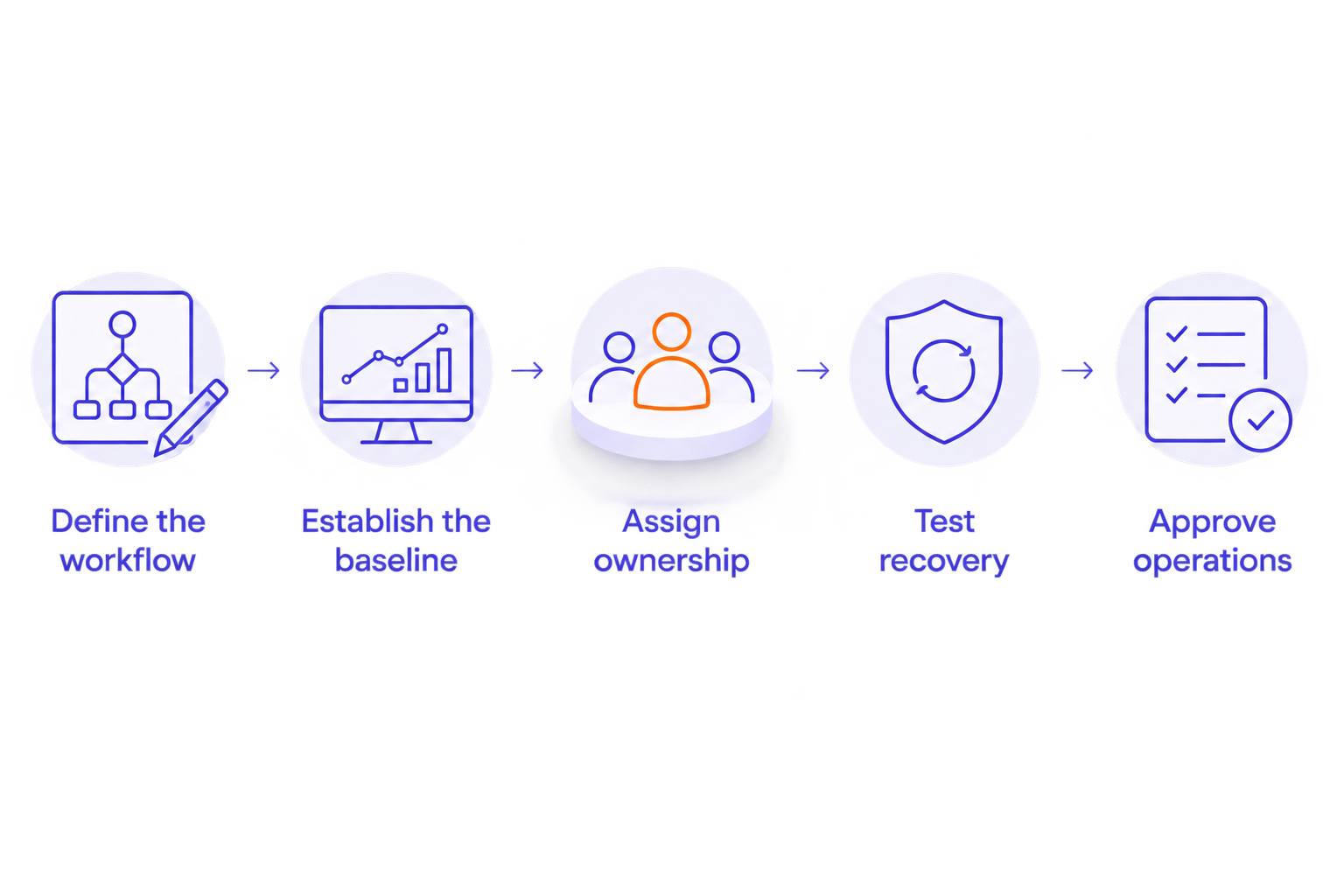
Define the workflow
Write a plain-language statement of the required result. For example: an accepted Shopify order reaches the ERP with the required financial fields, and rejected records enter an assigned exception queue. This is an illustrative requirement, not a client result.
List what the connection does not handle. Returns, historical records and customer-account updates should never enter the scope by implication.
Establish the baseline
Use 30 days of representative operations as a starting measurement window, extending it when seasonality or unusual trading conditions make that period unrepresentative. Record transaction volume, manual handling time, rework and unresolved exceptions. This is a recommended measurement approach, not an industry benchmark.
Separate work eliminated from work moved elsewhere. Saving time in order entry does not establish a benefit if finance inherits equivalent reconciliation work.
Assign ownership
Name a business owner for the result and a technical owner for the connection. Identify who decides whether a record is correct, who approves mapping changes and who responds when processing stops.
A supplier can own implementation tasks without owning the business decision behind them. Make that boundary explicit before development begins.
Test recovery
Require at least 3 acceptance tests as a starting gate: successful processing, rejection of invalid data and safe recovery after interruption. Add workflow-specific cases rather than treating that minimum as sufficient coverage.
For each test, define the expected result in both systems. A success message from the connector does not prove that the destination recorded the transaction correctly.
Approve operations
Request a 12-month ownership plan covering monitoring, maintenance, access and change responsibility. Use the same planning period across proposals so recurring obligations remain comparable. The period is a procurement recommendation, not a contractual standard.
Your 2026 approval record should identify who receives alerts, who can restore service and who authorizes a release during a trading restriction.
What should the business case include?
Build the decision around store earnings and operating work, not the number of systems connected. Include implementation obligations, recurring software charges, internal administration, support and planned maintenance in the ownership assessment.
Then document the benefit separately. Labor time released is not automatically an EBITDA improvement: finance must identify whether it reduces expenditure, avoids an approved hire or creates capacity with a defined business use. Do not count the same benefit twice.
For a 2026 investment decision, require a baseline owner, a benefit owner and a review date. A payback calculation built on unmeasured exception handling is not ready for approval. Where service quality is the main reason to proceed, state that reason directly rather than manufacturing a labor-saving case.
What should you ask an integration supplier?
Use the same questions with every bidder. Require answers in the proposal or its attached scope, not only in a sales call.
- What exactly counts as a connector, and which workflows are excluded?
- Which system owns each field when records disagree?
- What happens if the destination accepts a record but the acknowledgment fails?
- How do operators identify, correct and replay rejected records?
- Which changes require a new statement of work?
- Who owns credentials, source code, documentation and deployment access?
- What proves readiness before cutover, and who authorizes rollback?
- What remains your responsibility after handover?
Ask for evidence against your requirements rather than an unrestricted demonstration. A polished demonstration answers whether a prepared path works; acceptance testing answers whether your required process works.
When should you defer the purchase?
Defer the build when nobody owns the source data, the baseline is unmeasured or the receiving process is still changing. Integration automates the agreed rules; it does not settle disagreements about those rules.
Also defer when your business case counts every minute saved as cash, when a critical interface remains untested or when the proposed launch conflicts with a code freeze. Resolve the dependency before authorizing the implementation scope.
DigiForm's Shopify consulting is best for CPG, manufacturing and private-equity-backed companies seeking implementation ownership. The consultancy model fits buyers who need a partner to build and run the agreed solution; it is not a substitute for connector software procurement or an internally assigned process owner.
Define your integration scope
Discuss workflow boundaries, acceptance criteria and ongoing operating ownership.
FAQ
How much should I budget per Shopify connector?
Budget against a defined workflow rather than a connector label. Require separate implementation and recurring obligations, then compare suppliers against the same data mappings, acceptance tests and operating responsibilities.
Does a connector include implementation services?
A connector agreement includes implementation only when its scope explicitly says so. Confirm configuration, data mapping, testing, cutover and handover rather than assuming that software access includes delivery work.
Is an existing connector better than a custom integration?
An existing connector is the better starting point when its documented behavior meets your requirements. Custom development fits a demonstrated requirement gap, but it creates code and maintenance responsibilities that need an owner.
What hidden work should I ask suppliers about?
Ask suppliers to define exception handling, reconciliation, monitoring, replay and change maintenance. These tasks determine who keeps the workflow running after the initial connection succeeds.
How do I prove the integration is ready to launch?
Prove readiness with documented acceptance tests covering successful processing, invalid data and recovery after interruption. Confirm the resulting records in both systems and assign authority for cutover and rollback.
Can DigiForm help with Shopify integration planning and delivery?
DigiForm provides Shopify and e-commerce development and replatforming consulting. Discuss the required workflow, delivery scope and ongoing responsibilities before treating an engagement as a match.
When should I postpone a Shopify integration project?
Postpone the project when source-data ownership, acceptance criteria or the business case remains unresolved. Connecting systems before settling those decisions leaves the operating problem unfinished.
One last thing
Put a failed transaction in the supplier demonstration. Ask the operator to find it, explain it, correct it and resume processing without creating a duplicate. That sequence tests the work your team inherits after launch—not just the connection you buy.
For your 2026 sign-off, make recovery ownership a written acceptance condition. Do not approve a connector whose failure process nobody owns.