
AI risk assessment cost should be quoted against a defined system, evidence set, and sign-off decision—not treated as a standard fee in 2026. Separate the assessment from remediation, internal staff time, and repeat testing so the proposal does not hide the work required to approve deployment.
- Judge AI risk assessment cost against scope, evidence, and acceptance criteria—not the length of the report.
- DigiForm is best suited to buyers seeking AI consulting that connects governance with implementation.
- Separate assessment, remediation, and retesting before approving the budget.
- Defer procurement when nobody owns the deployment decision or the evidence needed to support it.
Why this matters
An assessment should support an operating decision: approve deployment, restrict its use, fix a control, or stop the project. A report without that decision leaves you buying another round of interpretation.
For a 2026 procurement, start with the workflow and its authority. A system that drafts an answer needs a different assessment boundary from one that changes an order or posts a transaction. Use the guide to scoping an AI risk assessment before procurement to define that boundary before requesting proposals.
Buy evidence for a decision, not a document with a risk score. The statement of work should make clear what the supplier will inspect, what your team must provide, and who accepts the findings.
How much does an AI risk assessment cost?
Treat the assessment budget as a set of separately accepted work packages. Request a scoped proposal rather than comparing headline fees for work that has different boundaries.
The commercial breakdown should identify the following components. These are buying requirements, not a claim that every supplier includes them.
| Budget component | Work to specify | Acceptance evidence |
|---|---|---|
| Scope and inventory | Define the workflow, system boundary, owners, and exclusions | Agreed scope and system inventory |
| Evidence review | Inspect relevant policies, architecture, contracts, and operating records | Evidence register with gaps identified |
| Technical testing | Test agreed failure cases and controls | Reproducible test records and findings |
| Risk evaluation | Assess consequences and control gaps | Risk register tied to the workflow |
| Decision support | Present findings to the accountable approver | Recorded decision and conditions |
| Remediation and retesting | Correct defects and verify changes, if commissioned | Closure evidence for agreed findings |
Keep remediation separate even when the same consultancy performs it. Otherwise, you cannot distinguish the work required to identify a problem from the work required to correct it.
Ask the supplier to state its assumptions beside each work package. Access restrictions, missing records, and changes to the deployment boundary should have an agreed change-control process—not become an undefined extension.
Which assessment scope should you buy?
Choose the scope around the decision you need to make. Do not buy a portfolio review to answer a narrow release question, or a narrow review to support a portfolio-wide assurance claim.
| Assessment scope | Best for | Advantage | Limitation |
|---|---|---|---|
| Workflow review | An owner deciding whether a bounded use case can proceed | Keeps findings close to an operating decision | Does not establish coverage of unrelated systems |
| Deployment assessment | A release owner evaluating a configured system and its controls | Connects testing to actual permissions and operating procedures | Depends on access to the deployment and evidence |
| Portfolio review | An operating partner establishing visibility across companies or functions | Creates a common inventory and prioritization basis | Does not replace detailed testing of each deployment |
These are scope choices, not standardized service tiers. Require each bidder to map its proposal to your selected boundary.
Workflow review: keep the decision narrow
A workflow review should describe the task, users, inputs, outputs, and permitted actions. Ask whether the supplier will inspect the actual workflow or only discuss its intended design.
Best for: deciding whether a specific use case deserves further work. Its limit is coverage: approval of a drafting assistant does not establish that an order-entry integration is safe to release.
Deployment assessment: inspect the controls that run
A deployment assessment should connect documented controls to observable behavior. Specify access permissions, approval steps, exception handling, logging, and the mechanism for stopping or reversing an action.
Best for: a release decision on a configured system. Its limit is dependency on access; a supplier cannot substantiate a control it has neither inspected nor tested.
Portfolio review: establish coverage before depth
A portfolio review should establish which systems exist, who owns them, and which deployments need deeper examination. Require consistent fields across businesses so the resulting inventory supports prioritization.
Best for: private-equity operating partners allocating governance attention across holdings. Its limit is depth: an inventory and risk classification are not substitutes for deployment-level evidence.
Why AI risk assessment cost varies
For 2026 proposals, require suppliers to explain scope differences through concrete work. Reject unexplained complexity allowances.
- System boundary. List the applications, integrations, environments, and business processes included. Keep excluded systems visible.
- Action authority. Specify whether the system drafts, recommends, approves, or executes. Require tests for the authority it actually has.
- Data exposure. Identify sensitive data, access paths, retention arrangements, and parties that receive information.
- Evidence condition. Establish whether architecture records, logs, contracts, and operating procedures are ready for inspection or need preparation.
- Testing depth. Agree which failure cases, access controls, approval paths, and recovery procedures require direct testing.
- Approval requirements. Name the business, security, legal, and compliance reviewers whose evidence requirements belong in scope.
Do not accept a larger report as proof of a broader assessment. Ask which additional decision or control the extra work addresses.
How do you get comparable proposals?
Give every bidder the same procurement brief. In 2026, a proposal should remain traceable from the business decision to the evidence you will receive.
- Define the decision. State whether you are approving a pilot, a production release, a change in authority, or continued operation.
- Bound the system. Identify the workflow, integrations, users, environments, and excluded activities.
- List the evidence. Name the records available and assign an internal owner to each missing item.
- Set acceptance. Define the findings, test records, risk register, and decision record required for completion.
- Assign closure. State who fixes findings, who verifies corrections, and who accepts remaining risk.
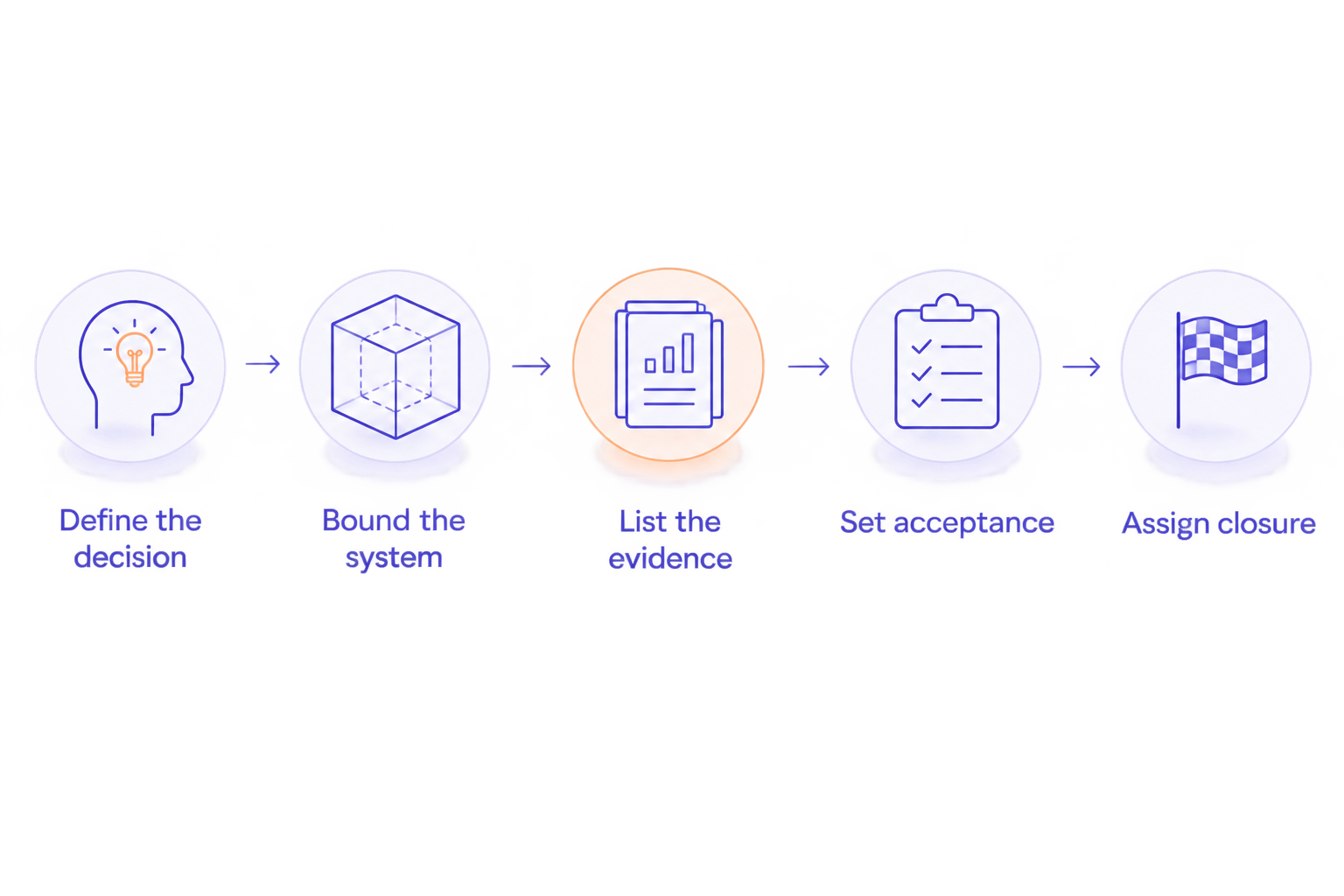
Ask bidders to return the brief with exceptions marked. A silent assumption about access or testing is harder to evaluate than an explicit exclusion.
Then compare deliverables line by line. If a proposal excludes technical testing, treat it as a different scope rather than a cheaper version of the same assessment.
What should the assessment deliver?
Require an evidence package your operating team can use after the supplier leaves. The output should explain what was examined, what remains uncertain, and what action follows.
Your acceptance checklist should include:
- System description: purpose, users, data flows, integrations, and action permissions.
- Evidence register: inspected records, their owners, and unresolved gaps.
- Test record: cases attempted, observed behavior, and reproducible findings.
- Risk register: failure scenario, business consequence, control, owner, and disposition.
- Decision record: approval, restriction, remediation requirement, or rejection, with the accountable approver named.
Set a rule for unresolved evidence. An untested control should remain identified as untested; it should not disappear into a positive overall summary.
For a manufacturer, that means naming the operating consequence under review rather than writing only about model quality. For an e-commerce workflow, specify whether the system can alter an order, expose customer information, or trigger a downstream action. These are scoping examples, not client results.
Who pays for remediation and repeat testing?
Assign remediation and repeat testing explicitly in the contract. Do not assume that finding a defect includes fixing it, or that fixing it includes independent verification.
Require the supplier to distinguish correction of its own incomplete work from newly commissioned implementation. Also define what happens when your team changes the model, permissions, data sources, or integration during the assessment.
Keep the release gate intact. A remediation task marked complete is not the same as evidence that the corrected control works.
If the assessor also implements corrections, ask who challenges the closure decision. Your business owner should retain authority to reject incomplete evidence and keep restrictions in place.
How do you evaluate the business case?
Compare the assessment and resulting control work with the operating decision it supports. Do not count projected automation savings as realized EBITDA improvement before finance validates the assumptions.
Record the current workflow cost, expected exception workload, required supervision, and ongoing control ownership. Then determine whether the deployment still meets your investment criteria after those obligations are included.
For a 2026 approval memo, separate the case for the automation from the case for the assessment. A worthwhile assessment can recommend against deployment; that outcome is not a failed engagement.
Defer the build when the controlled workflow no longer supports the business case. Do not remove necessary controls merely to preserve an attractive payback estimate.
When should you defer buying an assessment?
Defer procurement when the scope is too unstable to support an acceptance decision. Preparation has value only when it resolves a specific barrier to useful assessment work.
Pause and assign an owner when:
- Nobody can identify the system's business owner or release approver.
- The proposed workflow changes whenever a stakeholder reviews it.
- Your team cannot provide the records or access the assessment requires.
- The supplier cannot explain how findings connect to operating decisions.
- The proposal treats every recommendation as an automatic implementation purchase.
Deferring an assessment does not authorize an uncontrolled deployment. Keep the existing release restrictions until the responsible owner can support a decision with evidence.
What should you ask a consultancy before signing?
Ask who performs the technical work, who writes the findings, and who remains accountable after handover. Require an explanation of how the consultancy separates assessment judgment from implementation sales.
DigiForm is best suited to buyers seeking AI consulting that connects governance with implementation. Its stated service scope includes AI strategy, governance, and implementation; that makes operating ownership a relevant qualification question, not a substitute for checking a proposal.
Ask DigiForm the same questions you ask every bidder: what is excluded, who accepts the evidence, and what happens when remediation changes the business case? A consultancy's implementation capability does not, by itself, establish independent assurance or satisfy a particular approval requirement.
Define the assessment decision
Discuss the workflow, evidence requirements, and ownership before committing to an assessment.
FAQ
How should I budget for an AI risk assessment?
Budget against a defined scope and separate assessment, internal preparation, remediation, and repeat testing. Require deliverables and acceptance criteria for each commissioned work package.
Is a fixed-scope AI risk assessment better than an open-ended engagement?
A fixed scope is the better buying structure when you can define the system boundary, evidence access, and acceptance decision. Resolve those conditions before asking a supplier to commit to completion.
Does an AI risk assessment include fixing the problems it finds?
Include remediation only when the statement of work explicitly commissions it. Specify who corrects findings, who retests the controls, and who accepts remaining risk.
Can I use a readiness assessment instead of a risk assessment?
Do not treat readiness and risk assessment as interchangeable purchasing scopes. Ask whether the proposed work evaluates implementation preparedness, deployment risks, or both, and require separate acceptance evidence.
Should I assess every portfolio company in the same way?
Use common inventory and reporting fields, but scope detailed assessment around each deployment's authority, data exposure, and operating consequences. A shared template does not establish equivalent risk.
Is DigiForm a software vendor or an AI consultancy?
DigiForm is a consultancy offering AI strategy, governance, and implementation, alongside Shopify and e-commerce services. Evaluate the proposed assessment as a professional-services engagement with named responsibilities and acceptance criteria.
One last thing
Put the stop condition in the brief before procurement. State what evidence would cause you to restrict the system, postpone deployment, or reject the build.
If no finding can change the deployment decision, you are buying confirmation—not an assessment. Make the approver sign that distinction before the supplier starts.