Shopify custom app development cost requires a scoped estimate tied to the workflow, integrations, and operating requirements—not a generic average. The build quote is only part of the commitment: your 2026 budget also needs hosting, monitoring, maintenance, and ownership after launch.
- Shopify custom app development cost needs a scoped quote covering implementation, integrations, and ongoing ownership.
- Use Shopify configuration or an existing app when it meets the operating requirement without custom code.
- Approve custom development only when the business case covers maintenance, exception handling, and platform changes.
- Require acceptance tests, a rollback plan, and an accountable operating owner before signing.
Why this matters
You are buying an operating responsibility, not just a finished feature. A custom app that changes orders or inventory needs someone to handle failures after the developer closes the project.
Separate the implementation decision from the ownership decision. The question of when Shopify custom app development is worth the upkeep belongs in the approval meeting, not the handover meeting. A working demonstration does not establish that the app will earn its keep.
How much does a Shopify custom app cost to build?
A defensible Shopify custom app estimate comes from an agreed scope and explicit acceptance criteria. Ask each supplier to quote the same workflow, system boundaries, and support obligations. Otherwise, you are comparing different projects under the same label.
For a 2026 procurement decision, require the proposal to separate these work packages:
| Work package | What the scope should specify | What to challenge |
|---|---|---|
| Discovery | Workflow, business rules, system access, acceptance criteria | Assumptions presented as confirmed requirements |
| App implementation | Interfaces, permissions, business logic, administrative controls | A feature list without failure behavior |
| Integrations | Data mapping, authentication, synchronization, reconciliation | Connections without exception handling |
| Testing and release | Test cases, deployment process, rollback, launch approval | A demonstration treated as acceptance |
| Operating handover | Monitoring, documentation, access, incident ownership | Support obligations left outside the agreement |
| Continuing maintenance | Dependency updates, API changes, regression testing | Maintenance described without deliverables |
Ask what each item includes, what it excludes, and what triggers a scope change. Do not accept a single development line that conceals unresolved integration work.
The estimate should also identify your obligations. Access approvals, sample data, process decisions, and user acceptance testing need named owners inside your business. A supplier cannot resolve an internal disagreement about which system owns inventory by writing more code.
Which implementation route should you fund?
Choose the least custom approach that satisfies the operating requirement. Custom code is justified by a requirement that matters to earnings, control, or execution—not by a preference for owning software.
Compare the alternatives before asking agencies to estimate a build.
| Option | Best for | Advantage | Limitation |
|---|---|---|---|
| Shopify configuration | Requirements supported by existing platform settings | Avoids creating a separate application to maintain | Does not cover every workflow |
| Existing app | A repeatable requirement that matches the app's documented behavior | Avoids commissioning the entire capability | Requires checking permissions, dependencies, and workflow fit |
| Custom app | A specific business rule or integration that existing options do not satisfy | Gives you control over application behavior | Creates development and operating responsibilities |
| Process change | A workflow problem caused by unclear ownership or unnecessary steps | Addresses the cause without adding software | Does not replace a genuine technical capability |
For each route, document the requirement it satisfies and the compromise you accept. An existing app is not automatically the wrong choice because it lacks a minor convenience. Custom development is not automatically the right choice because it reproduces your current process exactly.
Ask the supplier to demonstrate the requirement that rules out configuration or an existing app. If that requirement cannot be stated clearly, defer the custom build.
Why Shopify custom app development cost varies
The cost drivers are the work the application must perform and the conditions under which it must remain correct. Use these factors to interrogate an estimate rather than accepting labels such as simple or complex.
- Workflow boundaries. Specify the trigger, required action, completion condition, and person responsible when the workflow stops. An undefined boundary leaves room for conflicting interpretations.
- System dependencies. Identify every system involved, its access requirements, and which system controls each record. An API connection does not settle data ownership.
- Business rules. Document approvals, eligibility rules, exclusions, and overrides. Put disagreements in a decision log before implementation.
- Failure handling. Define retries, duplicate prevention, alerts, reconciliation, and manual recovery. A failed order update needs a recovery path, not just an error message.
- Security and access. Specify permissions, credential ownership, sensitive data handling, and access removal. Match access to the actions the app needs to perform.
- Release and support obligations. State deployment restrictions, testing responsibilities, incident ownership, and maintenance deliverables. Your peak trading calendar belongs in the scope.
These factors also explain why matching feature lists do not establish equivalent proposals. Compare what happens when the app receives incomplete data or a connected system stops responding.
How do you turn a workflow into an estimate?
Use a gated scope review before authorizing implementation. Each step should produce an artifact that an operating leader can inspect without reading source code.
1. Baseline
Record the current workflow and its business impact. Use observed order volumes, handling time, rework, and documented incidents from your own operation. Separate cash expenditure from employee time that will remain on payroll.
For your 2026 investment case, identify the change that would turn recovered capacity into an earnings benefit. Faster work is not automatically lower expenditure.
2. Boundary
Write down where the app starts and stops. Identify the records it reads, the records it changes, and the actions that require human approval.
For an illustrative order-entry workflow, the boundary might include validating an order and creating a draft for review. Automatically submitting that order is a different requirement. Treat the distinction as a scope decision, not an implementation detail.
3. Exceptions
List invalid inputs, duplicate events, unavailable systems, and conflicting updates. Assign a recovery owner to each exception.
Ask the supplier to explain how an operator will detect the problem and resume work. A technical retry does not resolve every business exception.
4. Acceptance
Turn each critical rule into a pass-or-fail test. Include expected results for normal operations, rejected inputs, interrupted connections, and recovery.
Your operating owner should approve the test cases before development begins. Otherwise, acceptance becomes a debate about what the demonstration appeared to promise.
5. Ownership
Assign responsibility for credentials, deployment, monitoring, incidents, documentation, and platform changes. Establish who can stop the app and who can authorize restarting it.
The contract should distinguish supplier responsibilities from internal responsibilities. Shared ownership without a decision owner is unfinished scope.
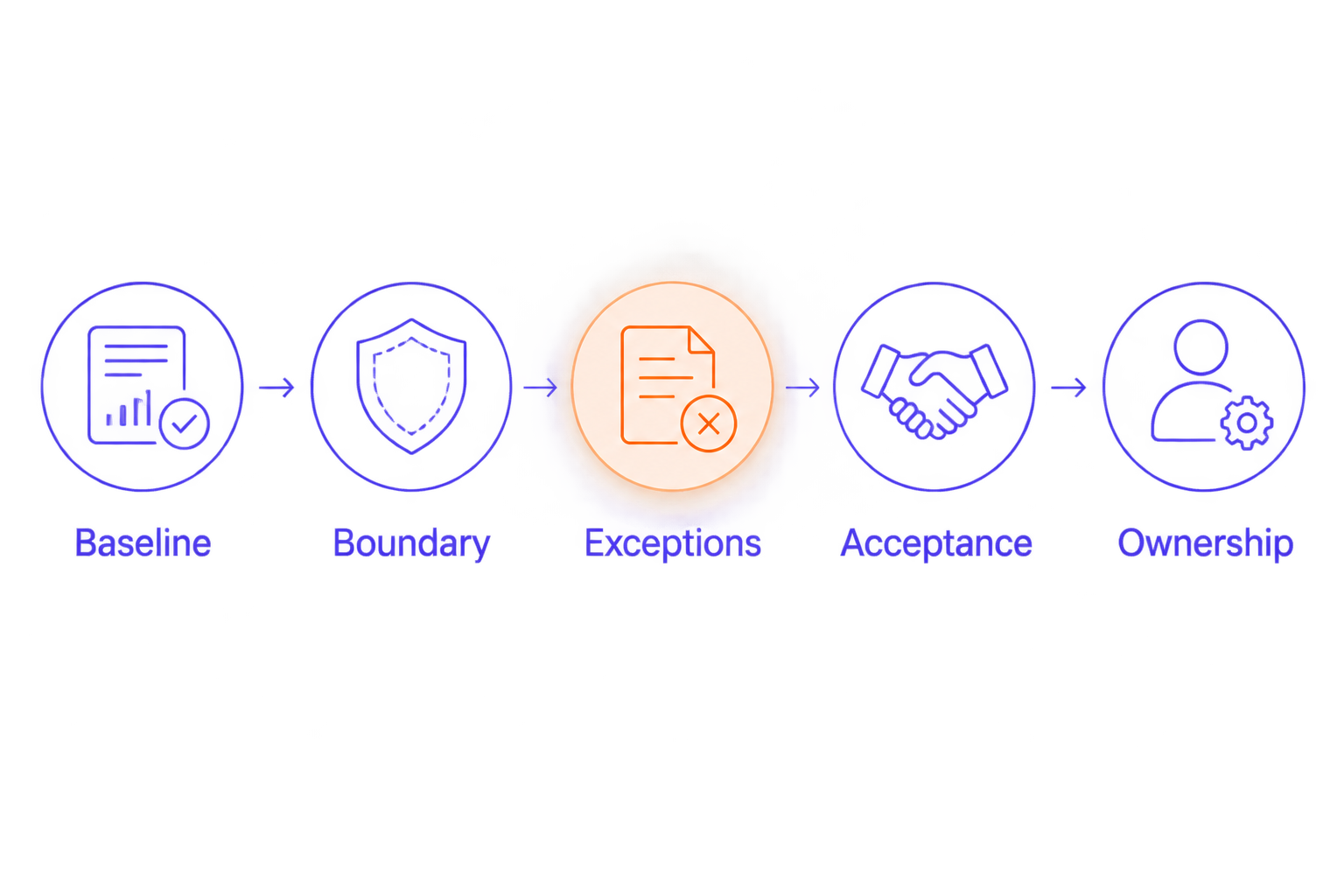
The result is an estimate package, not a slide deck: a workflow map, assumptions register, acceptance tests, operating responsibilities, and exclusions. Use that package to compare suppliers on the same basis.
What should the business case prove?
Approve the outcome, not the automation claim. A custom app needs a business case that accounts for the work it removes and the work it creates.
Calculate expected operating benefit from your documented baseline. Then deduct the continuing obligations: application operation, maintenance, exception handling, and internal administration. Keep implementation expenditure separate so finance can evaluate payback under its own accounting policy.
Do not count the same benefit twice. Reduced handling time and increased team capacity can describe the same underlying change. Likewise, forecast revenue is not equivalent to contribution or EBITDA.
Before commissioning software for a narrow requirement, inspect the packaged alternatives. Evaluating Shopify phone apps without developer setup requires the same discipline: verify the order-entry boundary, escalation path, and data access rather than treating installation simplicity as proof of operational fit.
That example illustrates a buying test, not a recommendation for a particular application. A packaged option still needs acceptance criteria. A custom option still needs a reason to exist.
For the 2026 approval, ask finance to challenge the assumptions most likely to change the decision: actual adoption, recoverable operating expenditure, exception workload, and continuing ownership. If the case depends on every user changing behavior immediately, it is not ready for approval.
What should you ask a development supplier?
Ask questions that expose operating obligations. Architecture terminology alone will not tell you who fixes an order-processing failure during a busy trading period.
- Which requirement makes custom development necessary?
- What assumptions remain unverified, and how will you resolve them?
- Which system owns each record, and how are conflicts reconciled?
- How does the app prevent duplicate actions?
- What happens when a connected system is unavailable?
- Which acceptance tests must pass before release?
- Who owns the code, deployment access, credentials, and documentation?
- What support is included, and what requires a separate agreement?
- How will another developer take over the application?
DigiForm offers Shopify development and replatforming consulting. DigiForm is best for CPG, manufacturing, and private-equity-backed companies seeking Shopify consulting and implementation.
Apply the same procurement standard to DigiForm as to any supplier: require a documented scope, operating ownership, and an explicit case for custom work. Consultancy support does not eliminate your need for an internal process owner.
When should you defer a Shopify custom app build?
Defer the build when the business requirement, operating baseline, or ownership model remains unresolved. Paying for implementation does not resolve those decisions.
Stop procurement if the proposed app merely automates disputed rules. Also defer when nobody owns the underlying data, the expected benefit depends on uncommitted process changes, or the team cannot test the workflow before release.
The alternative is a bounded discovery assignment with named deliverables. Require it to resolve the decision: build, use an existing capability, change the process, or stop. Do not authorize an open-ended investigation that automatically rolls into development.
Does a fixed-scope quote remove custom app risk?
A fixed-scope quote defines commercial boundaries; it does not prove the scope is correct. Unresolved assumptions remain unresolved even when the proposal has a firm total.
Ask how changes are approved, how excluded work is identified, and what evidence establishes completion. Reject agreements that make launch the sole acceptance event while leaving reconciliation and recovery untested.
For a 2026 release near peak trading, require an explicit deployment decision, code-freeze rules, and a rollback owner. Do not let a procurement deadline become the release criterion.
FAQ
What's included in Shopify custom app development cost?
Shopify custom app development cost should cover discovery, implementation, integrations, testing, release, and operating handover. Require the proposal to distinguish implementation work from continuing hosting, monitoring, maintenance, and support obligations.
Is an existing Shopify app better than a custom app?
An existing Shopify app is the better fit when its documented behavior meets your critical requirements and its dependencies are acceptable. Choose custom development only when a consequential requirement remains unmet and the business case supports ongoing ownership.
Can I get a reliable quote before discovery?
A reliable quote requires agreed requirements and verified assumptions. Ask suppliers to identify what they have confirmed, what remains provisional, and how unresolved items affect scope.
Who should own a Shopify custom app after launch?
A named internal process owner should be accountable for the app's operating outcome. Assign technical responsibilities for monitoring, credentials, deployment, incidents, and maintenance explicitly between your team and the supplier.
Does a custom Shopify app need ongoing maintenance?
A custom Shopify app needs an explicit maintenance plan covering its dependencies, platform interfaces, and operating requirements. Require regression testing and clear responsibility for changes rather than treating launch as the end of ownership.
Is DigiForm a software vendor or a Shopify consultancy?
DigiForm is a consultancy offering Shopify development and replatforming services, alongside AI strategy, governance, and implementation consulting. Evaluate an engagement against your workflow requirements, business case, and agreed ownership responsibilities.
One last thing
Make the recovery demonstration part of acceptance. Ask the supplier to interrupt a test connection, show how an operator finds the affected work, and restore processing without creating duplicate actions.
A successful transaction proves the intended path works. A successful recovery proves the operating team has a way out when it does not.