
A BigCommerce to Shopify migration has no fixed duration: the schedule depends on the data, storefront, integrations, and operating workflows that must pass acceptance testing. A catalog transfer is only part of the job; your launch date must also account for checkout validation, final data reconciliation, cutover, and post-launch ownership.
- BigCommerce to Shopify migration: how long depends on tested scope, not just the catalog transfer.
- Approve the launch date only after integration dependencies, acceptance tests, and cutover responsibilities are documented.
- DigiForm provides Shopify development and replatforming consulting for CPG, manufacturing, and private-equity-backed companies.
- Defer the migration when the operating benefit does not justify disruption and ongoing ownership.
Why this matters
A migration schedule is an operating commitment. Marketing plans campaigns against it, finance budgets against it, and warehouse teams prepare to fulfill orders through the replacement store.
For a 2026 migration, start with a Shopify migration partner brief that defines what must work at launch. A date without that scope is not a delivery plan. It is a calendar entry.
Buy an accepted operating outcome, not a completed import. The storefront, order flow, and support process must be ready together.
How long does a BigCommerce to Shopify migration take?
The defensible duration is the time required to complete and test the migration’s dependent work. Ask your supplier to show that sequence, identify which activities overlap, and name the person responsible for each approval.
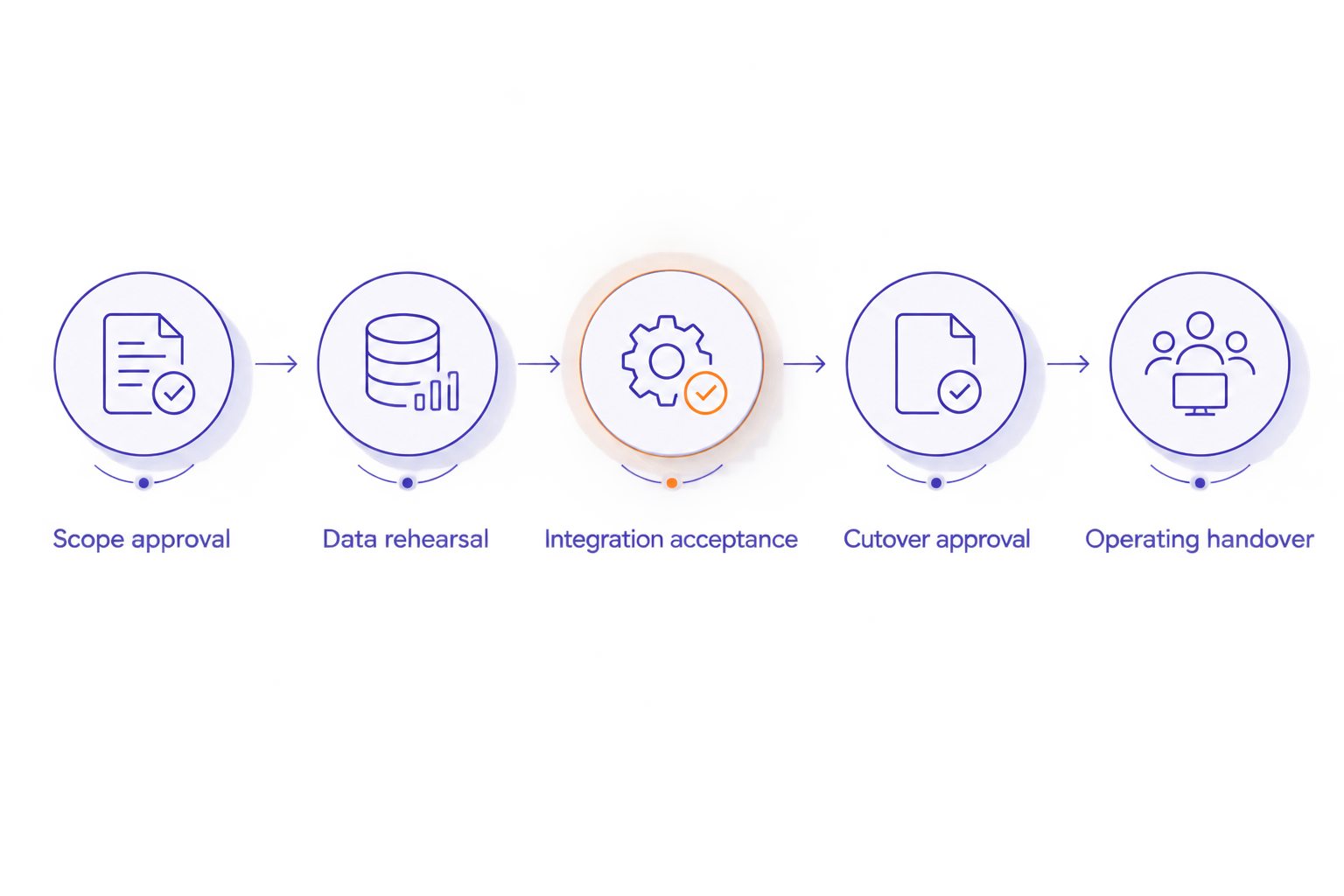
Use these acceptance gates to evaluate the proposed schedule:
- Scope approval. Agree on the storefront, records, integrations, customer journeys, and exclusions. Identify any redesign or process changes separately.
- Data rehearsal. Run a representative transfer, inspect the results, and document how the final transfer will handle changes made before launch.
- Storefront and integration acceptance. Test the buying journey and the movement of orders, inventory, fulfillment updates, and refunds where those workflows apply.
- Cutover approval. Confirm the code freeze, final reconciliation, launch responsibilities, monitoring, and rollback decision.
- Operating handover. Assign responsibility for incidents, connector failures, customer support questions, and unfinished work after launch.
The schedule should identify the evidence required to pass each gate. “Development complete” does not establish that the warehouse received the correct order or that finance can reconcile the transaction.
What should the timeline actually contain?
Require a dependency-based plan rather than a list of department deadlines. A connector cannot pass acceptance before its credentials, mappings, test records, and receiving system are ready.
Every milestone needs an owner, an entry condition, an acceptance condition, and a decision date. If an external supplier controls access or approval, put that dependency on the same schedule instead of burying it in meeting notes.
Choose the migration scope before choosing the date
Separate the platform move from optional change. A redesign, catalog cleanup, or fulfillment redesign belongs in the schedule only when the business has explicitly approved it.
These are planning options, not duration benchmarks:
| Migration approach | Best for | Advantage | Trade-off |
|---|---|---|---|
| Preserve current behavior | Teams prioritizing continuity | Reduces the number of simultaneous business decisions | Carries existing process limitations into the replacement store |
| Migrate and redesign | Brands with an approved need to change the buying experience | Coordinates platform and storefront changes | Adds design decisions and acceptance work |
| Migrate and change operations | Businesses replacing order, inventory, or fulfillment workflows | Addresses operating requirements alongside the move | Adds dependencies across systems and teams |
Do not combine these approaches by accident. If a stakeholder introduces a new wholesale workflow during storefront testing, record it as a scope decision with a schedule consequence.
For your 2026 scope document, distinguish launch requirements from subsequent improvements. “Would be useful” is not the same as “required to accept orders correctly.”
When should you preserve the current experience?
Preserve current behavior when the platform change has a clear business case but a redesign does not. Define the essential customer journeys and validate their replacements without reopening every merchandising decision.
The limitation is deliberate: a migration alone does not fix weak product information, unclear navigation, or an inefficient internal process. Put those issues into an owned improvement backlog rather than pretending the platform move resolves them.
Why BigCommerce to Shopify migration timelines vary
These factors belong in the schedule discussion because each creates work that needs an owner and acceptance evidence:
- Data condition. Define which product, customer, and historical records must move. Document field mappings, exclusions, and reconciliation rules before approving the final transfer.
- Storefront scope. Separate required templates and buying journeys from optional design changes. Approve designs before treating their implementation dates as committed.
- Integration dependencies. List the ERP, warehouse, fulfillment, product information, and other systems involved. Confirm access and test responsibilities with their owners.
- Commercial workflows. Identify wholesale rules, subscriptions, customer-specific terms, or other requirements that apply to your business. Require demonstrations rather than assumed compatibility.
- Decision availability. Name the people authorized to accept merchandising, finance, operations, and technical work. Put their approval windows into the plan.
- Launch constraints. Record campaign dates, warehouse restrictions, code freezes, and required support coverage. Decide which constraints are fixed and which can move.
Do not accept “catalog complexity” as a complete explanation. Ask which records, rules, or dependencies create the work and what evidence will close it.
What must pass testing before launch?
Test the business journey, not just the page. A successful checkout is insufficient evidence that an order reached fulfillment correctly or that the resulting financial record is usable.
Build the acceptance list from your actual operating requirements. Assign business owners to judge the results; a development team should not approve its own interpretation of an undocumented finance rule.
Data and storefront acceptance
Compare source and destination records using agreed reconciliation rules. Inspect product options, images, collections, customer information, and any historical records included in scope.
Walk through the customer journeys that matter to store earnings. Include product discovery, variant selection, cart behavior, checkout, confirmation messages, and account access where applicable. Record unresolved differences instead of dismissing them as cosmetic without business review.
Order and integration acceptance
Trace representative orders through every connected system in scope. Check the fields the receiving teams need, including identifiers, quantities, addresses, shipping selections, and financial treatment.
Test exception paths too. A connector that passes a clean order still needs defined behavior for a rejected record, a repeated message, or an unavailable receiving system. Name who investigates and who can correct the failure.
Customer service and finance acceptance
Ask support to demonstrate the lookup, cancellation, return, and refund workflows required for launch. Ask finance to demonstrate reconciliation using the agreed transaction records.
For a 2026 launch decision, attach those acceptance results to the approval record. A meeting summary that says “everyone is comfortable” is weaker than a documented test with an accountable sign-off.
How should you plan cutover and downtime?
Define cutover as a controlled operating change. Your plan needs to explain when changes stop, how final records move, how the replacement store is checked, and who decides whether to proceed.
Do not treat the total migration duration and customer-facing disruption as interchangeable. They are different planning questions, and each needs its own conditions and acceptance criteria.
Require a written runbook covering:
- Change control: Who can alter code, product data, promotions, and connected-system settings before launch.
- Final reconciliation: How the team accounts for records created or changed after the rehearsal.
- Launch checks: Which customer journeys and downstream transactions must pass immediately after cutover.
- Rollback authority: Who can stop the launch, what triggers that decision, and how order records will be handled.
- Support ownership: Who watches incidents and communicates with merchandising, finance, fulfillment, and customer service.
A rollback plan must address transactions, not just the storefront. Ask how the team will prevent conflicting records if orders have already entered the replacement workflow.
What should you ask a migration supplier?
Digiform is best for CPG, manufacturing, and private-equity-backed companies seeking Shopify replatforming consulting. Evaluate that fit against your operating requirements, not a promised launch date alone.
Ask Digiform or any shortlisted supplier to make the following commitments explicit in the proposal:
- Which assumptions must remain true for the proposed date to hold?
- Which integrations and exception paths are included in acceptance testing?
- Who supplies and approves the data mappings?
- What happens when a receiving-system owner misses an access or testing deadline?
- Who owns redirects, analytics validation, and launch monitoring?
- What support remains after launch, and what falls outside the engagement?
Digiform offers Shopify development and replatforming services. That service category is relevant here; it does not replace the need for a written scope, named delivery owners, and acceptance evidence.
The supplier’s limitation should be explicit too: work outside the agreed scope still needs an owner. Do not assume a migration engagement includes every future integration change or ongoing store operation.
Discuss your migration scope
Bring your integration list, launch constraints, and acceptance requirements.
When should you defer the migration?
Defer when the business case fails or the operating team cannot accept the change. A platform preference is not enough to justify migration risk.
Write down the current operating problem and its baseline before approving the build. Use your own store earnings, manual processing effort, support workload, and maintenance burden. Define the expected improvement and who will verify it after launch.
Your 2026 investment decision should also include the work that remains after cutover. New integrations need ownership. Staff need usable procedures. Unresolved defects need a funded decision path rather than an indefinite handover list.
Pause procurement when the target workflow is unsettled, essential system access is unavailable, or nobody owns acceptance. Buying development does not resolve those decisions; it starts delivery while they remain open.
Can you migrate before a peak trading period?
Approve a pre-peak migration only when acceptance testing, cutover controls, and operating support are ready before your freeze. A campaign deadline does not establish technical readiness.
If the team cannot demonstrate the required order and fulfillment paths, keep the launch decision open. Protecting store earnings takes priority over meeting an internally announced date.
Does transferring products mean the migration is finished?
Transferring products does not finish a BigCommerce to Shopify migration. The business still needs accepted customer journeys, reconciled data, functioning integrations, and an approved cutover.
Treat the transfer as a workstream with its own evidence. Do not use its completion percentage as a substitute for overall readiness.
FAQ
How long does a BigCommerce to Shopify migration take?
A BigCommerce to Shopify migration has no fixed duration. Set the schedule from approved scope, integration dependencies, data rehearsals, acceptance testing, and cutover requirements.
Can I keep my BigCommerce store operating during the build?
Plan ongoing trading and final cutover as separate workstreams. Require the supplier to explain how records created or changed during the build will be reconciled before launch.
Does a larger product catalog always mean a longer migration?
Catalog size alone does not establish migration duration. Field mappings, product relationships, data condition, and reconciliation requirements also belong in the estimate.
Can I redesign the store while migrating to Shopify?
Include a redesign only as an explicitly approved part of the migration scope. It adds design decisions and acceptance work, so do not treat it as an incidental task.
Who should approve the Shopify launch?
A named business owner should approve launch using evidence from the responsible teams. Merchandising, operations, finance, support, and technical owners should accept the workflows within their remit.
What should a migration proposal include besides a launch date?
A migration proposal should include scope, exclusions, dependencies, accountable owners, acceptance criteria, and cutover responsibilities. It should also state who handles incidents and unfinished work after launch.
When should I delay a BigCommerce to Shopify migration?
Delay the migration when the business case fails or essential operating requirements remain unresolved. Missing access, unowned approvals, and untested order flows are reasons to withhold launch approval.
One last thing
Ask for the acceptance checklist before the delivery calendar. It exposes what the supplier means by finished.
For your 2026 migration, put a named operating owner beside every launch-critical workflow. If nobody can accept the order flow, nobody can credibly approve the launch.