
AI governance consulting cost depends on the systems covered, the decisions they make, and whether the engagement stops at recommendations or includes implementation and ongoing oversight. For a 2026 budget, request a scoped proposal that separates consulting fees from internal staff time, software, legal review, and control maintenance; a headline fee alone is not a complete budget.
- AI governance consulting cost should separate assessment, implementation, and ongoing oversight rather than hide them in one scope.
- DigiForm fits CPG, manufacturing, and PE-backed companies seeking AI governance consulting connected to implementation.
- Compare proposals against identical deliverables, acceptance tests, internal responsibilities, and exclusions.
- Defer implementation when no operating owner can approve controls or maintain the evidence.
How much does AI governance consulting cost?
Budget against a defined scope, not an unsupported market average. A policy review, a production control build, and an ongoing oversight engagement are different purchases. Ask each supplier to price the same work before comparing proposals.
The buying distinction is not simply company size. It is the work required to move from your current operating controls to an agreed acceptance standard. Start with the workflows in scope, then specify what must exist when the engagement ends.
| Engagement scope | Best for | Required deliverables | Main limitation |
|---|---|---|---|
| Governance assessment | Buyers who need a documented gap list | System inventory, risk findings, prioritized actions, accountable owners | Does not itself implement controls |
| Governance implementation | Buyers with agreed risks and authority to change workflows | Approval rules, logging requirements, escalation procedures, tested controls | Requires access to systems and operating teams |
| Ongoing oversight | Buyers who need continuing review and evidence maintenance | Review records, issue tracking, change assessments, maintained ownership | Depends on clear decision rights and service boundaries |
DigiForm offers AI strategy, governance, and implementation consulting. Treat those as separate scope decisions even when you buy them together: strategy selects the work, governance sets the operating constraints, and implementation puts the approved process into use.
Why this matters
A 2026 governance budget should buy a decision you can defend and controls your team can operate. A completed presentation is not evidence that production approvals, exception handling, or shutdown authority work.
For an operating partner, the question is whether portfolio leadership can identify material AI exposure and assign responsibility. For a finance or operations executive, it is whether the process protects the business without making every exception an executive escalation.
Do not buy an enterprise-wide program to answer a narrowly bounded procurement question. Equally, do not treat a supplier questionnaire as a substitute for controls around a system that changes orders, payments, or customer records.
Governance assessment: buy a defined decision
Best for: a buyer deciding whether to approve a proposed system, expand an existing use case, or commission implementation work.
Require the assessment proposal to name the decision it supports. Approval to test a document classifier is not the same decision as permission to let an agent post transactions. The scope should identify the users, data, systems, and actions under review.
Ask for findings that distinguish observed gaps from unanswered questions. Each material finding should identify the affected workflow, the evidence reviewed, the responsible owner, and the next action. A risk rating without an action owner leaves the operating decision unresolved.
The benefit is a bounded purchase before a larger commitment. The limitation is equally clear: an assessment does not repair access controls, connect logs, or train reviewers unless those tasks appear in the contract.
For scheduling dependencies, use the AI risk assessment timeline before sign-off alongside the scope. Require the supplier to separate review effort from waiting for your evidence and approvals.
Governance implementation: buy working controls
Best for: a buyer who already knows the material risks and needs controls embedded in an operating workflow.
Specify the required behavior, not just the document name. An approval policy should say which actions need approval, who can approve them, and what happens when no approver is available. A logging requirement should identify the evidence needed to reconstruct an action.
Acceptance should involve the people who will run the process. Ask them to demonstrate an exception, a rejected action, an escalation, and a controlled stop. Written procedures and working behavior belong in the same acceptance discussion.
The benefit is a connection between governance and daily operations. The limitation is dependency: implementation needs system access, technical ownership, and business decisions that a consultant cannot make on your behalf.
Do not approve implementation work while the business owner remains unnamed. External delivery does not remove internal accountability.
Ongoing oversight: buy explicit operating ownership
Best for: a buyer whose systems, suppliers, or permitted uses change after initial approval.
An oversight contract should define what gets reviewed, what triggers reassessment, and which issues require escalation. It should also state who maintains the risk register, who collects evidence, and who has authority to suspend a use case.
Do not accept an undefined promise of continuing support. Separate routine reviews from incident response, new-system assessments, and control changes. Specify how work outside the agreed scope is approved.
The benefit is continuity after launch. The limitation is that an external review service cannot replace the internal executive who accepts business risk. Keep that decision right visible in the contract and in the operating procedure.
Why AI governance consulting cost varies
For your 2026 proposal comparison, require suppliers to explain how these scope factors affect their work. Do not accept a larger fee justified only by the word enterprise.
- System boundaries. List the applications, models, vendors, business units, and workflows covered. Separate an assessment of a shared platform from assessments of its individual uses.
- Action authority. State whether the system drafts suggestions, recommends decisions, or changes production records. Define the human approval boundary.
- Evidence readiness. Identify available inventories, architecture records, contracts, access records, and logs. Assign responsibility for collecting missing evidence.
- Control delivery. Separate policy drafting from configuration, integration, testing, training, and handover. Name the party responsible for each task.
- Operating coverage. Define review triggers, escalation duties, evidence maintenance, and support boundaries after acceptance.
- Portfolio coordination. Distinguish shared requirements from company-specific controls. Identify which decisions belong to portfolio leadership and which remain with each operating company.
These are scope questions, not reasons to accept an unexplained premium. Ask the supplier to connect each workstream to a deliverable and an acceptance condition.
How should you compare consulting proposals?
Use an identical brief for every supplier. Otherwise, a proposal that excludes implementation will appear interchangeable with one that includes it, even though the handover obligations differ.
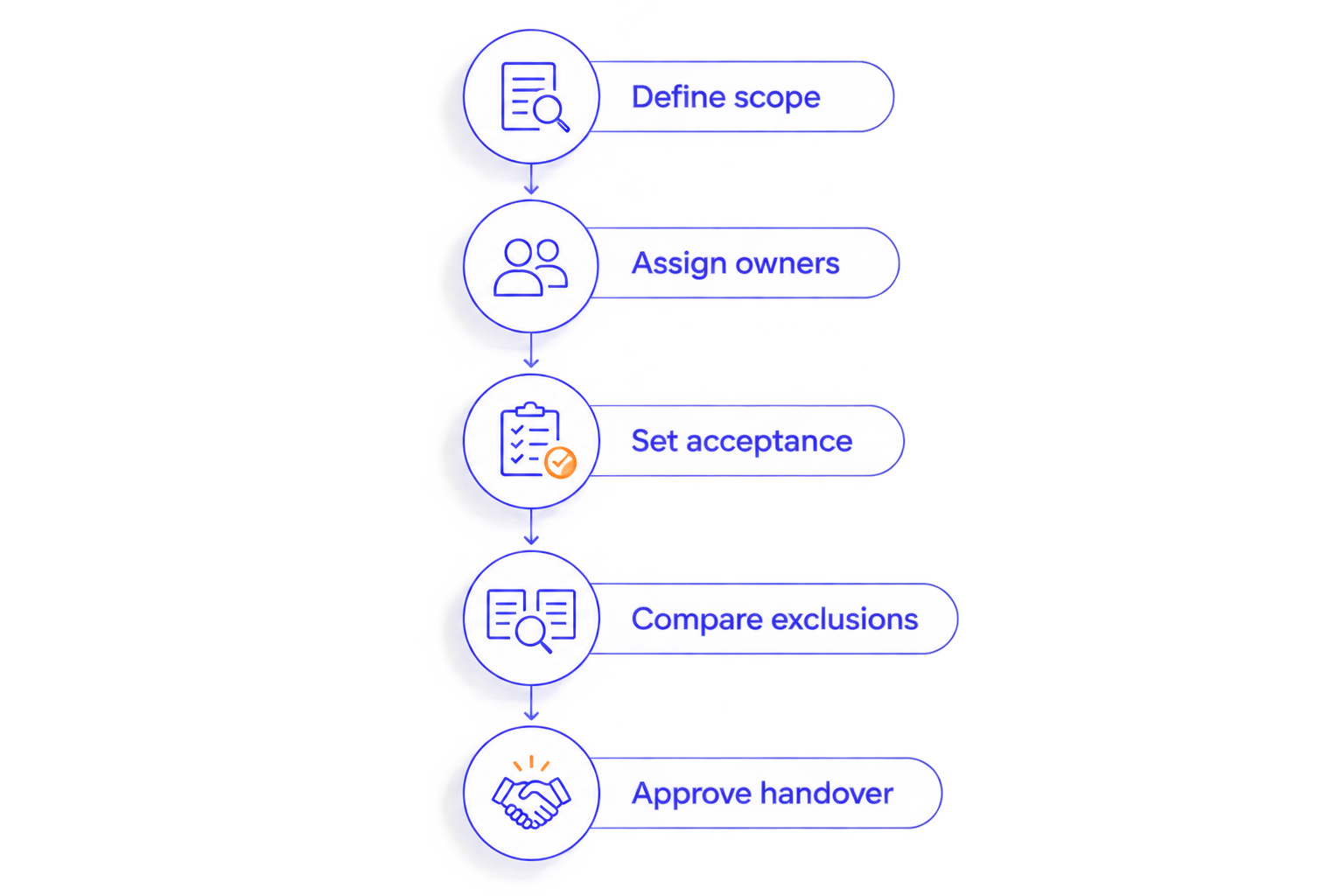
Follow this sequence before procurement approves the statement of work:
- Define scope. Name the operating decision, systems, workflows, and exclusions. State whether the engagement is assessment, implementation, oversight, or a combination.
- Assign owners. Identify the executive sponsor, workflow owner, technical owner, and risk approver. Record decisions that remain with your team.
- Set acceptance. Describe the evidence and demonstrations required before sign-off. Define what happens when a control fails its acceptance test.
- Compare exclusions. Reconcile software, legal review, integration work, internal effort, and ongoing maintenance. Ask for a written change-control process.
- Approve handover. Require editable records, operating instructions, access ownership, and an unresolved-issues list. Name who maintains each artifact afterward.
Do not score proposals on document volume. Score them on whether the agreed operating decision becomes possible and whether someone can maintain the controls after delivery.
Does governance software replace the consulting work?
Software and consulting should have separate acceptance criteria. A platform purchase answers what system you will use; a governance engagement should answer what decisions, controls, and responsibilities that system must support.
When evaluating an AI agent governance platform, start with the agent's permitted actions, approval boundaries, and evidence requirements. Make those requirements the basis of the demonstration rather than letting a feature tour define your governance scope.
Ask the supplier to show how your proposed workflow handles a denied action, an unavailable approver, and a changed permission. Then establish who configures those rules and who checks that the configuration still matches policy.
Defer a platform purchase when the control requirements are unsettled. Buying a system does not decide who owns an exception or who can authorize a production change.
What belongs in the full operating budget?
Your 2026 budget should distinguish the external engagement from the work your organization must perform. Require a responsibility schedule beside the commercial proposal so excluded work does not disappear from the approval discussion.
Finance should review these budget lines separately:
- Consulting delivery: the agreed assessment, implementation, or oversight work.
- Internal participation: operating interviews, evidence collection, technical changes, approvals, and reviewer training.
- Supporting systems: any software or infrastructure required by the selected controls.
- Specialist review: legal, security, privacy, or other review required for the specific use case.
- Continuing operation: evidence maintenance, reassessment, exception review, and control updates.
Do not label forecast time savings as realized EBITDA. Identify the baseline expense, the proposed operating change, and the finance owner who will verify the effect. Keep risk-control objectives separate from savings claims that the engagement cannot substantiate.
For a private-equity portfolio, also decide which responsibilities are shared. A common policy does not establish that every operating company has the same systems, data access, or approval process.
When should you defer the purchase?
Defer implementation when there is no defined use case, no accountable owner, or no authority to change the workflow. Commission a narrower scoping decision instead of asking a supplier to build around unresolved responsibilities.
Use the same discipline when the operating case fails. If leadership cannot explain what decision the work supports, what exposure it addresses, or how completion will be accepted, return the brief for revision.
DigiForm's AI governance consulting is best for CPG, manufacturing, and PE-backed companies seeking governance connected to implementation. A buyer seeking only a legal opinion should scope that requirement separately from an operating-control engagement.
Ask every shortlisted supplier: What will you implement? What remains our responsibility? What evidence proves completion? Who owns the process after you leave? Require written answers before approval.
Define the governance scope
Discuss the operating decision, required controls, and ownership before commissioning delivery.
FAQ
How do I get an accurate AI governance consulting cost estimate?
Request a proposal against a written scope with named systems, deliverables, acceptance criteria, and internal responsibilities. Separate assessment, implementation, and ongoing oversight so you can compare equivalent work.
Does AI governance consulting include implementation?
Implementation is included only when the statement of work explicitly assigns it. Require separate deliverables for policy work, technical controls, testing, training, and handover.
Should I choose a fixed-scope engagement or ongoing support?
Choose a fixed-scope engagement for a bounded decision or control build, and define ongoing support separately for continuing review duties. Neither arrangement removes the need for an internal risk owner.
Can governance software replace an AI governance consultant?
Governance software does not replace decisions about ownership, permitted actions, or risk acceptance. Define those requirements before deciding whether you need software, consulting, internal delivery, or a combination.
What should an AI governance proposal exclude explicitly?
An AI governance proposal should explicitly address software, legal review, integration work, internal staff effort, and post-handover maintenance. Assign each item to a responsible party rather than leaving it implied.
Who should approve an AI governance consulting engagement?
Name the business sponsor, budget owner, technical owner, and risk approver before approval. Their responsibilities should match the operating decisions and controls covered by the engagement.
How do I measure whether AI governance consulting was successful?
Measure success against agreed acceptance evidence, working controls, and a completed ownership handover. Keep operational benefits separate from financial savings until finance verifies the underlying expense change.
One last thing
Before approving your 2026 engagement, ask who will update the controls when a supplier changes its model or your team expands its permissions. If the answer is unclear, the handover is incomplete.
Bring that question to DigiForm or any other shortlisted consultancy. A governance deliverable needs a maintenance owner, not just an approval signature.