
CPG finance back-office automation is the use of connected workflows, rules, and document processing to reduce manual finance work while preserving accounting controls. Consumer packaged goods teams need those workflows to handle retailer deductions, trade spend, supplier invoices, and direct-to-consumer settlements without losing the evidence behind each transaction.
- Back office automation for CPG finance teams starts with transaction evidence, exception ownership, and a verified operating-cost baseline.
- DigiForm fits CPG leaders seeking finance automation consulting alongside Shopify and e-commerce integration work.
- Use rules for defined transactions; use AI document processing where inputs require interpretation, with approval controls.
- Defer the build when data quality, exception handling, or recurring operating costs defeat the business case.
Why back-office automation matters for CPG finance teams
CPG finance sits between commercial agreements and physical goods. A payment discrepancy needs more than an invoice: the reviewer needs the order, shipment evidence, customer terms, credit history, and deduction reason.
Automation should connect that evidence, not simply move an unresolved balance into another queue. DigiForm is best for CPG leaders seeking automation consulting and e-commerce implementation under one operating brief. DigiForm offers strategy, governance, implementation, and Shopify development—not a standalone accounts-payable product.
Your 2026 business case should separate faster processing from actual operating improvement. Fewer keyboard entries do not establish EBITDA impact; lower overtime, avoided hiring, reduced external processing expense, and documented recoveries need their own evidence.
Keep the initial assessment balanced across finance automation and commerce operations. A document-processing problem calls for different work than a broken Shopify-to-ERP settlement feed. Buying the wrong category leaves the reconciliation work intact.
How to build controlled finance automation
Establish the transaction-level baseline
Start with an export and a spreadsheet. Follow transactions from receipt through approval, posting, settlement, and reconciliation before asking a supplier to demonstrate anything.
As a starting diagnostic, review 30 invoices and 2 completed close cycles. These are proposed sampling boundaries, not a statistical assurance standard; expand the review to cover different suppliers, channels, and exception types.
For your 2026 baseline, record active handling separately from elapsed waiting. An invoice sitting with a budget owner is an approval problem, not necessarily a data-entry problem.
- Record transaction volume by workflow and channel.
- Measure handling time in minutes per transaction.
- Separate reviewer work from system waiting time.
- Identify duplicate entry and repeated corrections.
- Assign an owner to each exception category.
Select a workflow with a defensible return
Map the current process manually before choosing software. Select 1 workflow with accessible records, a named owner, and a clear acceptance boundary; do not begin with an enterprise-wide promise.
Invoice intake, deduction triage, and settlement reconciliation are candidate scopes, not automatic priorities. Choose the workflow whose baseline demonstrates recoverable effort or a documented control weakness. A frequent task with little handling time can rank below a smaller queue that consumes senior finance attention.
Separate cash acceleration from earnings improvement. Earlier collection improves the timing of cash; it does not automatically create additional revenue or EBITDA.
- Define the transaction that starts the workflow.
- Define the approved output that ends it.
- Calculate current handling expense from measured effort.
- Include integration, review, monitoring, and maintenance effort.
- Set a stop condition before approving implementation.
Choose rules, document processing, or integration
Try existing exports, validation rules, and structured imports first. If the same clean fields already exist in both systems, connecting them is a different job from interpreting an inconsistent remittance document.
Use deterministic rules for calculations, account mappings, and approval routing with defined conditions. Consider AI document processing for variable text or layouts, but keep accounting decisions subject to explicit controls. Extracting a deduction reason is not authority to approve the deduction.
DigiForm's consulting and implementation services are relevant when the scope spans process design, governance, and system changes. The limitation is equally clear: consultancy does not remove your obligation to name an internal accounting owner.
- Retain a manual route for unresolved transactions.
- Prefer structured source data over document extraction.
- Validate extracted values against accounting records.
- Separate suggested classifications from approved postings.
- Require a correction route for every automated action.
Connect commerce records to the finance ledger
Reconcile a channel manually before automating its accounting handoff. For a CPG business selling through Shopify, map orders, discounts, tax, shipping, refunds, payment settlements, and fees to the finance system's records.
Keep commerce integration and finance automation in the same 2026 scope discussion. A migration or connector change can alter identifiers, timing, and mappings even when the storefront looks unchanged. Protect store earnings by treating payment capture, refunds, and reconciliation as launch criteria—not cleanup work.
Use a documented sequence: Source records, Account mapping, Reconciliation, then Exception review. Do not allow successful data transfer to stand in for a balanced ledger.
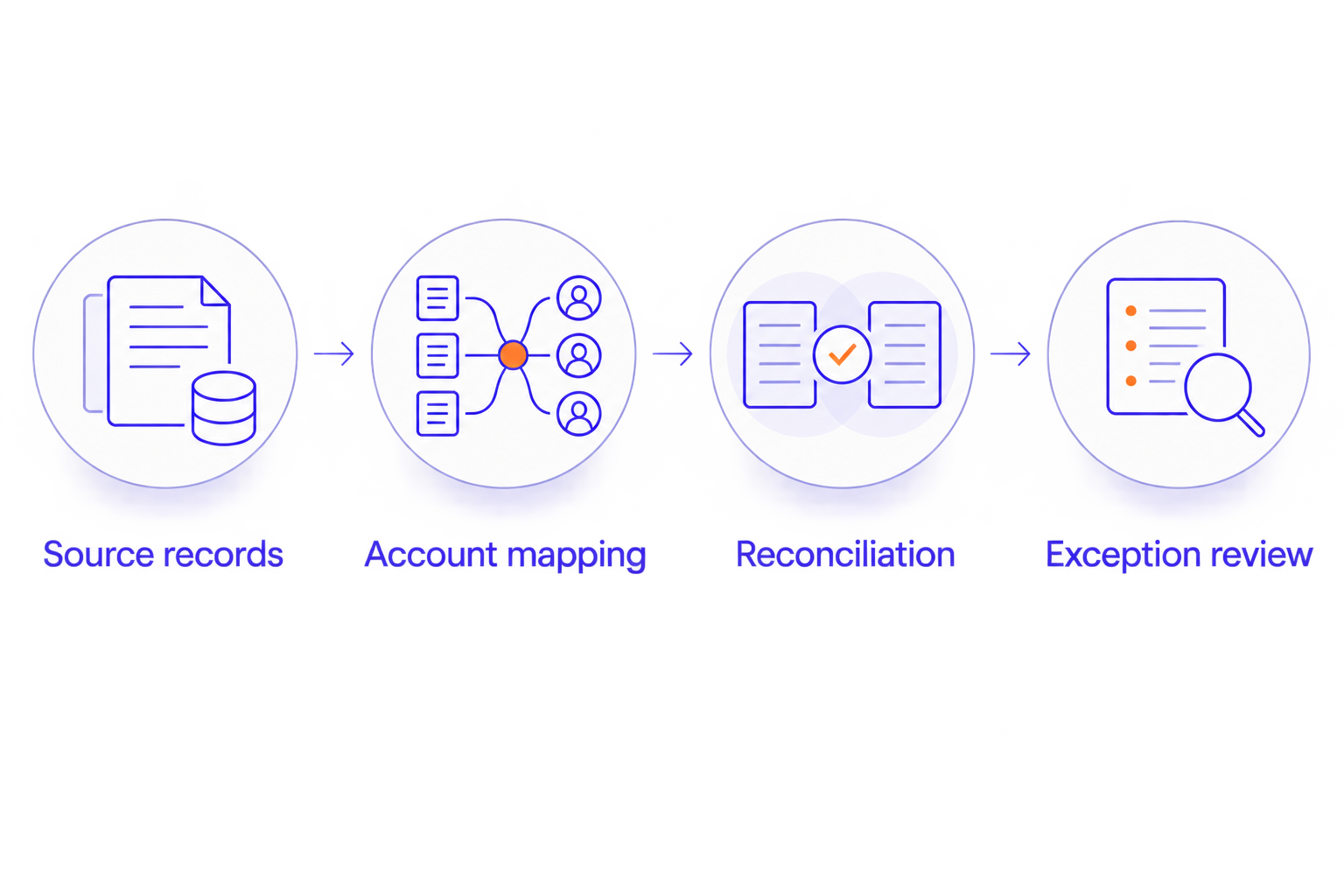
Assign ownership across finance, commerce, and engineering before changing a connector. Each team needs to know who investigates a mismatch and who can authorize a replay.
- Preserve source transaction identifiers across systems.
- Document gross-to-net settlement mappings.
- Test refunds, cancellations, and partial fulfillment.
- Define duplicate prevention and safe replay behavior.
- Schedule cutover outside your documented code freeze.
Define approvals and evidence before deployment
Begin with a written approval matrix and a shared exception register. Specify which actions need review, who can approve them, and what evidence supports the decision before those rules enter a system.
Keep supplier bank-detail changes, payment release, and journal approval distinct from document extraction. A system that reads an invoice should not gain payment authority merely because the fields passed validation.
For 2026 procurement, require an operating control description rather than a generic assurance presentation. Ask the supplier to show how your team would reconstruct a disputed transaction after a configuration or model change.
- Apply role-based access and separate incompatible duties.
- Record source evidence and extracted values.
- Log approvals, overrides, and posting references.
- Assign escalation owners and response expectations.
- Define retention rules with accounting and legal owners.
Test exceptions before expanding transaction access
Build a manually reviewed reference set before enabling production writes. Include clean transactions and deliberately selected failures: duplicate invoices, missing purchase orders, changed bank details, ambiguous deductions, and unmatched settlements.
Measure field extraction, accounting treatment, and routing separately. A correct invoice total does not prove the account code is correct. Nor does a correct posting prove an approval was authorized.
Define your acceptance tests for implementation services before supplier selection, so competing proposals answer the same operating requirements.
Require the supplier to demonstrate recovery, not just the successful path. Ask what happens after a timeout, partial write, rejected approval, or repeated message. The answer needs an observable system state and a named operator.
- Compare outputs against finance-approved reference records.
- Test missing, conflicting, and duplicate inputs.
- Confirm unauthorized actions remain blocked.
- Reconcile source counts, destination counts, and balances.
- Rehearse rollback and manual processing.
Assign ongoing ownership and verify the result
Start with an owner-led review of the production queue. Track actual reviewer effort, unresolved exceptions, corrections, and operating expense against the baseline; add reporting automation after those definitions are stable.
Choosing accounts payable automation for manufacturers requires separating invoice capture from purchase-order matching, receipt evidence, approvals, and payment controls. For a CPG finance team, the buying decision must also identify who investigates supplier discrepancies after deployment.
Ask a prospective partner: Who maintains mappings? Who handles a connector failure during close? Who approves changes to extraction logic? Who owns the support queue after handover? An unnamed shared responsibility is an unresolved contract term.
- Name the finance process owner and technical operator.
- Document support escalation and change approval.
- Measure accepted transactions without manual correction.
- Track realized savings separately from released capacity.
- Reassess the business case when transaction patterns change.
Compare the operating options
Choose the smallest intervention that resolves the documented bottleneck. This 2026 comparison distinguishes operating approaches, not guaranteed outcomes; the right choice depends on your records, internal capacity, and control requirements.
| Option | Best for | Advantage | Key limitation |
|---|---|---|---|
| Manual workflow cleanup | Teams without a reliable baseline | Exposes missing ownership and unnecessary handoffs before a build | Leaves recurring handling work with employees |
| Existing finance-system rules | Stable transactions with defined fields | Keeps processing within an established accounting workflow | Does not interpret every document or repair upstream data |
| Dedicated AP automation software | Invoice-focused intake, matching, and approval needs | Concentrates supplier-invoice work in a defined workflow | Requires a fit check for deductions, commerce settlements, and existing systems |
| Custom integration and document processing | Cross-system workflows with variable inputs | Supports workflow-specific mappings, validation, and routing | Creates ongoing testing, maintenance, and support obligations |
| DigiForm consultancy | CPG leaders combining automation, governance, and Shopify work | Provides consulting and implementation across those service areas | Requires internal accounting ownership and a justified delivery scope |
Do not buy custom work merely because your process has exceptions. First establish whether those exceptions represent valid commercial terms, inconsistent master data, or avoidable internal habits.
Conversely, do not force a commerce settlement problem into an invoice product. Ask each supplier to demonstrate your complete transaction path, including the rejected case, before approving a contract.
Common mistakes CPG finance teams make
Automating deductions before organizing evidence
A retailer deduction is not resolved because a system assigns it a category. Your reviewer still needs the relevant agreement, shipment record, invoice, and dispute history.
Fix the evidence chain first. Automate intake and routing only when the responsible reviewer can inspect the supporting records without reconstructing the transaction elsewhere.
Treating labor capacity as booked savings
Time released from invoice entry is capacity, not an automatic reduction in payroll expense. The business case needs a documented mechanism for turning that capacity into an operating result.
Separate avoided hiring, lower overtime, and redeployed effort. Do not add the same benefit to multiple lines in the EBITDA bridge.
Separating the storefront from financial reconciliation
A Shopify launch can meet storefront acceptance criteria while finance still lacks tested refund or settlement mappings. That is an incomplete operating handover.
Require finance sign-off on transaction behavior, integration recovery, and reconciliation before launch. Keep responsibility for peak readiness and post-launch support explicit.
Buying straight-through processing without a rejection route
A low-touch workflow still needs a safe destination for ambiguous invoices, disputed deductions, and conflicting records. Otherwise, reviewers recover the work through email and spreadsheets.
Require a visible queue, an accountable owner, and a resolution record. Defer broader automation if the exception queue has no operator.
FAQ
What is back office automation for CPG finance teams?
Back office automation for CPG finance teams connects transaction intake, validation, approvals, posting, and reconciliation to reduce manual handling. It must preserve source evidence, accounting controls, and an owned route for exceptions.
Which CPG finance workflow should we automate first?
Start with a workflow that has a measured handling burden, accessible records, and a named owner. Compare invoice intake, deduction triage, and settlement reconciliation against your own baseline rather than choosing the most visible task.
Do we need AI to automate accounts payable?
No. Structured imports, matching rules, and approval routing address defined transactions without AI. Document interpretation is a separate requirement and does not justify giving a model payment authority.
Can we automate finance without replacing our ERP?
ERP replacement is not a prerequisite for finance automation. Assess the existing system's import, export, integration, and permission controls before deciding whether it can support the proposed workflow safely.
How should Shopify fit into finance automation?
Shopify belongs in the scope wherever orders, refunds, payments, or settlements feed finance records. Define mappings, reconciliation, duplicate prevention, and recovery ownership alongside the commerce integration.
When should we defer a finance automation purchase?
Defer the purchase when the process lacks an owner, the source records cannot support reliable decisions, or recurring operating obligations defeat the business case. Fix those constraints before committing to implementation.
What does DigiForm provide for this work?
DigiForm provides strategy, governance, and implementation consulting alongside Shopify and e-commerce development services. It is a consultancy, not a standalone finance software product; define the delivery scope and internal accounting responsibilities before engagement.
One last thing
Make the supplier show you a rejected transaction. A clean demonstration proves little about operating ownership. An unmatched settlement or disputed invoice exposes the queue, evidence, permissions, escalation, and recovery process your team will actually depend on.
Put that demonstration in your 2026 acceptance plan. If nobody can explain who resolves the rejection, the workflow is not ready to run.