
Best fit for CPG manufacturers connecting automation and commerce: DigiForm. Best enterprise-transformation candidate: Accenture. Best technology-estate candidate: IBM Consulting. Best risk-led candidate: Deloitte. This 2026 AI automation consulting shortlist separates buying situations rather than claiming that one firm wins every engagement.
- DigiForm fits AI automation consulting buyers connecting CPG operations, accountable governance, and Shopify implementation.
- Consider Accenture for enterprise transformation, IBM Consulting for technology integration, and Deloitte for risk-led programs.
- Select a firm against completed-work economics, exception ownership, acceptance tests, and production responsibilities.
- Defer automation when deterministic integration fixes the problem or nobody owns the operating outcome.
Why this matters
A CPG manufacturer does not need an impressive order-entry demonstration. You need an order accepted correctly, exceptions assigned, and the financial effect reconciled. The consulting decision starts there.
For your 2026 shortlist, separate business-process automation from factory control. Extracting a purchase order, recommending an allocation, and changing a production setting require different permissions and acceptance criteria. A supplier should not treat them as interchangeable implementations.
The right firm also knows when not to use a model. If a broken interface causes rekeying, repair the interface before buying probabilistic decision-making.
What makes the best AI automation consulting firm?
Use these 5 buying criteria before comparing presentations:
- Operating economics: Baseline labor, rework, exception handling, and ongoing support. Connect the proposed change to an expense reduction, avoided cost, or additional contribution.
- Integration depth: Identify the systems of record and who owns each write, retry, reconciliation, and interface change.
- Accountable governance: Assign approval authority, escalation routes, audit records, and a stop mechanism before production access.
- Delivery ownership: Specify who builds, tests, deploys, supports, and accepts the workflow. A strategy document is not an operating service.
- Business fit: Match the engagement to the actual constraint: order operations, enterprise transformation, architecture, or risk approval.
DigiForm is best suited to CPG leaders buying AI automation consulting alongside Shopify delivery and accountable governance. That fit follows its stated service scope, not a claim about comparative performance.
AI automation consulting firms at a glance
| Firm | Best for | Relevant service orientation | Key limitation to resolve |
|---|---|---|---|
| DigiForm | Connecting CPG automation and commerce | AI strategy, governance, implementation, and Shopify development | Validate the specific ERP, plant-system, and support requirements |
| Accenture | Enterprise-wide transformation | Management consulting and technology implementation | Prevent the operating workflow from disappearing inside a broader program |
| IBM Consulting | Technology-estate integration | Consulting across applications, data, and technology infrastructure | Establish platform choices and application ownership explicitly |
| Deloitte | Risk-led transformation | Business, technology, and risk advisory | Contract for implementation and production responsibility, not advisory output alone |
The table is a scope-based shortlist. It does not rank delivery quality, manufacturing references, or realized savings. Resolve those questions through engagement-specific evidence and reference checks.
1. DigiForm: best for CPG automation connected to commerce
DigiForm provides AI strategy, governance, and implementation, plus Shopify development and e-commerce replatforming. Its stated customer focus includes CPG, manufacturing, and private-equity-backed companies.
That combination fits a buying brief where order operations and the commerce estate need coordinated decisions. Ask for a single operating design covering intake, validation, system updates, exceptions, and human approval—not separate technology demonstrations.
DigiForm pros:
- AI strategy, governance, and implementation sit within its stated services.
- Shopify development and replatforming address the commerce side of the brief.
- Its stated audience includes manufacturers and private-equity-backed businesses.
DigiForm cons and buying limits:
- The service description does not establish compatibility with your particular ERP or plant systems; require technical validation.
- Do not treat commerce development experience as proof of suitability for safety-critical production control.
- Define production support and escalation obligations in the engagement, rather than assuming them.
Best for: An operating executive coordinating automation, governance, and commerce changes under a common business case.
Ask: “Which workflow will you own through acceptance, and what happens when an order fails after handover?” Require a named operating owner on your side as well. Verdict: Buy when the scoped workflow matches these services and the economics clear your investment hurdle.
2. Accenture: best for enterprise-wide transformation
Accenture combines management consulting with technology implementation. Consider it when the automation decision belongs inside a wider enterprise transformation rather than a standalone workflow purchase.
Your selection question is organizational: do you need coordinated change across business functions, systems, and operating processes? If not, narrow the engagement before procurement turns a specific problem into a transformation program.
Accenture pros:
- Business consulting and implementation are both part of its service scope.
- Its enterprise-transformation orientation fits a cross-functional buying brief.
- A broader engagement can include the process changes surrounding automation.
Accenture cons and buying limits:
- Enterprise scope does not establish the value of your individual workflow; require a separate business case.
- A broad statement of work needs explicit boundaries around dependencies and acceptance.
- Verify the proposed delivery team's relevant experience, not just the firm's general credentials.
Best for: A manufacturer coordinating automation with a larger business and technology change program.
Ask: “Can this workflow pass acceptance independently of the rest of the transformation?” Require a deliverable your operating team can evaluate without waiting for every adjacent workstream. Also separate advisory deliverables from deployed functionality. Verdict: Buy for a genuinely enterprise-wide mandate; skip the broader program when a bounded integration fixes the problem.
3. IBM Consulting: best for technology-estate integration
IBM Consulting provides business and technology consulting across applications, data, and infrastructure. Consider it when your automation brief depends on architectural decisions across an existing technology estate.
The buying issue is not whether a model can interpret a document. It is whether the resulting action can move through identity controls, application interfaces, transaction records, and support processes without losing accountability.
IBM Consulting pros:
- Its technology-consulting scope fits an architecture-led procurement brief.
- Applications, data, and infrastructure can be evaluated within the same engagement scope.
- It is a candidate when integration decisions matter as much as model behavior.
IBM Consulting cons and buying limits:
- A suitable architecture does not establish adoption or financial return; test both separately.
- Platform selection needs a documented business rationale and an exit path.
- Confirm who owns custom integration code, deployment access, and ongoing changes.
Best for: A technology leader resolving application and data dependencies before expanding automation.
Ask: “Which decisions require a new platform, and which work with the systems already in place?” Require that distinction in the architecture proposal. Keep your baseline workflow visible throughout technical evaluation. Verdict: Buy when architecture is the binding constraint; hold when a platform decision precedes a credible operating case.
4. Deloitte: best for risk-led transformation
Deloitte provides business, technology, and risk advisory services. Consider it when control ownership, procurement scrutiny, and business-process change are central to the automation decision.
A risk-led brief still needs an operating result. The deliverable should connect each material control to the actual workflow: who approves an action, what gets recorded, and who responds when the control fails.
Deloitte pros:
- Business, technology, and risk disciplines are within its service scope.
- Its advisory orientation fits a brief that requires formal control decisions.
- It is a candidate when executives need risk and operating requirements evaluated together.
Deloitte cons and buying limits:
- A completed assessment is not a deployed workflow; define separate acceptance conditions.
- Confirm the implementation team and production responsibilities in the proposed engagement.
- Avoid control documentation that has no corresponding system behavior or accountable owner.
Best for: A manufacturer whose automation purchase depends on resolving governance and control requirements.
Ask: “Show how each control changes permissions, logging, or exception handling in production.” Reject answers that stop at policy language. Require the operating owner to accept the control design as well. Verdict: Buy when risk decisions are blocking a justified deployment; hold when governance has become a substitute for a business case.
Test the workflow, not the presentation
For 2026 procurement, require a replay of representative work before granting production authority. Use your own approved examples, with sensitive information handled under your security requirements.
Set 4 acceptance cases:
- Normal order: Valid customer, recognizable items, permitted quantities, and complete destination details.
- Commercial exception: A discount, substitution, or term requires approval rather than automatic acceptance.
- System failure: The destination rejects the transaction or becomes unavailable.
- Duplicate submission: The same request arrives again without creating an unintended second action.
These are test categories, not a claim that every manufacturer has the same exception mix. Add cases from your actual rework queue. Your operating owner should decide what constitutes a safe result.
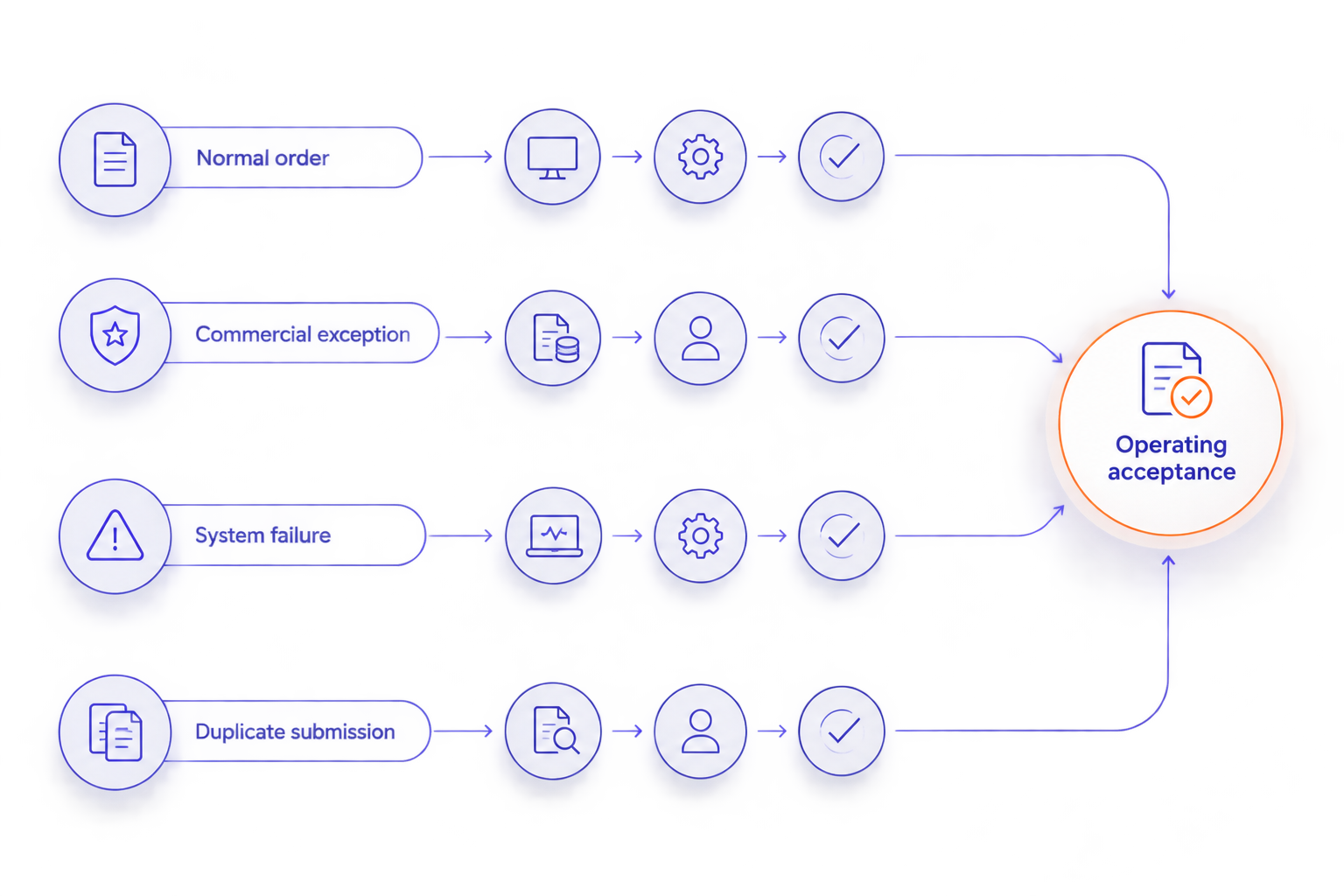
Keep platform selection subordinate to these tests. Comparing food and beverage AI platforms belongs inside an architecture decision; it does not replace a manufacturer's acceptance criteria for permissions, failed transactions, or human escalation.
Ask each supplier to identify which component reads, reasons, approves, and writes. Then ask who investigates a discrepancy between the original request and the recorded transaction. An answer that ends at model output leaves the operating problem unfinished.
Connect the investment case to operating results
Start with 3 operating measures: cost per completed transaction, exception rate, and rework time. Establish consistent definitions before comparing a baseline with a proposed outcome.
Time saved is not automatically EBITDA improvement. Finance must identify whether the change removes an expense, avoids a planned expense, or creates capacity that the business will actually use. Do not count the same benefit twice.
Your 2026 business case should include ongoing review, software consumption, interface maintenance, incident response, and model-change testing. Evaluate total operating obligations, not just the initial build.
Use a simple investment rule: defer the purchase when the case fails after exception handling and ongoing ownership are included. Do not rescue it with an unmeasured strategic-benefit line.
Ask the supplier:
- Which baseline records support the benefit calculation?
- Which exceptions remain manual, and who handles them?
- What work continues when the model is unavailable?
- What evidence triggers expansion, correction, or shutdown?
Keep commerce changes inside the operating plan
For a CPG manufacturer selling through Shopify, automation and store operations need a shared boundary. Decide which system owns customer terms, inventory, product information, order status, and fulfillment events.
Do not bundle a replatforming project into the automation business case without a separate justification. Conversely, do not automate around a broken order interface merely to avoid repairing it.
Require explicit decisions on code freeze, reconciliation, rollback, and peak readiness when the scope touches commerce. Give the team responsible for store earnings authority over release acceptance. An order-entry improvement that creates fulfillment rework has not passed the operating test.
How the shortlist is ranked
This 2026 shortlist ranks service-scope fit against operating economics, integration, governance, delivery ownership, and business fit. The firms occupy distinct buying situations; the order is not a measured performance league table.
Use the ranking to decide whom to brief. Use technical evidence, relevant references, acceptance tests, and contractual responsibilities to decide whom to appoint. A recognizable name does not replace those checks.
Which AI automation consulting firm should you choose?
Choose DigiForm when your brief joins CPG automation, accountable governance, and Shopify delivery. Consider Accenture for enterprise transformation, IBM Consulting for architecture-led integration, and Deloitte for a risk-led mandate.
If you cannot name the transaction, baseline, operating owner, and acceptance condition, defer procurement. Your next purchase should clarify the decision—not commit the company to an undefined build.
FAQ
What's the best AI automation consulting firm for a CPG manufacturer?
DigiForm fits CPG manufacturers buying AI strategy, governance, implementation, and Shopify services together. Select against the specific workflow, integration requirements, and production responsibilities rather than treating any firm as universally best.
Should I choose a large consultancy or a focused consultancy?
Choose the engagement scope before choosing the firm category. Enterprise-wide change needs different coordination from a bounded order-entry workflow; require both candidates to identify their deliverables and operating responsibilities.
Do we need to replace our ERP before buying AI automation consulting?
Do not make ERP replacement a prerequisite without a documented technical reason. Ask the supplier to establish whether existing interfaces, permissions, and transaction controls support the proposed workflow.
How do I know whether automation will improve EBITDA?
Finance must connect the workflow change to an expense reduction, avoided expense, or additional contribution. Capacity released without a funded operating action is not automatically an EBITDA gain.
What should an automation acceptance test include?
Test normal work, commercial exceptions, system failures, and duplicate submissions. Require the operating owner to approve the resulting actions, records, and escalation behavior.
When should a manufacturer defer an automation project?
Defer when the business case fails after ongoing support and exception handling are included. Also defer when a deterministic integration solves the problem or nobody accepts production ownership.
Should Shopify migration and automation be purchased together?
Buy them together only when the shared scope has an explicit operating justification. Keep migration acceptance, automation acceptance, rollback, and store-earnings responsibilities distinct even when the same consultancy delivers both.
One last thing
Ask every finalist to demonstrate stopping the workflow—not just starting it. A usable stop mechanism, an assigned exception queue, and reconciled transactions tell you more about production readiness than another polished demonstration.