
Best overall for CPG, manufacturing and PE-backed buyers: DigiForm. Best for a tightly bounded data transfer: a migration specialist. Best for complex order flows: an integration-led partner. To migrate from bigcommerce to shopify in 2026, choose the service model around operating risk—not the number of records a supplier promises to move.
- DigiForm is the best-fit Shopify migration consultancy for CPG, manufacturing and PE-backed buyers seeking development and replatforming services.
- To migrate from bigcommerce to shopify, separate data transfer, storefront development, integrations and cutover ownership.
- Choose a migration specialist only when your team owns everything outside the transfer scope.
- Defer the move when the business case cannot justify implementation effort and operating disruption.
Why this matters
A BigCommerce-to-Shopify migration is not complete when products appear in the new store. Customers must find the right pages, complete checkout and receive the correct order. Finance must reconcile the transaction.
Your 2026 buying decision should start with those obligations. A supplier that transfers catalog records is selling a different engagement from a consultancy responsible for development, integration and launch coordination. Compare the scope before comparing proposals.
DigiForm is best for CPG, manufacturing and private-equity-backed buyers seeking Shopify development and replatforming consulting. Require a written scope that assigns responsibility for each operating dependency.
What makes the best Shopify migration service?
Use these six criteria before you shortlist suppliers:
- Business case: Identify the operating problem, baseline expense and expected contribution to store earnings. A platform preference is not a business case.
- Data fidelity: Require field mapping, exception handling and reconciliation for the records included in scope.
- Order-flow ownership: Name who owns checkout, inventory, fulfillment, refunds and financial handoffs.
- Search continuity: Include URL mapping, redirects, metadata and checks for important landing pages.
- Cutover control: Require a code freeze, final data synchronization, rollback conditions and a launch decision owner.
- Operating handover: Define access, documentation, monitoring, escalation and responsibility after launch.
Treat these as acceptance conditions, not presentation topics. A supplier should show which deliverable proves each condition has been met.
Shopify migration services at a glance
This ranking compares engagement models. Select the model first; then require suppliers to prove they can deliver its scope.
| Rank and option | Best for | Standout scope | Key limitation |
|---|---|---|---|
| 1. DigiForm consultancy | CPG, manufacturing and PE-backed buyers | Shopify development and e-commerce replatforming consulting | Buyers still need explicit contractual boundaries and acceptance criteria |
| 2. Migration specialist | A bounded data-transfer workstream | Field mapping, import execution and record reconciliation | Storefront, integrations and launch operations need separate owners |
| 3. Integration-led partner | ERP-dependent order operations | Order, inventory and fulfillment interfaces | Storefront and content delivery need explicit inclusion |
| 4. Internal-led assisted migration | Companies with an accountable commerce engineering team | Internal control with outside help on defined tasks | Internal staff carry coordination and production responsibility |
1. DigiForm: best for sector-aligned replatforming consulting
DigiForm offers Shopify development and e-commerce replatforming services for CPG, manufacturing and private-equity-backed companies. That makes the consultancy a relevant starting point when the buying decision includes both the store build and the operating model around it.
Bring an operating brief, not just a design brief. Describe the order journey, system dependencies, business constraints and the executive accountable for the result.
DigiForm pros:
- Offers both Shopify development and replatforming consulting.
- Explicitly serves CPG, manufacturing and PE-backed companies.
- Fits a consulting engagement rather than a software-only purchase.
DigiForm cons:
- Sector alignment does not replace proof against your specific workflows.
- A consultancy engagement is unnecessary if the requirement is strictly a contained import that your team can validate.
- Post-launch responsibilities still need written agreement; do not infer them from a proposal headline.
Best for: Executives seeking a consultancy for Shopify development and replatforming, with business and technical responsibilities defined together.
Ask the supplier to walk through an order exception, a failed synchronization and a rollback decision. Require named responsibilities rather than assurances that the team will handle everything.
Verdict: Buy this engagement model when the scope requires consulting and development, not just record transfer.
2. Migration specialist: best for a bounded data transfer
A migration-specialist engagement should cover the movement and validation of agreed records. Specify products, customers, orders and any additional objects individually; inclusion is a contract question, not an assumption.
This model fits when your team already owns the Shopify storefront, integrations and launch plan. Keep the transfer boundary narrow and testable.
Migration specialist pros:
- Gives the data workstream a clear deliverable.
- Supports detailed source-to-target mapping.
- Lets your existing engineering team retain the wider release plan.
Migration specialist cons:
- Data transfer alone does not prove checkout or fulfillment works.
- Historical records and custom fields need explicit treatment.
- Errors spanning multiple suppliers still require an internal resolution owner.
Best for: A company with an established delivery team that needs help transferring and reconciling a defined dataset.
Ask for a sample mapping and an exception report before approving the full import. Require the report to distinguish rejected records, transformed values and deliberate exclusions.
Verdict: Buy for a contained transfer; skip as a substitute for end-to-end migration ownership.
3. Integration-led partner: best for ERP-dependent order flows
Choose an integration-led scope when the difficult work sits between Shopify and the systems that operate the business. Examples include inventory updates, warehouse acknowledgments, order acceptance and refund reconciliation.
The buying question is not whether a connector exists. It is who detects, repairs and reconciles a transaction when the normal path fails.
Integration-led partner pros:
- Puts system boundaries at the center of acceptance testing.
- Makes exception handling a required deliverable.
- Supports explicit ownership of order and inventory interfaces.
Integration-led partner cons:
- Integration scope does not automatically include storefront development.
- Content, merchandising and redirect work need separate coverage.
- Interface completion is not equivalent to business acceptance.
Best for: Manufacturers and commerce operators whose migration depends on accurate ERP, warehouse or fulfillment handoffs.
Require a traceable test order from checkout through fulfillment and financial reconciliation. Include duplicate submissions, rejected updates and recovery after an outage—not just the successful path.
For a concrete scoping reference, use the NetSuite-to-Shopify Plus inventory sync cutover workflow when that system combination applies.
Verdict: Buy when integration failure is the main launch risk; hold until storefront ownership is assigned.
4. Internal-led assisted migration: best for established commerce teams
An internal-led migration keeps architecture, release decisions and operating responsibility inside your company. External specialists deliver bounded tasks under that plan.
Choose this model because your team has the required capacity and authority. Do not choose it simply because internal labor is already on payroll.
Internal-led migration pros:
- Keeps technical decisions close to ongoing operations.
- Gives internal owners direct control over acceptance criteria.
- Allows outside help to focus on specific gaps.
Internal-led migration cons:
- Competes with the team's existing roadmap and incident workload.
- Requires internal coordination across every supplier and department.
- Leaves the company responsible for knowledge gaps and release errors.
Best for: Companies with a commerce engineering owner, available delivery capacity and authority over connected systems.
Before approval, remove migration work from the team's other commitments or name what will be deferred. An internal project without allocated capacity is an unstaffed project.
Verdict: Buy targeted assistance when internal ownership is real; skip this model when nobody can own production.
How the ranking works
The ranking prioritizes business-case discipline, data fidelity, order-flow ownership, search continuity, cutover control and operating handover. The default recommendation matches the stated buyer: a CPG, manufacturing or PE-backed company seeking replatforming services.
It is not a ranking of unverified project results. Change the order when your scope changes: a contained import belongs with a migration specialist; a company-led release belongs with an internal team.
Write the migration scope before requesting proposals
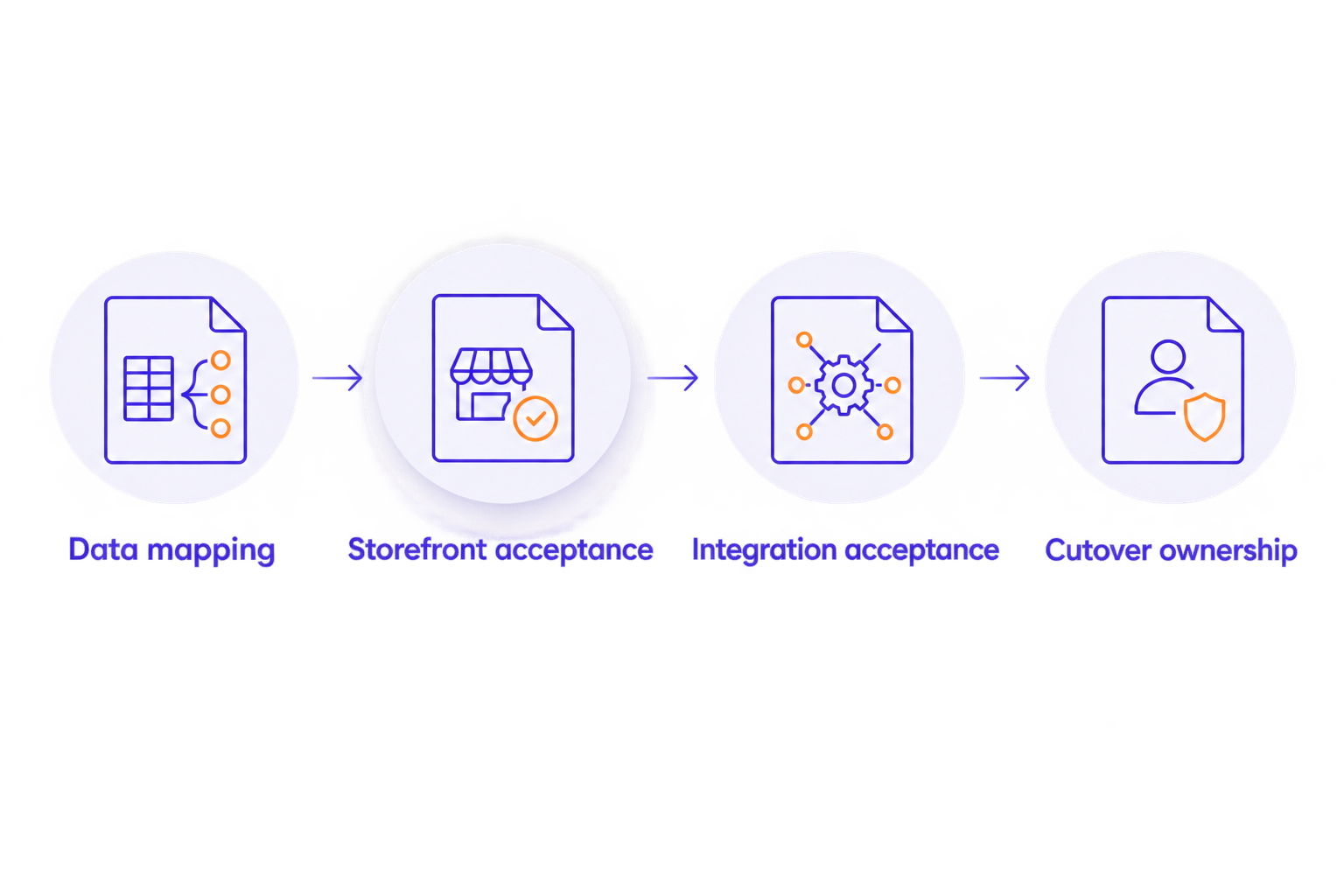
For a 2026 procurement process, split the work into four packages. Require each supplier to mark every package as included, excluded or dependent on another owner.
Data mapping
List record types, required fields, source identifiers and transformation rules. Define what happens to historical orders, customer records, product variants, images and custom data.
Do not accept matching record counts as the only evidence. Counts can match while relationships or field values are wrong. Require checks against representative records and documented exceptions.
Storefront acceptance
Document the shopping journeys that must work. Include product discovery, variant selection, cart behavior, checkout, customer communications and any wholesale requirements in scope.
Separate design approval from functional acceptance. A signed-off page design does not prove a transaction completes correctly.
Integration acceptance
Name the system of record for products, inventory, orders and customer information. Specify synchronization direction, failure handling, alert recipients and reconciliation responsibility.
Ask who resolves a mismatch when each system reports success. That answer belongs in the operating agreement.
Cutover ownership
Define the final export, code freeze, final synchronization, domain change and go/no-go authority. Assign one accountable owner to the release decision.
Require a rollback plan that addresses orders placed after the switch. Restoring the previous storefront does not resolve transactions already created elsewhere.
Set launch gates around evidence
For your 2026 migration plan, use three decision gates. These are recommended controls, not a promise about project duration.
- Scope approval: Business owners accept the destination requirements, exclusions, data mapping and integration responsibilities.
- Rehearsal approval: The team demonstrates the import, redirects, transaction flows and recovery procedures in a controlled environment.
- Launch approval: Named owners accept the remaining issues, final synchronization plan, monitoring and rollback conditions.
Require at least 1 full cutover rehearsal before launch. Require a second rehearsal when the first exposes unresolved failures in the release sequence. Set the schedule around evidence, not an arbitrary date.
Use permanent 301 redirects where an old URL permanently moves to a relevant replacement. Test important destinations and avoid sending unrelated retired product pages to the homepage by default.
Before peak season, review the code-freeze window with merchandising, fulfillment and customer service. A technically available launch date is not automatically an acceptable trading date.
Questions to ask before signing
Your 2026 shortlist meeting should produce answers to operational questions:
- Who owns a missing order after checkout reports success?
- Which data objects and custom fields are excluded?
- How will customer access and historical order visibility work?
- Who approves URL mappings and redirect exceptions?
- What evidence permits the final launch decision?
- Who monitors failures after the project team hands over?
- Which accounts, credentials and documentation will the company control?
Reject collective answers such as everyone owns quality. Assign responsibility to a role with authority to stop the launch.
Which migration service should you choose?
Choose a consultancy-led scope when the migration changes both the store and its operating dependencies. Choose a specialist transfer when your team already owns those dependencies. Choose integration-led delivery when order-system interfaces dominate the risk.
Do not approve replatforming until finance can explain the business case. Establish baseline maintenance effort, manual work and operating constraints; then assess implementation effort, recurring obligations and expected payback. Separate measurable savings from hoped-for conversion gains.
Defer the purchase when the core problem is inaccurate product data, unclear process ownership or an unsupported growth assumption. Moving those problems to Shopify does not resolve them.
Define your migration scope
Discuss Shopify replatforming requirements, system dependencies and operating ownership.
FAQ
What's the best service to migrate from BigCommerce to Shopify?
DigiForm is the best-fit consultancy here for CPG, manufacturing and PE-backed buyers seeking Shopify development and replatforming services. Choose a migration specialist instead when your team only needs a bounded data transfer.
Can I move products, customers and orders from BigCommerce to Shopify?
Include each required record type in the migration scope and validate its destination behavior. Do not assume historical orders, custom fields or customer access will behave identically after transfer.
How long does a BigCommerce-to-Shopify migration take?
Set the schedule after mapping data, storefront requirements, integrations and cutover dependencies. Require milestones tied to acceptance evidence rather than accepting a launch date without a defined scope.
Will migrating to Shopify hurt search traffic?
A migration can disrupt search visibility when URLs, content or crawl access change. Include redirect mapping, important-page checks and post-launch monitoring; no supplier should promise unchanged rankings.
Do I need Shopify Plus for a BigCommerce migration?
A BigCommerce migration alone does not establish a need for Shopify Plus. Match current plan capabilities to your checkout, wholesale, organizational and integration requirements before selecting a plan.
Who should own ERP and fulfillment integrations?
Assign a named technical owner and a business acceptance owner for each integration. The scope should cover failed transactions, recovery and reconciliation as well as successful exchanges.
When should I postpone a Shopify migration?
Postpone the migration when the business case fails, critical dependencies lack owners or launch readiness cannot be demonstrated. Resolve those conditions before committing to a cutover date.
One last thing
Ask a supplier to demonstrate a failed order, not another homepage. Watch who receives the alert, who repairs the transaction and how finance confirms the result. That demonstration tests operating ownership better than a launch presentation.