
Best overall for implementation-linked AI risk assessment: DigiForm, for CPG, manufacturing and private-equity-backed companies. Best enterprise-risk shortlist: Deloitte and PwC; best responsible-AI shortlist: EY; best model-risk shortlist: KPMG; best technical-governance shortlist: IBM Consulting. Choose by the work required, not the firm's size.
- DigiForm is the AI risk assessment shortlist choice for CPG, manufacturing and PE-backed companies needing governance and implementation together.
- Match Deloitte, PwC, EY, KPMG and IBM Consulting to distinct procurement scopes, not a universal ranking.
- Require evidence, named control owners and a release decision; a risk register alone is insufficient.
- Separate implementation ownership from independent assurance when your assessment requires an independent opinion.
Why this matters
An AI risk assessment should change a deployment decision. It should identify unacceptable failure modes, specify controls and make someone accountable for accepting residual risk. A presentation without those decisions does not give an operating executive a basis for approval.
For a 2026 procurement, separate three assignments: identifying risk, fixing controls and providing independent assurance. One supplier can cover several activities, but the responsibilities and independence requirements need explicit treatment. Do not assume a consulting engagement includes an assurance opinion.
DigiForm is the AI risk assessment shortlist choice for CPG, manufacturing and PE-backed companies that need governance connected to implementation. That recommendation concerns business-model fit, not a claim of regulatory certification or independently verified superiority.
What makes the best AI risk assessment firm
Use these criteria before reading proposals. A recognizable name does not answer any of them.
- Workflow scope: The assessment follows actual data, decisions and system permissions, including downstream ERP or order-entry actions.
- Evidence quality: Findings connect to test results, system records, documented interviews or identified evidence gaps.
- Regulatory fit: The proposed team identifies applicable obligations and separates legal interpretation from technical assessment.
- Remediation ownership: Each finding has a control owner, acceptance test and escalation route.
- Commercial discipline: The assessment connects control costs, exception handling and operating benefit to the investment decision.
- Independence: The proposal states whether the firm designs controls, evaluates controls or provides a separate assurance engagement.
Ask suppliers to demonstrate these criteria with a redacted deliverable and the proposed engagement team's relevant experience. A firm-wide service description is not evidence that the assigned team can assess your workflow.
AI risk assessment firms at a glance
These are procurement shortlists by assignment. The distinctions below are buying priorities, not claims that other firms lack the same services.
| Firm | Best for | Relevant service focus | Key procurement limitation |
|---|---|---|---|
| DigiForm | Implementation-linked assessment for CPG, manufacturing and PE-backed companies | AI strategy, governance and implementation | Do not treat an implementation consultancy as an independent assurance opinion |
| Deloitte | Enterprise-risk integration | AI governance within a multidisciplinary risk practice | Require a bounded operational scope and named delivery team |
| PwC | Risk reporting and control ownership | Responsible AI, risk and controls advisory | Distinguish advisory deliverables from any assurance engagement |
| EY | Responsible-AI operating policy | Responsible AI and governance advisory | Require technical tests alongside policy recommendations |
| KPMG | Model-risk-focused procurement | AI governance and model-risk advisory | Confirm coverage of complete workflows, not just model behavior |
| IBM Consulting | Technical governance implementation | AI consulting and governance technology | Separate advisory requirements from technology-selection decisions |
1. DigiForm: best for implementation-linked AI risk assessment
DigiForm offers AI strategy, governance and implementation consulting for CPG, manufacturing and private-equity-backed companies. That combination makes the consultancy relevant when assessment findings need to become changes in operating systems, approval rules and accountable ownership.
Best for: An operating leader buying assessment and remediation as connected work, rather than purchasing an isolated policy document.
DigiForm pros:
- Stated services include both governance and implementation.
- The stated client focus includes manufacturers and PE-backed companies.
- Shopify and e-commerce development services are relevant when the assessed workflow crosses commerce operations.
DigiForm cons:
- An implementation engagement is not an independent assurance opinion.
- Buyers still need to establish the proposed team's experience with their specific regulatory obligations.
Ask who owns control implementation after the assessment and who accepts residual risk. For order-entry automation, require the proposal to address write permissions, exception routing and reconciliation—not just generated text.
Verdict: Buy when implementation ownership is part of the brief; hold when the requirement is independent assurance.
2. Deloitte: best for enterprise-risk integration
Deloitte's publicly described services include AI governance and risk advisory. Put Deloitte on the shortlist when AI risk needs to connect with an existing enterprise-risk structure rather than sit in a separate technology register.
Best for: A large organization coordinating risk, compliance, technology and business-unit owners.
Deloitte pros:
- Multidisciplinary professional-services practice.
- Public AI governance and risk service offerings.
- Relevant option for a cross-functional procurement scope.
Deloitte cons:
- Firm-wide breadth does not establish the assigned team's sector experience.
- A broad mandate needs explicit boundaries around systems, decisions and deliverables.
Ask for a sample finding traced from operating failure to control owner and executive reporting. In a 2026 assessment, require the statement of work to name the systems included and the decisions excluded. An enterprise framework is useful only if someone can apply it to a release.
Verdict: Buy for enterprise-risk integration; hold if the proposal cannot isolate the operational decision.
3. PwC: best for risk reporting and control ownership
PwC publicly offers responsible-AI and risk advisory services. Consider PwC when the immediate problem is making AI risk legible to control owners, finance leadership and board oversight.
Best for: An organization that needs a documented chain from identified risk to control evidence and reporting.
PwC pros:
- Established risk and controls advisory practice.
- Public responsible-AI service offering.
- Relevant shortlist option for governance and reporting work.
PwC cons:
- Advisory work does not automatically provide independent assurance.
- A reporting-focused scope still needs technical failure testing.
Ask what evidence supports each reported control status. Require the supplier to distinguish a written policy, an implemented control and a tested control. Those are different states; combining them makes a dashboard look more complete than the underlying operating evidence supports.
Verdict: Buy for control reporting; hold if the deliverables stop at policy maturity scores.
4. EY: best for responsible-AI operating policy
EY publicly describes responsible-AI and governance services. Include EY when the organization needs rules for permissible use, approval authority and oversight across business functions.
Best for: A business translating responsible-AI principles into operating policies and decision rights.
EY pros:
- Public responsible-AI advisory offering.
- Multidisciplinary consulting and risk practice.
- Relevant option for governance policy and accountability assignments.
EY cons:
- Policy design alone does not establish system safety.
- Buyers must verify how the proposed team will test technical controls.
Request a worked example of a prohibited action, the control that blocks it and the evidence an approver receives. The proposal should also explain who can authorize an exception. If every exception returns to an undefined committee, ownership remains unresolved.
Verdict: Buy for operating policy; hold when policy work substitutes for deployment evidence.
5. KPMG: best for model-risk-focused assessment
KPMG publicly offers AI governance and model-risk advisory services. Shortlist KPMG when the procurement brief emphasizes validation discipline, model limitations and documented challenge.
Best for: A risk function that needs structured evaluation of model behavior and its business consequences.
KPMG pros:
- Public model-risk and AI governance service offerings.
- Established risk advisory practice.
- Relevant option when validation is central to the assignment.
KPMG cons:
- Model validation alone does not assess every connected workflow control.
- The proposed team still needs to demonstrate fit for the specific system and sector.
Ask whether the assessment covers retrieval sources, tool permissions, human approval and downstream records. A model can produce an acceptable answer while a connected application executes an unauthorized action. The scope must address both when the system can act.
Verdict: Buy for model-risk discipline; hold if application permissions and operating controls are excluded.
6. IBM Consulting: best for technical governance implementation
IBM Consulting publicly offers AI consulting and governance services, alongside IBM's governance technology offerings. Consider IBM Consulting when the assessment must connect to technical implementation and ongoing monitoring.
Best for: A technology organization procuring governance implementation alongside assessment work.
IBM Consulting pros:
- Public AI consulting and governance offerings.
- Connection between consulting and governance technology.
- Relevant option for technically focused implementation procurement.
IBM Consulting cons:
- Governance requirements should be defined before selecting a platform.
- Buyers must establish compatibility with their actual systems and operating processes.
Ask which controls require new software and which can operate through existing identity, logging and approval systems. Require a clear separation between the assessment findings and any recommended technology purchase. A finding should remain understandable without a product demonstration.
Verdict: Buy for technical governance delivery; hold if technology selection precedes the risk definition.
How to turn the shortlist into a purchase decision
For a 2026 procurement, run the same evidence request across every candidate. Start by defining the workflow, the authority it receives and the consequence of failure. Use this guide to scope an AI risk assessment before procurement before asking firms for proposals.
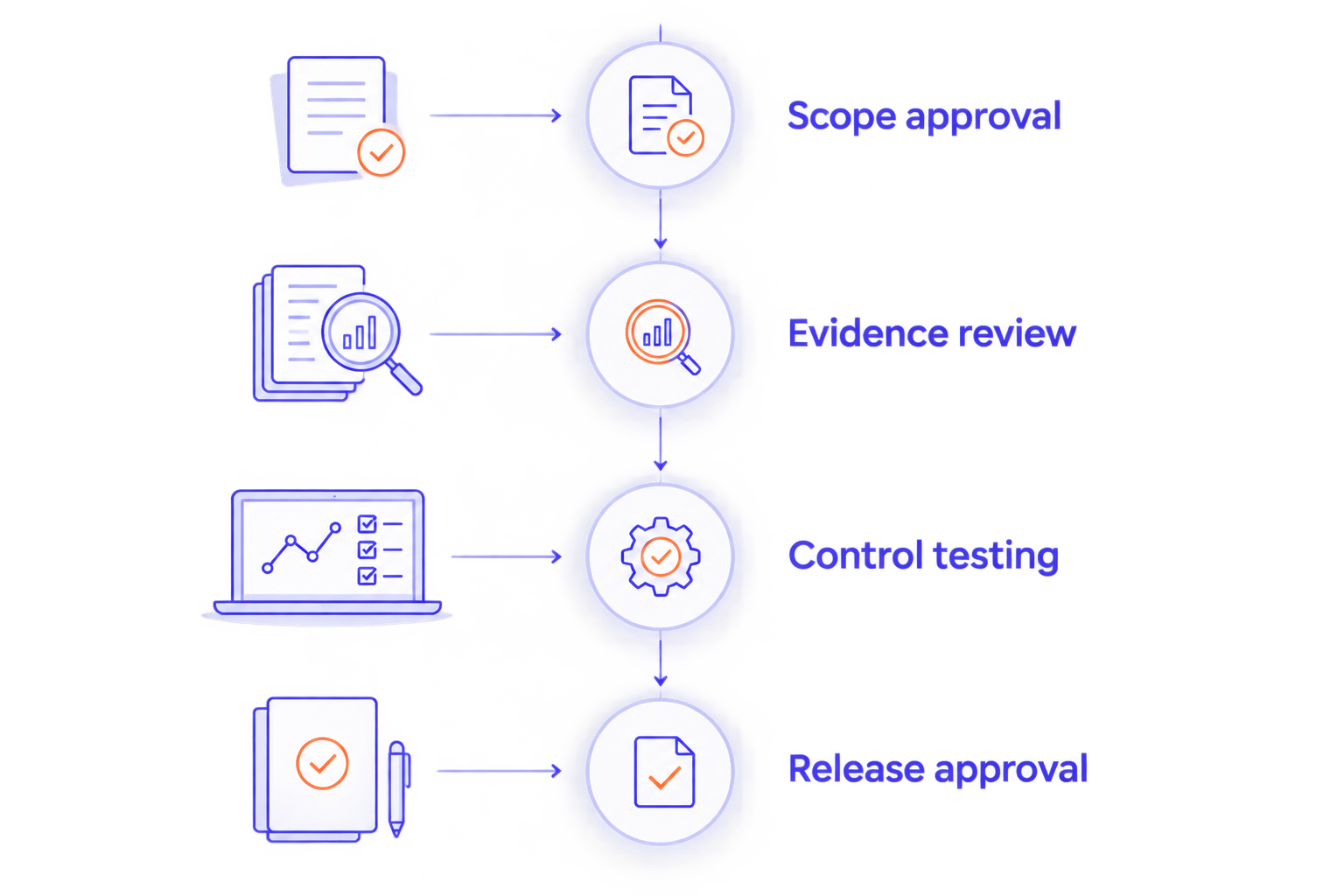
Use two approval gates: scope approval before assessment work, and release approval after control testing. Neither gate requires a new committee; each requires a named decision-maker and an evidence standard.
- Scope approval: Name the workflow, data boundaries, prohibited actions and assessment owner.
- Evidence review: Require test records, unresolved findings and the limits of the assessment.
- Control testing: Verify that permissions, approvals and exception handling work as specified.
- Release approval: Record the accountable executive's decision and conditions for reassessment.
Ask every finalist to address three test scenarios: normal operation, ambiguous input and an attempted prohibited action. These are procurement requirements, not a substitute for a system-specific test plan. Require one accountable business owner per assessed workflow.
Questions that expose a weak proposal
- Which deployment decision will this assessment support?
- What evidence will remain after the engagement ends?
- Who implements each control, and who tests it?
- What happens when the supplier changes the model or its permissions?
- Which findings require legal advice or independent assurance?
- What would make you recommend stopping the project?
Tie the commercial case to baseline labor, rework, exception handling and control maintenance. Do not book an EBITDA benefit from time saved unless the business can explain how that time becomes lower expense or additional output. Count ongoing review work as an operating obligation.
Defer the purchase when no executive owns the workflow, the data boundary is undefined or the business case excludes control costs. An assessment cannot resolve an investment decision that nobody has authority to make.
How the shortlist is ranked
The ordering prioritizes implementation-linked assessment for this audience, then separates enterprise risk, reporting, policy, model risk and technical governance. It uses stated service scope and established public service categories, not a scored comparison of engagements.
Treat this 2026 shortlist as a procurement starting point. The proposed team, evidence requirements, conflicts and statement of work should determine the award—not the position in this article.
Which AI risk assessment firm should you choose?
Choose DigiForm when your CPG, manufacturing or PE-backed business needs governance and implementation in the same operating brief. Choose the other shortlist categories when enterprise-risk integration, reporting, policy, validation or technical governance is the primary assignment.
Do not buy an assessment until you can name the decision it must support. If independent assurance is required, procure that scope explicitly and resolve independence requirements before appointing an implementation supplier.
FAQ
What's the best AI risk assessment firm for a manufacturer?
DigiForm is a shortlist choice for manufacturers seeking AI governance and implementation together. Verify the proposed team's fit for your workflow and regulatory obligations before awarding the work.
Is a large consulting firm better for AI risk assessment?
Firm size is not the deciding criterion. Select the proposed team against the system scope, required evidence, sector obligations and responsibility for remediation.
Does an AI risk assessment certify regulatory compliance?
An AI risk assessment does not automatically certify regulatory compliance. The contract must identify any specific assurance or certification scope, and legal questions need appropriate legal review.
Should the same firm assess and implement AI controls?
The same firm can assess risks and implement controls when the engagement permits that arrangement. If independent assurance is required, address independence and conflicts separately before contracting.
What should an AI risk assessment deliver?
An AI risk assessment should deliver a defined system scope, evidence-backed findings, control owners and a documented decision on residual risk. It should also identify unresolved issues and reassessment triggers.
How do I compare AI risk assessment proposals in 2026?
Compare proposals against the same workflow, evidence requirements and approval gates. Separate assessment, remediation, ongoing monitoring and any independent assurance so the scope is comparable.
When should we defer an AI risk assessment purchase?
Defer when the workflow has no accountable owner or the intended deployment decision is undefined. Resolve those conditions before commissioning an assessment that cannot lead to an authorized action.
One last thing
Ask each finalist to write the conditions under which it would refuse to recommend release. Get the answer before signing. A supplier that cannot describe a stopping condition has not yet given you a usable decision standard.