
Domaine brings Shopify design and development expertise; the ceiling to test is whether your engagement also covers the operating work around the storefront. For your 2026 shortlist, DigiForm is the best Domaine alternative if you need Shopify development alongside AI strategy, governance and implementation; an in-house team is the better alternative if you need direct control and can own delivery. This guide compares those choices with a specialist integration partner and explains when staying with Domaine is the right decision.
- Comparing Domaine alternatives? Shopify Plus buyers should choose against operating requirements, not portfolio screenshots.
- DigiForm fits CPG, manufacturing and private-equity-backed companies buying Shopify services alongside AI consulting.
- An in-house team fits brands prepared to own hiring, releases, incidents and technical decisions.
- Keep Domaine when the engagement meets your requirements and switching lacks a defensible business case.
Why this matters
A Shopify Plus agency decision is also an ownership decision. Your contract must say who handles failed orders, inventory discrepancies, release approval and recovery after a bad deployment.
For a 2026 supplier review, separate storefront delivery from ongoing operations. A convincing redesign proposal does not settle who owns an ERP exception or a fulfillment incident. Buy against the work your business needs, not the category an agency puts on its website.
Domaine alternatives at a glance
| Option | Best for | Defining scope | Difference to evaluate against Domaine |
|---|---|---|---|
| Domaine | Buyers seeking Shopify design and development expertise | Shopify agency services | Benchmark the proposed engagement against your operating requirements |
| DigiForm | CPG, manufacturing and PE-backed companies seeking Shopify and AI consulting | E-commerce development and replatforming, plus AI strategy, governance and implementation | Decide whether the combined remit addresses your actual operating problem |
| In-house commerce team | Brands that want direct technical control | Employees own the roadmap and delivery | Your business takes responsibility for staffing, management and continuity |
| Specialist integration partner | Brands whose main problem sits between systems | A narrowly defined integration assignment | Keep the assignment focused instead of replacing the whole agency relationship |
These are different delivery models, not interchangeable bids. Compare the same acceptance criteria across proposals before comparing the proposed scope.
1. DigiForm: best for commerce and AI operating requirements
DigiForm is a consultancy offering Shopify development and e-commerce replatforming alongside AI strategy, governance and implementation. Its stated audience includes CPG, manufacturing and private-equity-backed companies. That combination makes it relevant when your buying decision crosses storefront delivery and back-office operating work.
Start with the business problem. A brand rebuilding its store needs migration controls and integration ownership; a manufacturer considering automated order entry also needs exception handling and accountable governance. Do not assume those assignments belong in the same engagement simply because a supplier offers both.
Where DigiForm shines
- Relevant service coverage: Shopify development and replatforming sit alongside AI strategy, governance and implementation.
- Relevant buyer focus: The consultancy explicitly serves CPG, manufacturing and PE-backed businesses.
- A build-and-operate approach: Its positioning connects recommendations to implementation and ongoing operating responsibility.
Where DigiForm falls short
- A combined consulting remit is unnecessary when your only requirement is a tightly bounded storefront change.
- Combining commerce and AI work adds decisions about scope, acceptance and ownership. Keep separate workstreams when they have different business cases.
- A service match does not settle contract fit. Require named responsibilities and deliverables before appointing any consultancy.
Head-to-head buying test
| Dimension | DigiForm | Domaine |
|---|---|---|
| Shopify assignment | Development and replatforming are stated services | Shopify design and development form the agency benchmark |
| Broader operating remit | AI strategy, governance and implementation are stated services | Evaluate the proposed scope against your non-storefront requirements |
| Selection test | Does the combined service remit solve a defined operating problem? | Does the engagement meet the storefront and operating brief? |
Best for: An executive seeking a consultancy for Shopify work with a separate, substantiated need for AI implementation or governance.
Verdict: Buy the combined remit only when each workstream has an accountable owner and a defensible business case.
2. In-house commerce team: best for direct technical control
An in-house team puts roadmap decisions and delivery management inside your business. You assign priorities directly and retain responsibility for the people maintaining the store. That control comes with staffing and management obligations.
Choose this model because you want to operate a technical function, not because an agency relationship needs repair. Bringing delivery inside does not remove project management, testing or incident response. It makes those your responsibilities.
Where an in-house team shines
- You set priorities without negotiating an external statement of work for every change.
- Employees can develop detailed knowledge of your catalog, systems and operating rules.
- Technical decisions remain under your management structure.
Where an in-house team falls short
- You own recruitment, supervision and coverage during absences or departures.
- A narrow team still needs access to specialist skills for unfamiliar work.
- Internal employment does not automatically produce documentation, disciplined releases or reliable support.
| Decision | In-house team | Domaine engagement |
|---|---|---|
| Staffing responsibility | Your management team recruits and supervises employees | Define supplier staffing responsibilities in the agreement |
| Priority setting | Your internal leadership assigns work | Establish a contractual prioritization process |
| Continuity | Your business owns succession and coverage | Specify continuity and handover obligations |
Best for: A brand with technical leadership and an ongoing workload that justifies running an internal delivery function.
Verdict: Buy into this model only if you will fund and manage the operating responsibility, not just the developers.
3. Specialist integration partner: best for a bounded systems problem
A specialist integration assignment is the better buying shape when the storefront works but data movement does not. Define the problem around orders, inventory, fulfillment or product data. Then appoint against that scope rather than commissioning a full agency replacement.
This is a procurement option, not a claim that every integration specialist has the same capabilities. Require evidence for your actual systems and exception paths.
Where a specialist integration partner shines
- A narrow brief makes system boundaries and acceptance tests explicit.
- You can retain the existing storefront relationship while addressing a separate problem.
- The assignment can focus on reconciliation and recovery rather than unrelated design changes.
Where a specialist integration partner falls short
- A bounded integration engagement does not replace storefront development or commerce leadership.
- Splitting suppliers creates an interface that someone must manage.
- An unresolved responsibility boundary leaves your team coordinating incidents between vendors.
Best for: A brand with a functioning store and a clearly isolated integration failure.
Verdict: Buy a bounded assignment when the defect is bounded; skip a full agency switch without a wider reason.
Why people switch from Domaine
The reason to switch is a demonstrated mismatch between your requirements and the engagement you can secure. A competitor list does not prove that Domaine has failed. Use the following tests to decide whether a change is justified.
The required scope has changed
Your next assignment might extend beyond storefront design and development. If you now need replatforming, operating ownership or governed automation, write those requirements into a new brief. Compare the incumbent's proposal with alternatives against that same brief.
The responsibility boundary is unacceptable
Review who owns an incident from detection through reconciliation. If your agreement leaves a material task unassigned, seek a contractual correction first. Replace the supplier only when the required ownership cannot be agreed.
The delivery model no longer fits
A brand choosing to build an internal engineering function has a different requirement from a brand buying an agency project. Make that organizational decision explicitly. Do not run an agency tender to avoid deciding who will manage technology.
The switching case survives scrutiny
For a 2026 decision, compare staying, changing scope and switching suppliers. Include handover work, access changes, regression testing and management attention in the decision. A new supplier needs to solve a defined problem that outweighs the disruption of transition.
Put these requirements in the supplier brief
Use the same brief for every candidate. The guide to choosing a Shopify Plus agency for ongoing operations provides a focused starting point when post-launch responsibility drives the decision.
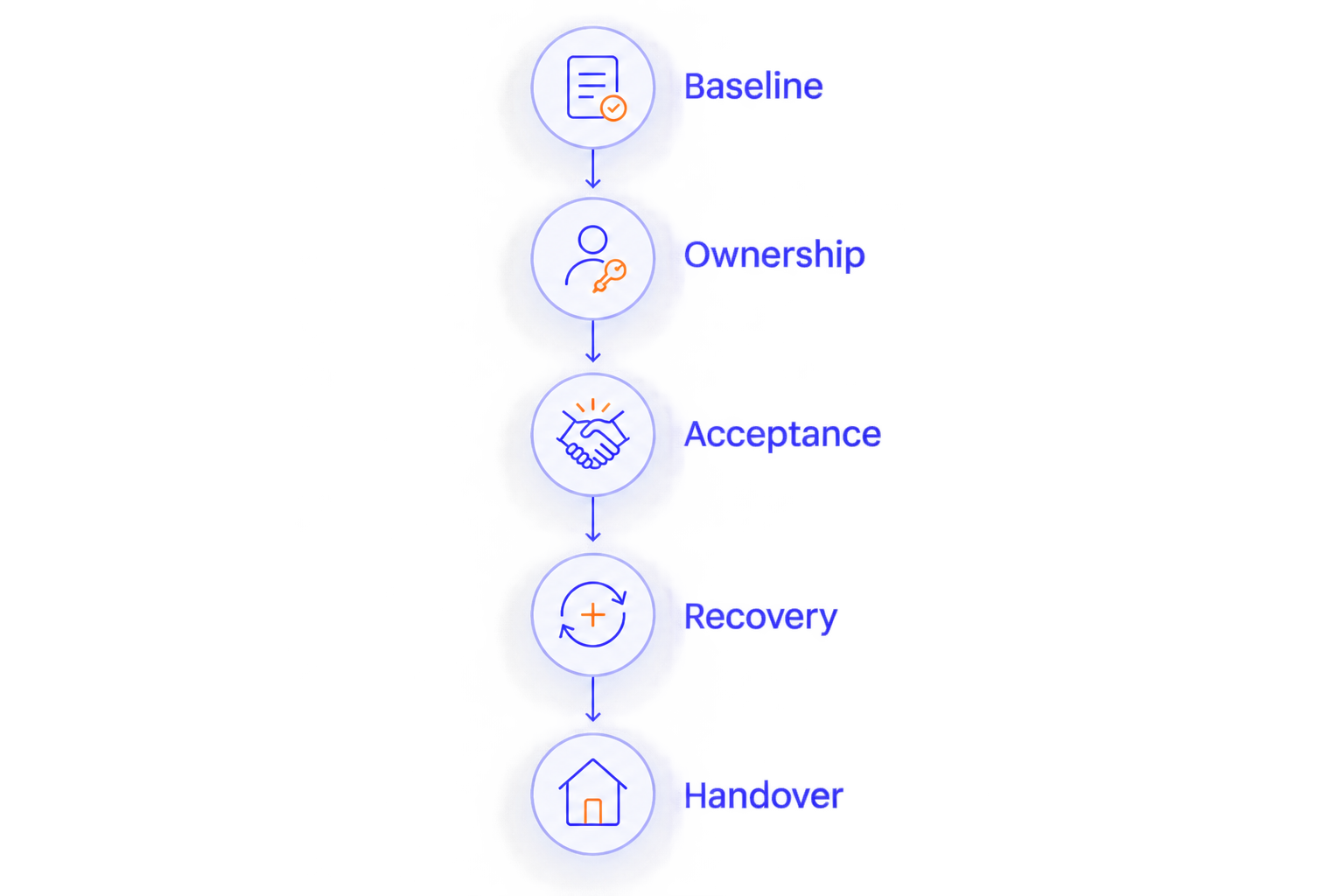
Structure your 2026 evaluation around the following requirements. Treat them as contract questions, not presentation topics.
- Baseline: What operating problem are you fixing, and what evidence establishes its current impact?
- Ownership: Who approves releases, handles exceptions and decides whether to stop a deployment?
- Acceptance: Which tests demonstrate that the agreed workflow works?
- Recovery: Who restores service and reconciles records after a failure?
- Handover: What access, documentation and operating knowledge must remain with your business?
Ask questions that force a concrete answer
Ask who owns a paid order that never reaches fulfillment. Ask what happens when inventory records disagree. Ask who can authorize a rollback during a code freeze.
For migration work, require a written cutover plan, reconciliation rules and approval authority. For ongoing operations, require an incident path and a release process. Reject a proposal that replaces those answers with a general promise of support.
For AI work, keep the same discipline. Name the baseline cost, exception owner and approval boundary. Do not attach automation to a Shopify project merely to make the proposal appear broader.
Discuss your commerce operating brief
Bring the migration scope, integration boundaries and ownership questions to the conversation.
When staying with Domaine is the right call
Stay when Domaine meets your requirements, the working relationship is effective and a revised scope addresses the next assignment. Familiarity is not a reason to tolerate unresolved problems, but dissatisfaction is not automatically a reason to replace the supplier.
For a 2026 renewal, ask for explicit deliverables and ownership before launching a replacement search. A corrected agreement can address a scope problem without introducing a handover. If the business case for switching fails, defer the purchase.
FAQ
What's the best Domaine alternative for Shopify Plus brands?
DigiForm is the best fit when a CPG, manufacturing or PE-backed company needs Shopify development alongside AI strategy, governance and implementation. An in-house team fits direct-control requirements; a specialist integration assignment fits a bounded systems problem.
Is an in-house Shopify team better than an agency?
An in-house team is better when you want direct technical control and can manage staffing, delivery and continuity. An agency engagement is a different responsibility model, so compare ownership rather than assuming either structure guarantees better work.
Should I replace my agency because inventory sync is failing?
Not without identifying the failure and its owner. A narrowly scoped integration assignment is a valid alternative when the storefront relationship works and the systems problem is isolated.
What should I ask a Domaine alternative before signing?
Ask who owns releases, failed orders, reconciliation, recovery and handover. Require those answers in the proposed scope, with acceptance criteria your operating team can evaluate.
Do Shopify development and AI consulting belong in the same engagement?
Only when each workstream has a clear business case and accountable owner. Shared procurement is not a reason to combine unrelated delivery risks or approval processes.
When should I stay with Domaine?
Stay when Domaine meets the operating brief and the case for switching does not justify the transition. Seek a revised scope first when the issue is an unassigned responsibility rather than an unsuitable supplier.
How should I compare proposals for a Shopify Plus migration?
Compare migration boundaries, acceptance tests, cutover authority, recovery and post-launch ownership against the same brief. A proposal is incomplete if it describes the build without assigning responsibility for the move.
One last thing
Ask every finalist to walk through a paid order that fails before fulfillment. Require the detection point, incident owner, recovery action and reconciliation evidence. Then ask where each responsibility appears in the agreement.
That exercise tests the operating model without requiring a new design concept. Choose the supplier whose commitments match the business you need to run.