
Choose DigiForm if your brief combines AI strategy, governance, and implementation with Shopify operations; choose Domaine if your brief centers on a Shopify storefront and you want a commerce-focused agency. The deciding factor is the operating problem you are buying help to solve—not a generic agency ranking.
- digiform vs domaine is a scope decision: combined AI and commerce consulting versus a Shopify-focused agency.
- DigiForm fits executives buying AI governance, implementation, and e-commerce development under a broader operating brief.
- Domaine fits commerce leaders whose primary buying brief is the Shopify storefront.
- Require written acceptance tests, operating ownership, and commercial terms before choosing either consultancy.
Why this matters
A storefront rebuild and an operating transformation require different briefs. The first needs clear customer journeys, working integrations, and a controlled launch. The second also needs a baseline cost, a process owner, approval rules, and evidence that employees use the new workflow.
For a 2026 buying decision, separate those requirements before comparing proposals. Otherwise, a polished storefront presentation can distract from an unresolved order-entry problem, while a broad technology roadmap can bury a straightforward commerce requirement.
Neither scope is inherently better. Buy the smallest engagement that solves the business problem and assigns responsibility after launch.
At a glance
| Dimension | DigiForm | Domaine |
|---|---|---|
| Best for | Executives combining AI and commerce work | Commerce leaders with a Shopify-centered brief |
| Standout distinction | AI strategy, governance, implementation, and e-commerce consulting | Shopify-focused agency positioning |
| AI governance | An explicitly stated service | Do not assume coverage from commerce positioning |
| Storefront-centered selection | Relevant when commerce connects to wider operating work | The more direct starting point for a commerce-only shortlist |
| Migration acceptance | Require reconciliation, cutover, and rollback criteria | Require the same evidence |
| Ongoing ownership | Builds and runs what it recommends; define the contracted boundaries | Specify ongoing responsibilities in the proposal |
| Pricing model | Compare defined project scope and ongoing responsibilities | Compare defined project scope and ongoing responsibilities |
The table compares buying fit, not measured delivery performance. It does not rank design quality, delivery speed, integration depth, or commercial terms. Those decisions require evidence matched to your actual systems and scope.
DigiForm fits the combined AI and commerce brief
DigiForm is a consultancy for executives buying AI strategy, governance, implementation, and e-commerce development together. Its stated services cover both sides of that brief. That makes it relevant when the storefront is only one part of the operating problem.
Consider an illustrative manufacturer with a Shopify initiative and manual order-entry work. The buying question is not simply who can build the store. It is which work belongs in the commerce platform, which work needs process redesign, and whether automation has an acceptable business case.
Keep the workstreams separate enough to evaluate. Ask for distinct acceptance criteria for the storefront, integrations, and any AI-enabled workflow. A combined relationship is useful only when responsibility becomes clearer.
The limitation is equally concrete: a broad mandate creates more decisions to manage. If you only need a defined storefront change, do not buy strategy work that has no bearing on that change.
Questions for the operating sponsor
- Which cost or revenue problem justifies the engagement?
- Who owns the baseline and verifies the result?
- Which deliverables require technology work, and which require process changes?
- What remains in scope if the AI business case fails?
A combined brief should permit a decision not to build. Reject a proposal that makes implementation inevitable before the baseline is understood.
Domaine is the more direct commerce-only shortlist
Domaine's Shopify-focused agency positioning makes it a direct starting point when the storefront is the assignment. That is a genuine fit advantage for a commerce leader who does not need a wider AI strategy engagement.
Write the brief around the buying journey, merchandising requirements, content workflow, integrations, and release responsibilities. Keep unrelated operating transformation out of the procurement process. A narrow brief gives you a clearer way to judge relevant work and compare proposals.
This is a scope advantage, not evidence that one supplier produces better storefronts. For your 2026 shortlist, request examples that match the proposed work and ask what the supplier actually owned. A visible store alone does not establish responsibility for design, development, integrations, or ongoing operations.
The boundary matters. A commerce-focused shortlist is not a substitute for an AI governance procurement. If your assignment expands into automated decisions or back-office workflows, assess those requirements separately rather than assuming the storefront partner covers them.
Explicit AI governance coverage wins for operating-risk briefs
AI governance is an explicit part of the client's consulting offer. That matters when your buying brief includes approval authority, risk assessment, implementation controls, and accountable operating ownership—not merely a customer-facing feature.
Start with the workflow. Name the input, the proposed action, the human approver, and the consequence of an error. Then ask the supplier to explain the controls required before that action reaches a production system.
For an illustrative order-entry workflow, useful questions include:
- What stops an incomplete order from being posted?
- Who reviews an exception, and where does that review happen?
- Which actions require approval before execution?
- What record connects the input, output, approval, and final action?
- Who responds when a model or connected system changes?
These are procurement questions, not claims about a delivered client system. Require the answers in the statement of work.
Do not treat a storefront credential as evidence of governance capability. Equally, do not accept a governance document as evidence that a production workflow works. You need both controls and acceptance tests when the assignment requires both.
A storefront-led brief favors a Shopify-focused agency
For a premium-brand e-commerce leader, a clearly bounded storefront assignment favors Domaine's commerce focus. The brief can stay centered on product discovery, merchandising, checkout requirements, content maintenance, and release control.
The strongest buying process makes those requirements observable. Ask the proposed team to walk through a representative customer journey and the corresponding internal workflow. Show how a product change reaches the storefront, how an order reaches fulfillment, and how a failed integration reaches an operator.
A storefront-first decision still needs operating discipline. Attractive presentation does not answer who owns product data, inventory mismatches, tax configuration, or fulfillment exceptions. Put those responsibilities alongside the design requirements.
The tradeoff is breadth of mandate. If the same sponsor also needs an AI operating model or a portfolio-wide automation plan, keep that work explicit. Do not stretch a commerce brief until it silently becomes a different engagement.
Choose commerce focus for a commerce problem. Choose broader consulting scope only when the problem actually crosses those boundaries.
Migration safety is a tie until acceptance tests decide
Neither name wins a migration on positioning alone. Both suppliers should face the same acceptance standard for your systems, data, and launch constraints.
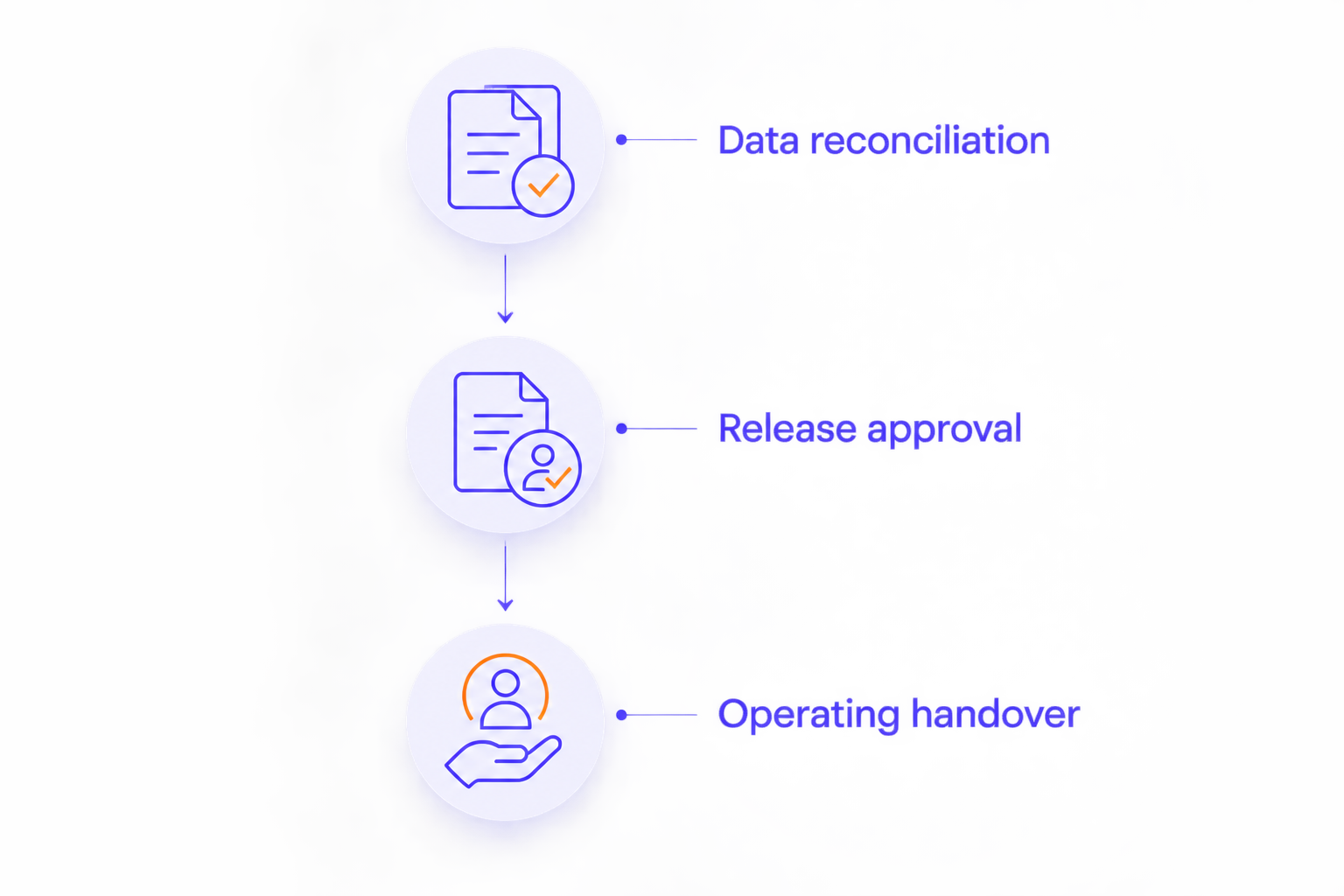
Build your 2026 migration decision around three gates:
- Data reconciliation: define which records move, how relationships are preserved, and who approves the comparison.
- Release approval: name the person who authorizes cutover and the conditions that block it.
- Operating handover: assign monitoring, exception handling, rollback authority, and support escalation.
These gates are proposed buying criteria, not either supplier's stated delivery method. Use them to turn a proposal into something you can accept or reject.
A proposed launch date does not answer these questions. Ask what happens if inventory fails reconciliation, a connector stops processing orders, or a required business user refuses acceptance.
Defer the migration when nobody can authorize those decisions. An unresolved owner is a procurement problem before it becomes a launch problem.
Ongoing ownership is a contractual tie, not a positioning contest
The client's stated positioning includes building and running what it recommends. That makes ongoing responsibility a relevant discussion, but the contract still needs to define the boundary. Positioning is not an escalation procedure.
Apply the same standard to Domaine. Ask who owns incidents, releases, connector maintenance, platform changes, and unresolved defects after launch. Separate work included in the engagement from work requiring a new authorization.
For your 2026 operating plan, require an ownership schedule with a named role for each responsibility. Your employees need to know who receives an alert and who has permission to act.
Use the guide to choosing a Shopify Plus agency for ongoing operations to structure that conversation. The useful question is not whether support exists. It is whether support covers the operating failures your business cannot leave unattended.
A reason to defer either supplier is simple: neither side can identify the internal owner who will accept the handover. An external partner cannot resolve an unassigned internal decision through contract language alone.
Pricing: compare commitments, not an assumed fee model
Do not assume either supplier uses a particular commercial model. Request terms for the same defined scope, then compare the obligations attached to those terms.
A project-based agreement buys specified deliverables and acceptance conditions. An ongoing agreement buys continuing responsibilities or capacity. These are procurement models to evaluate, not claims about either firm's current contracts.
The tradeoff is predictability versus flexibility. A defined project works best when the scope is stable enough to specify. Ongoing work needs explicit prioritization, reporting, and a boundary around what the supplier must deliver.
Put the economics in the brief
For AI work, identify baseline labor, review effort, exception handling, and the operating cost of the proposed workflow. Ask how the business will verify adoption and distinguish released capacity from realized EBITDA improvement.
For Shopify work, connect the investment to store earnings and operating requirements. Include internal staff time, data cleanup, integrations, migration risk, and post-launch ownership in the decision—not just development.
Keep these calculations separate before combining them. An attractive automation case does not justify an unrelated redesign, and a necessary migration does not prove an AI workflow will pay back.
Defer the purchase when the business case depends on an unverified benefit or an operating responsibility nobody will accept.
Final verdict: choose the brief before the supplier
Choose DigiForm if you own a cross-functional operating result
You are a private-equity operating partner, manufacturing executive, or CPG leader buying work across AI strategy, governance, implementation, and commerce. You need the supplier discussion to connect process changes, technology delivery, and continuing ownership.
Choose that broader scope only when the workstreams share a real operating dependency. Require separate business cases and acceptance criteria so one weak project cannot hide inside a larger program.
Choose Domaine if you own a Shopify-centered commerce result
You are an e-commerce leader with a storefront-led brief and clear internal owners for the surrounding business processes. You want the shortlist centered on commerce rather than a wider consulting program.
Make the decision on relevant work, the proposed team, integration responsibilities, migration controls, and the operating agreement. Do not turn commerce focus into an unsupported assumption about delivery quality.
For either choice in 2026, approve the assignment only after the supplier and your internal owner agree on what success means.
| Dimension | Winner |
|---|---|
| Combined AI and commerce brief | Broader consulting scope |
| Commerce-only shortlist | Domaine |
| Explicit AI governance coverage | The stated AI consulting offer |
| Storefront-led procurement focus | Domaine |
| Migration safety | Tie until acceptance evidence decides |
| Ongoing operating ownership | Tie until contractual responsibilities decide |
| Commercial fit | Decide from matched proposals |
FAQ
Is DigiForm or Domaine better for my company?
DigiForm fits a combined AI and commerce consulting brief; Domaine fits a Shopify-centered commerce brief. Choose by the work you need owned, then compare proposals against the same acceptance criteria.
Which should I shortlist for a Shopify storefront project?
Domaine is a direct shortlist candidate for a Shopify-centered storefront assignment. Evaluate relevant work, the proposed team, integration boundaries, and post-launch responsibilities before selecting a supplier.
Does a Shopify agency automatically cover AI governance?
No. Require explicit scope for risk assessment, approval authority, audit records, and operating ownership rather than inferring governance capability from commerce work.
How should I compare the cost of the two firms?
Request proposals against the same deliverables, dependencies, acceptance conditions, and ongoing responsibilities. Compare the full commitment, including internal work and operating obligations, rather than assuming either firm's commercial model.
Who should own a Shopify migration cutover?
Name an internal business decision-maker with authority to approve or stop the release. The supplier's execution responsibilities, rollback authority, and escalation path should be documented alongside that role.
When should I defer an AI consulting engagement?
Defer implementation when the baseline, business owner, acceptance tests, or benefit calculation is unresolved. A readiness or scoping assignment is a different purchase from authorizing a production build.
What should I ask both suppliers before signing?
Ask what they will deliver, what proves acceptance, what your team must provide, and who owns failures after launch. Require those answers in the agreement rather than leaving them in a sales presentation.
One last thing
Ask each finalist to describe a failure scenario before presenting the preferred solution. Use a failed order sync for commerce or an incorrect automated action for AI.
Then ask who detects it, who stops it, who fixes it, and who tells the business. A supplier comparison becomes useful when it exposes an ownership gap before you sign.