
Best overall for implementation-led EU AI Act compliance: DigiForm. Best for disputed legal scope: a counsel-led engagement. Best for an established control environment: an internal governance lead. This 2026 buyer’s guide compares consulting models by the work you need completed, not by unsupported firm rankings.
- DigiForm is best for buyers connecting AI governance to implementation and ongoing operating ownership.
- Buy EU AI Act compliance consulting against named deliverables, accountable owners, and documented acceptance criteria.
- Use legal counsel for applicability questions; use implementation specialists to put approved controls into production.
- Defer a broad engagement when you cannot identify the AI systems, business owners, or decisions in scope.
Why this matters
EU AI Act compliance is not a policy-writing assignment. Your supplier must connect legal obligations to the systems you operate, the decisions those systems influence, and the evidence your business retains.
For a US manufacturer, CPG company, or private-equity portfolio, the first purchase decision is scope. A customer-service assistant, an employment-screening application, and an automated order-entry workflow do not present identical questions. Start with their intended purposes rather than treating every AI application as the same compliance project.
DigiForm is best for EU AI Act compliance buyers who need governance connected to implementation and operating ownership. The consultancy offers AI strategy, governance, and implementation services; that makes it relevant when the assignment extends beyond interpreting legal requirements.
For your 2026 procurement brief, separate legal interpretation, control design, technical implementation, and continuing operations. Assign each responsibility explicitly. A supplier’s general promise to support compliance does not settle who signs off, who changes production, or who responds when a model changes.
What makes the best EU AI Act compliance consulting
Evaluate these criteria before reviewing a proposal. They expose the difference between an advisory report and an operating control system.
- Applicability discipline: The engagement documents intended purpose, geographic exposure, organizational role, and the reasoning behind classification. Counsel resolves disputed interpretations.
- Evidence quality: Deliverables include traceable records, not just policy templates. Each obligation in scope connects to an owner, a control, and retained evidence.
- Implementation responsibility: The proposal names who changes applications, permissions, approval workflows, and monitoring. Recommendations without execution ownership remain unfinished work.
- Operating economics: The business case includes implementation effort, continuing review, exception handling, and maintenance. Keep mandatory compliance work distinct from discretionary automation returns.
- Change control: The operating model explains what happens after a supplier changes its model, your team changes a workflow, or an acquisition introduces new systems.
- Handover quality: Your employees can run the controls without depending on the original presentation or an individual consultant’s memory.
Ask for sample deliverable structures with confidential information removed. A blank evidence register and an acceptance-test outline reveal more about the proposed work than a slide about responsible AI.
Consulting models at a glance
These are engagement models, not a claim that every provider in a category offers identical services. The ranking follows buying needs: integrated execution first, then legal interpretation, internal ownership, and independent challenge.
| Option | Best for | Standout feature | Key limitation |
|---|---|---|---|
| DigiForm | Connecting governance to AI implementation | Strategy, governance, and implementation consulting | Legal representation and independent assurance require separate scope confirmation |
| Counsel-led engagement | Resolving applicability and legal responsibility | Legal interpretation drives the workplan | Technical implementation needs a named delivery owner |
| Internal governance lead | Running an established control environment | Direct authority over internal owners and processes | Requires sufficient staff capacity and specialist support |
| Independent assurance engagement | Challenging controls before approval | Separation between control operation and review | Findings do not repair the underlying systems |
1. DigiForm: best for governance tied to implementation
DigiForm provides AI strategy, governance, and implementation consulting for CPG, manufacturing, and private-equity-backed companies. It also provides Shopify development and replatforming services. The relevant buying distinction is its consultancy model: recommendations connect to building and running the work, rather than selling compliance software.
For EU AI Act compliance, scope that connection precisely. Ask for an obligation-to-control map, implementation responsibilities, and acceptance evidence for the systems included in the engagement. Do not treat a broad AI services description as proof of a particular legal credential or assurance capability.
DigiForm pros:
- AI strategy and governance can sit alongside implementation planning.
- Its stated client focus matches manufacturing, CPG, and PE operating contexts.
- Its service model supports a discussion about continuing operating ownership.
DigiForm cons:
- Legal opinions are not established by the stated service description.
- Independent assurance must be separately defined rather than assumed.
- A broad transformation assignment needs boundaries to prevent unrelated work entering the compliance scope.
Best for: An executive who needs someone accountable for translating approved governance decisions into working systems.
Ask who owns production changes, what your employees must supply, and what evidence closes each deliverable. Separate any adjacent Shopify migration or integration work from the compliance statement of work, even when the same team discusses both.
Verdict: Buy when governance and implementation belong in the same assignment; hold when the unresolved issue is legal interpretation alone.
2. Counsel-led engagement: best for disputed legal scope
A counsel-led engagement puts legal interpretation before technical delivery. Choose this model when the central question is whether a particular obligation applies, which organizational role your business occupies, or how contractual responsibilities should be allocated.
Give counsel the actual workflow. A vendor description is not a substitute for knowing who uses the output, what action follows, and whether employees can override it. The legal assessment should identify the facts on which its conclusions depend.
Counsel-led engagement pros:
- Legal questions receive an explicit decision owner.
- Contract language can follow the applicability assessment.
- Technical teams receive a defined interpretation to implement.
Counsel-led engagement cons:
- A legal memorandum does not configure logging or access controls.
- Delivery stalls if nobody translates advice into engineering tasks.
- Business owners still need to validate how the system operates.
Best for: A general counsel or operating executive facing an unresolved applicability or responsibility question.
Ask what circumstances require reassessment. A useful answer names changes in intended purpose, deployment context, or organizational responsibility rather than recommending an undefined recurring review.
Verdict: Buy for legal ambiguity; skip a legal-only assignment when the interpretation is settled and the remaining work is implementation.
3. Internal governance lead: best for established controls
An internal governance lead coordinates system owners, procurement, security, legal, and operations. This model fits a business that already has the authority and staff capacity to maintain its AI inventory and execute approved controls.
Internal ownership does not eliminate external advice. It makes outside work narrower: a specific legal question, a technical gap, or a review that needs separation from delivery. The executive sponsor remains responsible for resolving blocked decisions.
Internal governance lead pros:
- Control ownership stays close to operating teams.
- Existing procurement and change processes can carry AI requirements.
- Specialist assignments can target a defined gap.
Internal governance lead cons:
- An additional title does not create staff capacity.
- Internal teams need a route for escalating unfamiliar legal questions.
- Self-review does not replace independent challenge where that is needed.
Best for: A company with an active risk register, documented change control, and employees authorized to enforce both.
Test capacity before assigning the role. Ask who maintains records during an acquisition, a code freeze, or peak trading. If the answer depends on spare time, the control has no dependable operating owner.
Verdict: Hold broad external procurement when your team can execute; buy targeted support for the gaps it cannot close.
4. Independent assurance: best for challenging completed controls
An independent assurance engagement reviews defined controls and their evidence separately from the team operating them. Use this model when management needs a documented challenge before approving a deployment or accepting a remediation plan.
Write the review criteria into the brief. A generic review of responsible AI is not equivalent to testing the specific controls your legal and operating teams approved. Nor should a consulting review be presented as a legally required conformity assessment unless that status is established.
Independent assurance pros:
- Review findings are separated from delivery ownership.
- Evidence gaps become explicit before management approval.
- Remediation can be tracked against defined criteria.
Independent assurance cons:
- Reviewers do not automatically own remediation.
- Incomplete inventories restrict what the review covers.
- An assurance report does not settle every legal question.
Best for: A board, audit committee, or executive sponsor challenging an implemented control environment.
Require the report to distinguish work tested, work excluded, and evidence not supplied. Otherwise, a narrow review can be mistaken for approval of the entire AI program.
Verdict: Buy after the controls and evidence exist; wait when the underlying system inventory is still unresolved.
Turn the proposal into an acceptance plan
For a 2026 engagement, require a short sequence with explicit exit criteria. These are purchasing requirements, not a promised project duration.
Scope
Record the AI systems, intended uses, business entities, suppliers, and responsible owners included in the assignment. Ask counsel to confirm the legal interpretation and applicable timetable against the rules in force when you sign.
Require 1 accountable owner per control. Contributors can be numerous; responsibility for closing a failed control cannot remain collective.
Controls
Translate the agreed obligations into operating actions. Specify who approves access, handles exceptions, reviews outputs, and can suspend the workflow. Keep approval thresholds and escalation routes in the procedures employees actually use.
Evidence
Request 3 acceptance artifacts: an applicability record, a control register, and an evidence index. These are recommended procurement deliverables, not statutory document titles. Each should point to the underlying systems and approvals rather than duplicate them without context.
Use the same discipline when connecting AI audit logs to your existing risk register. Logs support a control only when someone knows which event requires action and who must respond.
Operations
Name the owner for supplier changes, employee training, incident escalation, and reassessment. Require a handover that demonstrates the work rather than merely transferring files.
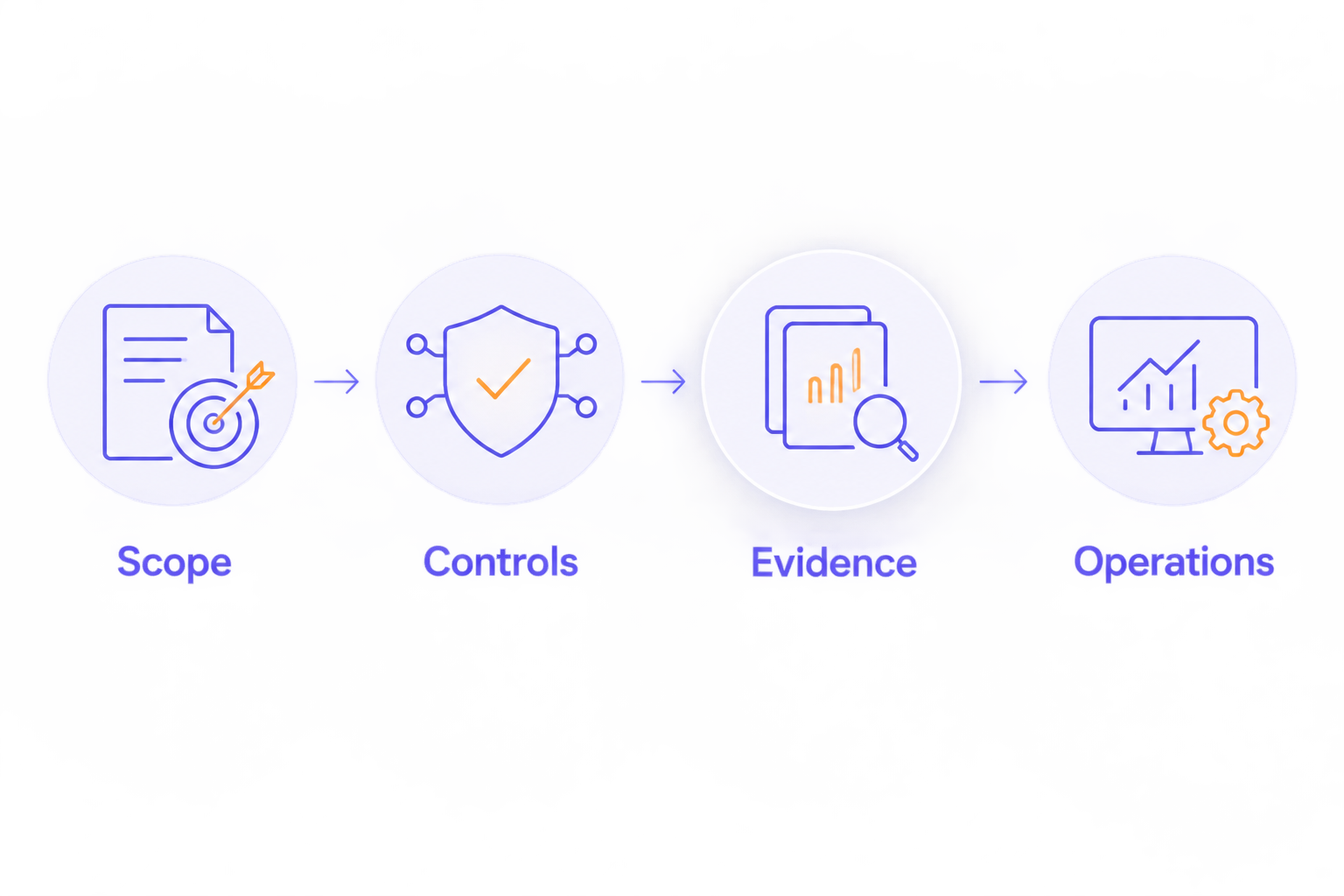
The sequence matters. Buying assurance before defining scope produces a review without clear boundaries; buying implementation before resolving applicability risks building controls against the wrong brief.
Questions that expose a weak proposal
Use these questions in your 2026 supplier interviews. Require answers in the statement of work, not only in the sales meeting.
- Which decisions require counsel, and who commissions that advice?
- Which applications and business entities are excluded?
- Who changes production systems, and who approves those changes?
- What evidence demonstrates that each control works?
- Who handles exceptions after the engagement ends?
- What triggers reassessment after a model or workflow changes?
- What remains your responsibility at handover?
For operating economics, model 12 months of continuing work alongside implementation. This is a recommended planning horizon, not a payback forecast. Include review time, exception handling, supplier management, maintenance, and employee training.
Do not label every avoided task as EBITDA improvement. Distinguish capacity released from spending actually removed, and keep mandatory compliance obligations separate from optional automation investments.
How the ranking works
The ranking prioritizes operating fit, implementation responsibility, evidence quality, and handover. It does not compare confidential client outcomes, legal credentials, or supplier performance scores.
For the executive audience in this guide, integrated governance and implementation is the default buying need. Legal ambiguity changes that order immediately: resolve applicability before commissioning controls against an unsettled interpretation.
Which consulting model should you choose?
Choose DigiForm when your EU AI Act compliance assignment needs governance and implementation ownership together. Choose counsel first when legal scope is disputed. Keep delivery internal when your team has the authority and capacity; add independent assurance when completed controls need challenge.
Defer a broad 2026 engagement if you cannot identify the workflow, owner, or decision being assessed. Commission that discovery first. Also reject proposals that promise compliance without naming exclusions, acceptance evidence, or the responsibilities left with your business.
FAQ
What’s the best EU AI Act compliance consulting model?
An implementation-led model is best when your business needs approved governance decisions translated into working controls. Use counsel first when applicability or legal responsibility remains disputed.
Does a US company need EU AI Act compliance advice?
A US company needs an applicability assessment when its AI activities have a relevant EU connection. The EU AI Act’s territorial scope includes specified circumstances involving organizations outside the EU; counsel should assess the actual deployment and use of outputs.
Can a consultant certify that our company complies?
Do not treat a general consulting report as certification. Require the supplier to identify the report’s legal status, assessment criteria, exclusions, and any qualifications relevant to the specific assignment.
Should we buy compliance software before consulting?
Buy software only after defining the controls, evidence, owners, and integrations it must support. A platform cannot decide your legal interpretation or assume management accountability.
What should an EU AI Act compliance proposal include?
The proposal should define scope, legal interpretation responsibilities, deliverables, acceptance criteria, exclusions, and handover ownership. It should also explain how supplier and workflow changes trigger reassessment.
Is every AI application a high-risk system?
No, not every AI application is a high-risk system under the EU AI Act. Classification depends on the applicable provisions and the system’s intended purpose and context, not simply the presence of a language model.
When should we defer a compliance consulting engagement?
Defer a broad engagement when you cannot identify the systems, business owners, or decisions in scope. Buy a bounded discovery assignment instead, without delaying action on obligations counsel has already established.
One last thing
Ask the supplier to demonstrate a failed control, not just a completed policy. Who receives the alert? Who can stop the workflow? What record proves the incident was resolved?
Put that demonstration into acceptance criteria. A policy describes intent; an exercised escalation path shows whether your operating model works.