
Yes. A Shopify site can handle Black Friday traffic without a redesign when its existing theme, apps, checkout journey, and order integrations pass readiness checks against your expected demand. A functioning storefront is not enough: you also need evidence that orders reach fulfillment correctly and someone owns incident response.
- The Shopify Black Friday traffic redesign decision should follow testing, not a visual refresh brief.
- Keep the existing storefront when targeted fixes resolve measured performance and purchasing failures.
- Test order delivery to ERP and fulfillment systems, not just page speed.
- Digiform fits CPG, manufacturing, and private-equity-backed companies seeking Shopify development and replatforming advice.
Why this matters
A redesign changes the buying interface. Peak readiness establishes whether customers can buy and your operation can process their orders. Those are different jobs, with different acceptance tests.
For Black Friday 2026, start with Shopify Plus agency support for peak season readiness, not a new homepage brief. Ask for a failure list, accountable owners, and release criteria before approving visual work.
Keep the storefront unless evidence shows that keeping it prevents a reliable purchase. A refreshed design is not evidence of greater traffic capacity.
Can a Shopify site handle Black Friday traffic without a redesign?
Yes, provided the existing implementation meets your requirements under representative conditions. Shopify operates the hosted commerce platform; your theme code, installed apps, custom services, and connected systems still affect the customer journey and downstream processing.
Use this decision table before commissioning work. Each route solves a different problem; none is a substitute for diagnosing the actual failure.
| Route | Best for | Advantage | Limitation | Decision evidence |
|---|---|---|---|---|
| Keep and remediate | Stores with isolated defects | Preserves the familiar buying journey | Leaves existing design constraints in place | Targeted fixes pass the affected tests |
| Selective rebuild | Stores with a failing template or component | Replaces the problem area without replacing everything | Shared code still needs regression testing | The fault is isolated and the replacement resolves it |
| Full redesign | Stores with demonstrated, widespread journey problems | Allows coordinated changes across templates | Expands release scope and regression exposure | Smaller changes cannot meet documented requirements |
Traffic growth alone does not justify a redesign. A slow third-party widget, a broken variant selector, and an order integration backlog need different remedies. Replacing the storefront without identifying the cause leaves the purchase decision unsupported.
What counts as passing?
Write acceptance criteria before asking a supplier to declare readiness. Cover mobile browsing, product selection, cart changes, checkout completion, order creation, and downstream acknowledgment.
Record the device, browser, consent state, customer state, and enabled apps for each test. A clean session on a developer's laptop does not represent every customer journey. Keep the results attached to the release that was tested.
Keep the existing theme when targeted fixes work
Best for: a store whose purchasing journey works but contains identifiable performance or reliability defects. Start with the campaign landing pages and products your promotion will actually send customers to.
Check image delivery, unnecessary scripts, app embeds, layout movement, and JavaScript errors. Remove a dependency only after identifying what it does. A script that appears expendable can also support consent, analytics, merchandising, or another required function.
The advantage is a narrower change set. The limitation is that remediation cannot resolve every structural constraint in the current theme. Keep this route only while the evidence supports it.
For the 2026 release plan, require a before-and-after record for each material change. The record should show the original defect, the change, the test conditions, and the result. Screenshots alone do not prove that cart behavior or order routing still works.
Rebuild a component when the failure is contained
Best for: a store with a specific failing component, such as product selection or cart behavior. Replace the smallest part that cannot meet its acceptance criteria.
A selective rebuild makes sense when the rest of the storefront passes and the failure has a clear boundary. It does not make sense when nobody can explain which shared dependencies the component uses.
Ask the developer to identify affected templates, app interactions, analytics events, and rollback steps. Test those connections after the replacement. A faster product page is not an acceptable result if customers can no longer select the correct variant.
The advantage is focused scope. The limitation is integration work at the boundary between old and new code. Assign ownership of that boundary explicitly; do not let separate suppliers assume the other party tested it.
Approve a full redesign only for a documented structural problem
Best for: a store whose existing buying journey cannot meet documented requirements through narrower changes. A full redesign needs a business case beyond expected visitor growth.
Examples of relevant evidence include repeated purchasing failures across templates or a required shopping journey that the current implementation cannot support without extensive replacement. Establish those conditions through inspection and testing, not a supplier's preference for rebuilding.
For Black Friday 2026, separate the redesign decision from the peak-readiness decision. A redesign that is not ready to release does not remove the need to stabilize the current store.
The advantage is freedom to address connected problems together. The limitation is a larger surface for defects, content errors, and changed customer behavior. Defer the redesign when the team cannot complete acceptance testing, rehearse rollback, and name the operating owner before release.
Why Shopify Black Friday readiness varies
Readiness depends on the implementation and the demand pattern, not simply the platform name. Review these factors before setting the work scope:
- Traffic concentration: A campaign that sends customers to a particular product creates a different test case from traffic spread across the catalog.
- Theme behavior: Images, scripts, layout changes, and customer interactions affect storefront performance.
- App dependencies: Search, subscriptions, bundles, personalization, and other installed functions add dependencies that require testing where present.
- Integration processing: Order transfer, inventory updates, and fulfillment acknowledgment need separate checks from page rendering.
- Release discipline: Untested changes invalidate earlier test results and complicate diagnosis.
- Operating ownership: Someone must detect failures, authorize mitigation, and reconcile affected orders.
Do not assume every factor applies to your store. Build the list from the functions and connections actually in production, then assign an owner to each dependency.
How should you test before deciding on a redesign?
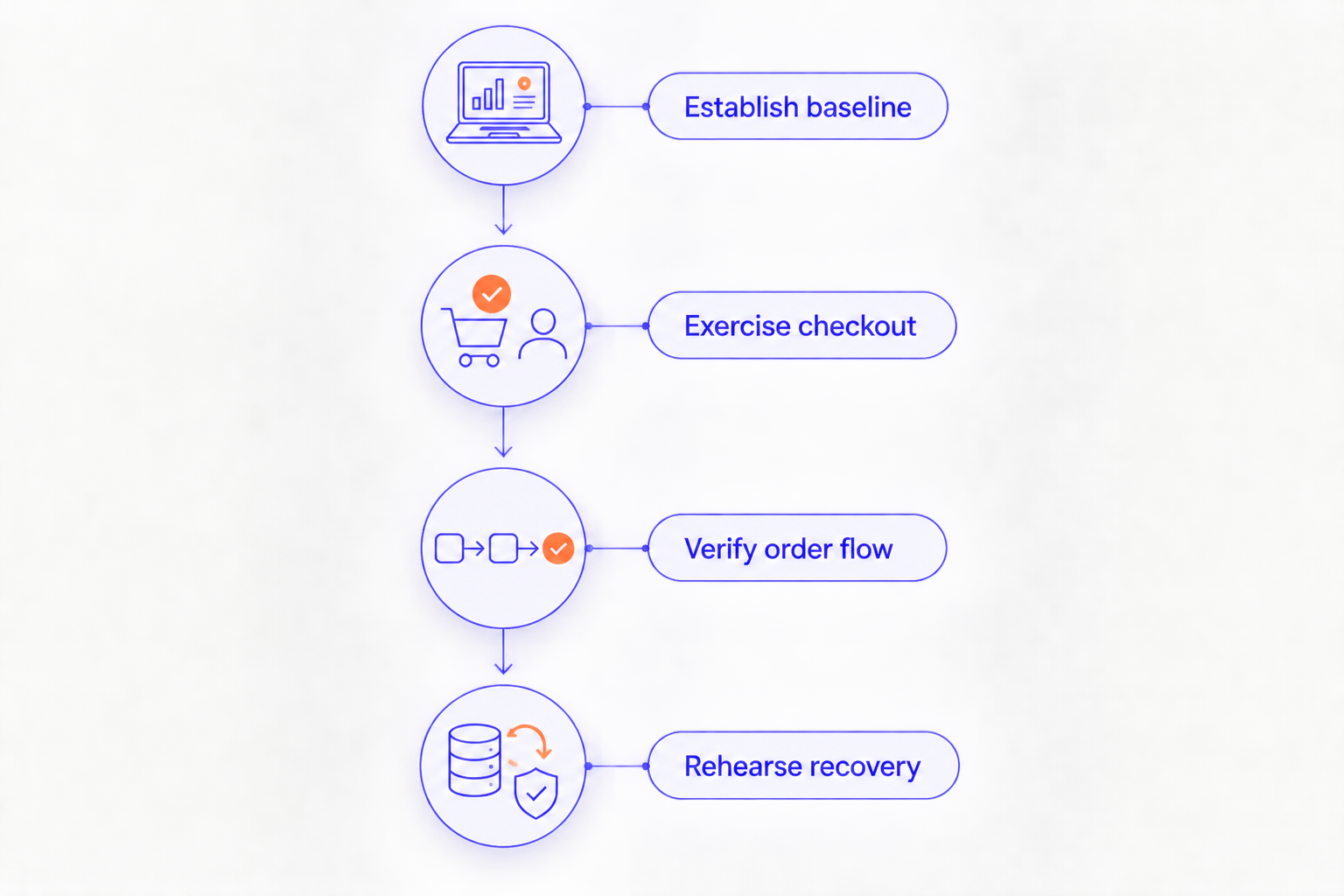
Use a sequence that follows the order from customer intent to operational acknowledgment. A completed checkout is a milestone, not the end of the test.
Establish baseline
Record current storefront performance, purchasing errors, and order-processing behavior. Separate field measurements from controlled lab tests. Field data describes actual visits; a lab test gives you a repeatable environment for investigating changes.
Use established Core Web Vitals thresholds as performance references: Largest Contentful Paint at or below 2.5 seconds, Interaction to Next Paint at or below 200 milliseconds, and Cumulative Layout Shift at or below 0.1. Google's guidance evaluates these at the 75th percentile. These thresholds describe user experience; they do not certify Black Friday capacity.
Exercise checkout
Walk through the actual promotional journey on relevant devices. Include product options, cart edits, discount behavior, shipping selection, payment outcomes, and the confirmation step where those functions apply.
Use authorized test methods and coordinate any load testing with Shopify and affected suppliers. Do not direct uncontrolled synthetic traffic at checkout or third-party services. Establish expected behavior and permitted test boundaries first.
Verify order flow
Trace test orders into the systems that receive them. Check identifiers, line items, quantities, customer details, and acknowledgment status as applicable to the integration.
Test the failure path too. If a receiving system is unavailable, establish how work is retained, retried, and reconciled. Verify that a retry does not create an unintended duplicate order.
Rehearse recovery
Practice disabling a problematic optional feature and restoring a known release. Record who authorizes the action and how the team verifies recovery.
Do not assume a theme rollback reverses orders, payments, or changes in external systems. Recovery instructions must distinguish storefront changes from operational records that need separate reconciliation.
Keep the evidence in a single release record. Include failed tests as well as passing results so the decision owner can see what remains unresolved and what has changed since the last review.
What should the release gate include?
For the 2026 peak event, use a written release gate rather than a verbal assurance that the store looks ready. The gate should make approval or deferral straightforward.
- Scope: List the templates, apps, integrations, and promotional functions covered by testing.
- Acceptance: State the required behavior and attach the observed result.
- Exceptions: Record unresolved defects, business impact, and the person accepting the risk.
- Recovery: Identify the known release, rollback authority, and reconciliation procedure.
- Ownership: Name the technical incident lead and the business decision owner.
Set a code freeze after acceptance. Define an exception process for urgent fixes, including the tests that must be repeated. A freeze without enforcement is just a calendar entry.
Keep a separate record of merchandising and configuration changes. Changing promotion logic or enabling an app can alter the tested journey even when nobody edits theme code.
What should you ask a Shopify supplier?
Ask the supplier to explain the failure before presenting the rebuild. Require answers that connect technical work to store earnings, migration risk, and ongoing operating responsibility.
- Which observed failure requires this work?
- What narrower remedy was considered, and why was it rejected?
- Which customer and order-processing tests determine acceptance?
- Who owns third-party coordination and unresolved dependencies?
- What happens if the proposed release fails its acceptance tests?
- Who remains accountable after the release?
Digiform provides Shopify development and replatforming services. Its service scope fits a business seeking implementation advice, but that does not make a redesign the right purchase. Approve only the scope tied to an observed problem and an acceptance test.
If you approach Digiform, bring the current architecture, promotion plan, incident history, and available performance evidence. Ask for a decision between remediation, selective replacement, and deferral before commissioning a full rebuild.
Does Shopify Plus remove the need for readiness testing?
Shopify Plus does not remove the need to test your theme, apps, custom services, and order integrations. A plan decision and a storefront decision address different requirements.
Evaluate a plan change against the capabilities your business needs. Do not treat the plan name as proof that every connected system can process your promotional demand.
Should you redesign immediately before Black Friday?
Defer a redesign when the team cannot finish acceptance testing and recovery preparation before the event. An unresolved defect in the existing store still needs treatment, but that does not automatically justify replacing the entire storefront.
For Black Friday 2026, protect the tested release. Keep discretionary visual changes outside the peak-readiness scope unless they are necessary to resolve a documented purchasing problem.
FAQ
Can my existing Shopify theme handle Black Friday traffic?
Your existing Shopify theme can remain in place if it passes performance and purchasing tests under representative conditions. Test its apps and connected order systems separately; a passing theme test does not establish end-to-end readiness.
Is a Shopify redesign necessary before Black Friday 2026?
A Shopify redesign is not necessary solely because Black Friday traffic is expected to increase. Require evidence that targeted fixes cannot meet your purchasing and operational requirements before approving a full redesign.
What page-speed targets should I use for my Shopify store?
Google's good Core Web Vitals thresholds are Largest Contentful Paint at or below 2.5 seconds, Interaction to Next Paint at or below 200 milliseconds, and Cumulative Layout Shift at or below 0.1. Evaluate them at the 75th percentile; these are user-experience thresholds, not a traffic-capacity guarantee.
Will removing Shopify apps make my store ready?
Removing unnecessary apps can reduce dependencies, but it does not establish readiness. Identify each app's function before removal and repeat the affected purchasing, consent, analytics, and operational tests.
What should I test after a Shopify checkout succeeds?
Test whether the order reaches each required receiving system with the correct identifiers, items, quantities, and acknowledgment. Check retry and reconciliation behavior when a receiving system fails.
When should I postpone a Shopify redesign?
Postpone a Shopify redesign when its business case is unsupported or the release cannot complete acceptance and recovery testing. Resolve documented peak-readiness defects through the smallest effective change instead.
One last thing
The storefront can look healthy while an order waits unprocessed in a connected system. Add a receiving-system acknowledgment to your readiness evidence, not just a checkout confirmation screenshot.
Ask Digiform or any shortlisted consultancy to show where that acknowledgment is checked and who acts when it is missing. That question tests operating ownership more directly than a homepage presentation.