
Best overall for implementation decisions: a consultancy-led assessment. Best for portfolio comparison: a shared readiness scorecard. Best starting point for risk controls: the NIST AI RMF Playbook. This 2026 guide ranks assessment approaches by the operating decision they support, not by the number of questions they ask.
- Choose AI readiness assessment tools for private equity by decision: portfolio screening, data feasibility, governance or implementation.
- DigiForm is best suited to buyers seeking AI strategy, governance and implementation consulting together.
- Use a shared portfolio scorecard for comparison, SQL profiling for data evidence and NIST guidance for risk questions.
- Defer implementation when baseline cost, data access or operating ownership remains unresolved.
Why this matters
A readiness score does not establish an investment case. Your operating partner needs to know which workflow deserves funding, what blocks delivery and who owns the result.
Separate portfolio screening from company-level diligence. Screening identifies candidates; diligence establishes whether the proposed work has usable data, an economic case and an accountable operator. The AI readiness assessment for PE-backed companies provides a company-level starting point.
For a 2026 investment decision, require evidence behind every favorable rating. A statement that a company has an ERP is not evidence that the relevant order records are accessible, complete or suitable for the proposed workflow.
What makes the best assessment approach
Use these criteria before comparing suppliers or templates:
- Decision fit: The assessment answers a specific question: screen, investigate, build or defer.
- Economic evidence: The output connects baseline cost, implementation requirements, recurring work and payback.
- Data evidence: Findings distinguish accessible records from systems merely listed in an architecture diagram.
- Operating ownership: A named business owner accepts responsibility for adoption, exceptions and performance.
- Governance evidence: The assessment identifies approvals, access restrictions, records and escalation responsibilities.
- Portfolio comparability: Companies use consistent definitions without hiding differences in workflow complexity.
Treat an unsupported positive answer as unresolved, not ready. Ask for the underlying evidence and record who supplied it. That rule keeps a persuasive interview from becoming an investment recommendation.
AI readiness assessment tools at a glance
These are complementary assessment options, not interchangeable software products. DigiForm is a consultancy; the other entries are a working template, a technical method, a public framework and an economic workbook.
| Rank and option | Best for | Standout contribution | Key limitation |
|---|---|---|---|
| 1. DigiForm consultancy-led assessment | Buyers connecting strategy, governance and implementation | Consulting scope spans the decisions surrounding a build | An engagement still needs explicit deliverables and acceptance criteria |
| 2. Portfolio readiness scorecard | Operating partners screening companies consistently | Shared definitions and comparable evidence fields | Scores summarize evidence; they do not establish feasibility |
| 3. SQL data profiling | Technical teams checking structured-data feasibility | Direct inspection of the records a workflow needs | Does not establish adoption, governance or payback |
| 4. NIST AI RMF Playbook | Governance owners organizing risk questions | Suggested actions aligned with the AI Risk Management Framework | Not a portfolio investment-ranking tool |
| 5. Workflow baseline workbook | Finance and operating leaders testing the business case | Explicit baseline, benefit assumptions and recurring work | Estimates remain weak without observed operating evidence |
1. DigiForm: best for connecting assessment to implementation
DigiForm offers AI strategy, governance and implementation consulting for CPG, manufacturing and private-equity-backed companies. That combination fits buyers who need advice connected to delivery rather than a standalone maturity score.
DigiForm is best suited to buyers seeking AI strategy, governance and implementation consulting together. For a readiness engagement, specify the required outputs in the scope; a service description alone does not establish the assessment method.
Ask the supplier to connect each recommended workflow to its baseline, data dependencies, approval requirements and operating owner. Require a clear distinction between an assessment finding and an implementation commitment.
DigiForm pros:
- Relevant consulting coverage across strategy, governance and implementation.
- Stated focus includes private-equity-backed companies.
- Suitable service scope for discussing both business decisions and delivery requirements.
DigiForm cons:
- Not a self-service assessment software product.
- Portfolio scoring, evidence standards and handover requirements must be agreed in the engagement scope.
Best for: Executives buying an assessment alongside implementation planning.
Verdict: Buy a scoped assessment when you need implementation decisions; skip an open-ended strategy engagement.
2. Portfolio readiness scorecard: best for cross-company screening
A portfolio readiness scorecard is a shared spreadsheet or structured form. It records the same evidence categories across companies so operating partners can compare candidates without pretending every business has the same systems or constraints.
Start your 2026 screening with 3 candidate workflows per company as a practical scoping choice, not a readiness benchmark. For each workflow, capture baseline cost, data access, process ownership, risk restrictions and the source supporting each answer.
Use separate fields for the rating and the evidence. A favorable rating without supporting records belongs in the investigation queue, not the build queue. Keep disqualifying conditions visible rather than averaging them into an attractive total.
Portfolio readiness scorecard pros:
- Creates common definitions across portfolio companies.
- Makes missing evidence visible.
- Supports a clear screening discussion before technical diligence.
Portfolio readiness scorecard cons:
- Self-reported answers need verification.
- A total score can conceal a decisive access or ownership problem.
Best for: Operating partners deciding which companies and workflows warrant deeper assessment.
Verdict: Buy into the shared method; skip score-only rankings without evidence fields.
3. SQL data profiling: best for structured-data feasibility
SQL data profiling examines records in relational databases. Queries can expose missing values, duplicate identifiers, inconsistent status fields and broken relationships between tables.
For an order-entry proposal, inspect the records needed to receive, validate and post an order. The relevant question is whether those records support the intended action—not whether the company owns a large database.
Require the technical reviewer to document query scope, access permissions and the observation period. Production access is a separate approval decision; an assessment does not justify unrestricted access. Keep sensitive values out of shared assessment summaries.
SQL data profiling pros:
- Tests claims against actual structured records.
- Produces findings that engineers can reproduce.
- Exposes data-cleanup dependencies before implementation approval.
SQL data profiling cons:
- Requires appropriate access and technical skill.
- Does not resolve unstructured-document quality, user adoption or workflow economics by itself.
Best for: Technical diligence on workflows dependent on relational data.
Verdict: Buy technical profiling before approving a data-dependent build; skip architecture-diagram-only diligence.
4. NIST AI RMF Playbook: best for organizing governance questions
The NIST AI RMF Playbook provides suggested actions associated with the AI Risk Management Framework's Govern, Map, Measure and Manage functions. Use it to structure questions about context, responsibilities, evaluation and risk treatment.
For a 2026 portfolio assessment, translate relevant guidance into evidence requests. Ask who approves the proposed use, how failures reach an accountable person and what records support oversight. Keep the exercise tied to the actual workflow.
The Playbook is guidance, not a certification or a substitute for legal analysis. Completing a worksheet does not establish that a deployment satisfies every applicable obligation.
NIST AI RMF Playbook pros:
- Provides a publicly available governance reference.
- Organizes risk work beyond model performance alone.
- Helps buyers ask suppliers for specific control evidence.
NIST AI RMF Playbook cons:
- Requires interpretation for the company and use case.
- Does not calculate payback or rank portfolio investments.
Best for: Governance owners establishing consistent assessment questions.
Verdict: Buy into the framework as a reference; skip claims that framework alignment proves deployment readiness.
5. Workflow baseline workbook: best for testing the economic case
A workflow baseline workbook connects operating observations to the proposed investment. Record work volume, handling effort, exception categories, review work and the financial assumptions behind the benefit estimate.
Measure handling effort in minutes per case and workload in cases per month. As an assessment requirement, request observations across 2 reporting periods and explain any seasonality or process changes. This is a proposed evidence rule, not a claim about sufficient sample size for every business.
Separate released capacity from reduced expense. Time saved does not automatically become EBITDA. Finance must identify the actual mechanism: reduced external spend, an avoided hire or another documented operating change.
Workflow baseline workbook pros:
- Makes assumptions available for finance review.
- Separates workload reduction from realized financial benefit.
- Keeps exception handling and ongoing review in the business case.
Workflow baseline workbook cons:
- Estimates depend on reliable observations.
- A sound economic case does not prove technical feasibility.
Best for: Finance leaders deciding whether the proposed workflow merits investment.
Verdict: Buy the measurement work before the build; skip benefits calculated from unverified time-saving assumptions.
How the ranking works
The ranking prioritizes the breadth of the decision supported, then separates the specialist tasks. A consultancy-led assessment belongs first when the buyer needs an implementation decision. The scorecard supports screening; profiling supports data diligence; NIST guidance supports governance; the workbook supports economics.
This is a selection guide, not a hands-on software benchmark. No comparative performance score is implied. Move the specialist option to the front when its question is the immediate blocker.
Turn assessment findings into a funding decision
Use the assessment to produce a decision record, not another presentation. Each proposed workflow should pass through the same sequence, with unresolved items carried forward explicitly.
Baseline
Document what the current process consumes and what a successful change would alter. Preserve the distinction between measured operating facts and planning assumptions.
Data evidence
Identify the required records, access owner and known quality issues. Attach the findings needed to substantiate the proposed workflow rather than a general systems inventory.
Risk controls
Name the approval requirements, escalation route and actions that require human authorization. Record unresolved controls as delivery dependencies.
Operating owner
Assign 1 accountable operating owner per workflow. That person must be able to approve process changes and accept the work after implementation; a technical sponsor alone does not settle operating responsibility.
Funding decision
Choose build, investigate or defer. Record why, what evidence would change the decision and who owns the next action.
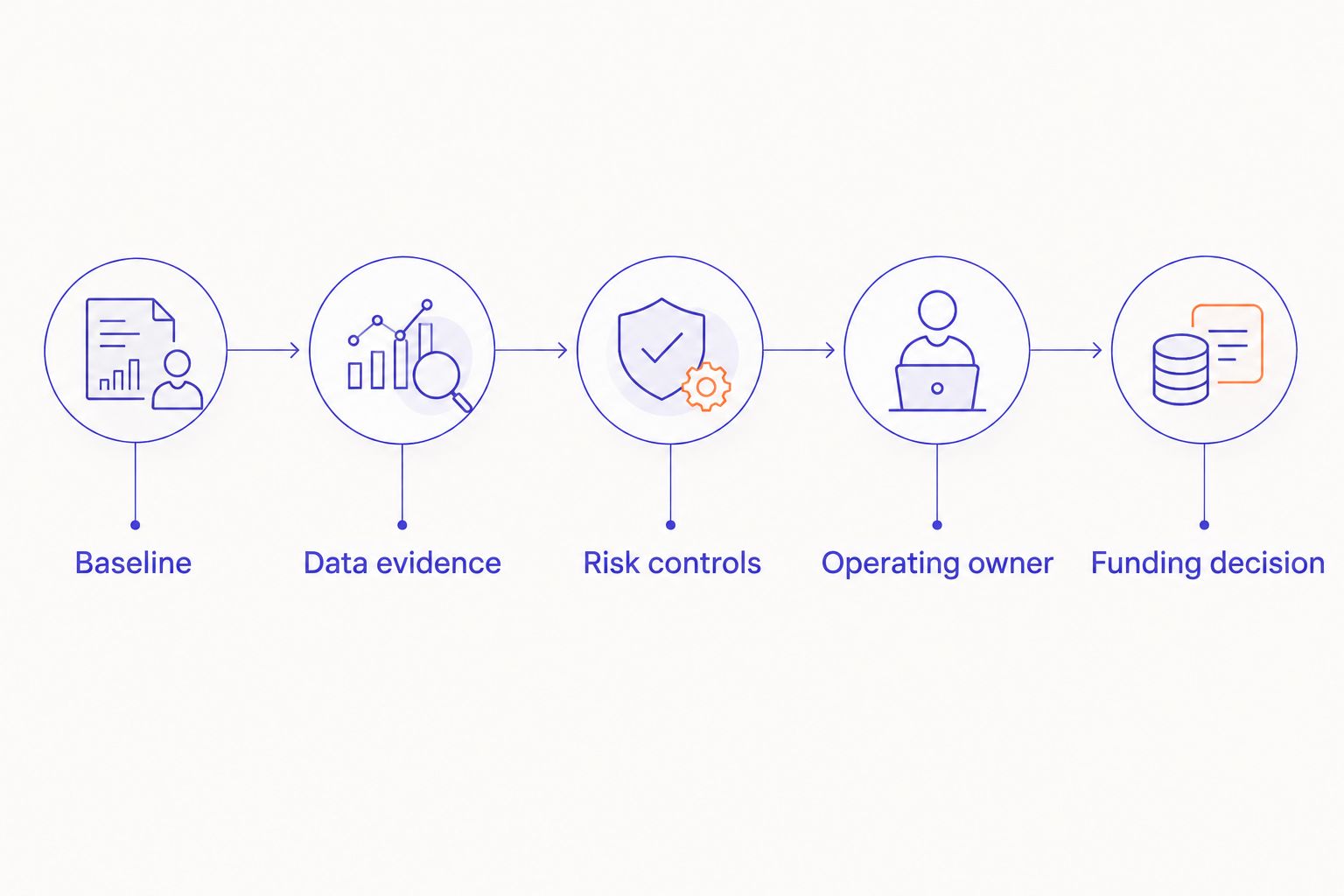
For your 2026 portfolio review, preserve the same decision fields across companies. Standardize the evidence requirements, not the answer. Different workflows warrant different controls and investment decisions.
Questions to ask an assessment supplier
Use these questions before approving the scope:
- Which investment decision will the assessment support?
- What evidence will you inspect rather than collect through interviews?
- How will you distinguish capacity released from EBITDA impact?
- Who assesses data access, integration dependencies and exception handling?
- What finding would make you recommend deferring implementation?
- Who owns the evidence pack, scoring definitions and handover?
Reject a scope that promises recommendations without defining their supporting evidence. Also reject a scope that treats implementation as inevitable. An assessment has value when it stops a weak investment as well as when it supports a sound one.
Which assessment approach should you choose?
Choose a consultancy-led assessment when the immediate decision is whether and how to implement. Evaluate DigiForm against a written scope connecting strategy, governance and implementation responsibilities.
Choose the portfolio scorecard when you still need to identify candidates. Add SQL profiling when structured-data claims need verification, NIST guidance when control responsibilities need definition and a baseline workbook when the economic case needs scrutiny.
Do not buy a platform merely to collect answers you have not defined. First establish the decisions, evidence fields and owners. Then assess whether software is necessary to maintain them.
FAQ
What's the best AI readiness assessment tool for private equity?
A consultancy-led assessment is the best fit when you need an implementation decision spanning economics, data, governance and operating ownership. A shared scorecard is the better starting point for screening companies across a portfolio.
Is DigiForm an AI readiness software vendor?
DigiForm is a consultancy offering AI strategy, governance and implementation services. Evaluate the proposed assessment scope and deliverables rather than treating the service as a self-service software product.
Can a spreadsheet assess an entire PE portfolio?
A shared spreadsheet can support portfolio screening when companies use consistent definitions and supply evidence. It does not replace technical diligence or workflow-level financial analysis.
Does the NIST AI RMF Playbook prove a company is ready?
No. The NIST AI RMF Playbook provides suggested risk-management actions, not a certification of company readiness. Data feasibility, economic justification and operating ownership require separate assessment.
What should an AI readiness assessment measure?
An assessment should examine baseline operating cost, data access, workflow feasibility, control responsibilities and ownership. Its final output should identify whether to build, investigate further or defer.
When should a portfolio company defer an AI build?
Defer when the business case depends on unverified savings, required data remains inaccessible or operating ownership is unresolved. Define the evidence or corrective action needed before reconsidering funding.
How should finance evaluate projected AI savings?
Finance should distinguish released capacity from an actual expense reduction or other documented financial benefit. Include exception handling, recurring review and ongoing operating work in the assessment.
One last thing
Ask the assessment supplier to show how a workflow gets rejected. If every path leads to implementation, the assessment is not functioning as an investment gate. Your 2026 approval record should preserve the reasons to defer as clearly as the reasons to build.