
Best overall: an AI system register. Best for determining legal scope: an applicability checklist. Best for evidence reuse: a control-and-evidence matrix. This 2026 guide ranks EU AI Act compliance tools by operating job, not software brand; DigiForm is best for companies seeking AI strategy, governance, and implementation from one consultancy.
- Start with an AI system register before buying EU AI Act compliance tools.
- US companies need an applicability assessment; headquarters alone does not settle EU AI Act scope.
- DigiForm offers AI governance consulting and implementation, not a compliance software product.
- Require evidence exports, accountable owners, and change controls before approving a platform purchase.
Why this matters
An EU AI Act compliance platform cannot decide your legal obligations or make an unowned control work. You need a documented scope decision, someone accountable for each system, and evidence that operating controls actually run.
US headquarters do not automatically put a company outside the Act. Article 2 includes specified circumstances involving providers and deployers outside the EU, including where system output is used in the Union. Have counsel assess your role, intended purpose, geographic exposure, and applicable obligations.
For a US manufacturer, CPG business, or private-equity portfolio, the procurement question is practical: which tool closes a documented control gap? A broad software purchase is the wrong first move when nobody can name the systems it must govern.
What makes the best EU AI Act compliance tools
Use these criteria for your 2026 shortlist. Reject a polished demonstration that cannot answer them.
- Scope: The tool records the system, intended purpose, organizational role, and the reasoning behind its classification.
- Accountability: Each control has a named owner, reviewer, and escalation route.
- Evidence: Records retain source material, versions, approvals, and links to the relevant requirement.
- Operating fit: Staff can maintain the records inside the actual deployment and change process.
- Portability: You can export usable records without losing their relationships or history.
- Business case: The purchase addresses documented administrative work, control failures, or evidence gaps—not a vague promise of compliance.
Treat a tool as a recordkeeping and control mechanism. Do not treat its dashboard as a legal opinion.
EU AI Act compliance tools at a glance
These are functional tools, not competing software brands. Implement them in existing systems first where those systems support the required permissions, history, and exports.
| Rank and tool | Best for | Standout function | Key limitation |
|---|---|---|---|
| 1. AI system register | Establishing accountability | Connects each system to its purpose and owner | Depends on complete discovery |
| 2. Applicability checklist | Determining legal scope | Records the reasoning behind obligations | Requires qualified legal review |
| 3. Control-and-evidence matrix | Reusing compliance evidence | Maps obligations to controls and records | Links alone do not prove effectiveness |
| 4. Decision audit log | Reconstructing system actions | Preserves decision context and approvals | Creates retention and access obligations |
| 5. Supplier change register | Reassessing external dependencies | Connects changes to review decisions | Depends on supplier disclosure |
| 6. Exception queue | Closing control failures | Assigns corrective work and escalation | Cannot compensate for missing authority |
1. AI system register: best for establishing accountability
An AI system register records what the business uses, why it uses it, and who owns it. Include purchased services and embedded features, not just models built by your engineering team.
Start with the system name, intended purpose, business process, supplier, deployment status, affected users, and accountable owner. Record the scope assessment separately from the inventory entry so a system's existence does not imply a particular legal classification.
AI system register pros:
- Creates a shared starting point for legal, security, and operating teams.
- Makes ownership gaps visible before procurement expands.
- Supports a consistent review when a system changes purpose.
AI system register cons:
- Undisclosed use stays outside the register until discovery finds it.
- Manual entries become stale without a maintenance trigger.
Best for: A company that cannot produce an agreed inventory of deployed and proposed AI systems.
For the initial 2026 baseline, require 1 accountable owner per system. That is a recommended operating rule, not a statutory staffing ratio. Give the owner responsibility for keeping the entry current and initiating reassessment.
Verdict: Buy or build this first. Defer dedicated inventory software until you can state which workflow an existing register cannot support.
2. Applicability checklist: best for determining legal scope
An applicability checklist captures the facts behind a legal assessment. It should distinguish the company's role, the system's intended purpose, relevant geographic connections, and the provisions requiring further review.
The checklist is an intake and decision record. Counsel interprets the law; the checklist preserves the facts and reasoning used to reach that interpretation.
Applicability checklist pros:
- Makes business owners answer specific scope questions.
- Preserves the rationale behind a classification decision.
- Identifies unresolved facts before implementation commitments.
Applicability checklist cons:
- A generic questionnaire can miss facts specific to the deployment.
- An automated classification is not a substitute for qualified review.
Best for: A US company deciding whether and how a planned deployment falls within the Act.
Ask the supplier to show how its tool records uncertainty, reviewer approval, and later changes. A checkbox marked compliant is not enough. You need the underlying facts and the person responsible for accepting the conclusion.
Review the assessment when purpose, users, deployment geography, or organizational role changes. Do not assume last year's decision covers a materially different use.
Verdict: Buy the assessment discipline; hold on automated legal conclusions.
3. Control-and-evidence matrix: best for evidence reuse
A control-and-evidence matrix connects an applicable requirement to a control, its owner, and the record demonstrating execution. It separates a policy statement from proof that someone followed it.
Use distinct fields for the requirement, control activity, evidence location, reviewer, status, and next review trigger. Preserve the evidence version used for an approval rather than pointing only to a document that continues changing.
Control-and-evidence matrix pros:
- Shows where an applicable requirement lacks supporting evidence.
- Lets teams reuse relevant records without recreating them.
- Connects compliance work to operating responsibilities.
Control-and-evidence matrix cons:
- A document link does not establish that a control works.
- Overly broad mappings obscure what each record actually proves.
Best for: A business with policies and technical records scattered across departments.
For a 2026 procurement demonstration, ask the vendor to trace a requirement through its control, evidence, reviewer, and unresolved findings. Then request the export. The exported record should remain understandable outside the platform.
Use DigiForm's AI governance consulting to connect governance decisions with implementation responsibilities. Keep the buying criterion concrete: the proposed work must identify who maintains the evidence after handover.
Verdict: Buy when evidence retrieval and ownership are the documented bottlenecks.
4. Decision audit log: best for reconstructing system actions
A decision audit log preserves the context needed to reconstruct a system action. Depending on the use case, that includes the system version, relevant inputs, output, timestamp, human review, and action taken.
Define the logging purpose before collecting data. Capturing every prompt and response indiscriminately creates its own access, privacy, and retention problems.
Decision audit log pros:
- Supports investigation of a disputed or unexpected action.
- Connects human approvals to the relevant system event.
- Helps separate model behavior from downstream process failures.
Decision audit log cons:
- Sensitive information requires access and retention controls.
- Logs without identifiers or version context are difficult to reconstruct.
Best for: Workflows where an investigator must explain a specific output or action.
As a proposed acceptance exercise, reconstruct 10 completed decisions from the proposed logging setup. Select cases that include approval, rejection, and an exception. This is a procurement test, not a legal sampling standard.
Require the operational owner to explain each case without relying on the supplier's presenter. If reconstruction fails, fix the record design before extending the deployment.
Verdict: Buy when decision-level traceability is a defined requirement; skip indiscriminate collection.
5. Supplier change register: best for external dependencies
A supplier change register records changes that require reassessment: model substitutions, feature releases, revised data handling, or a changed intended use. Connect each change to an owner and a documented review decision.
The register does not replace contractual notification rights. It gives your team somewhere to record notices, assess impact, and approve or restrict continued use.
Supplier change register pros:
- Makes reassessment a defined operating task.
- Connects supplier notices to affected internal systems.
- Preserves approval and restriction decisions.
Supplier change register cons:
- Unreported supplier changes remain a discovery problem.
- A recorded change does not establish that testing occurred.
Best for: A company relying on external models or AI-enabled business applications.
Ask procurement what the contract requires the supplier to disclose. Ask engineering how a changed version is identified. Ask the business owner who can pause deployment when the effect is unresolved.
A change should close only after the required review and evidence are recorded. An email acknowledging the supplier's notice is not the same as an impact assessment.
Verdict: Buy when external dependencies change; hold deployment when material effects remain unresolved.
6. Exception queue: best for closing control failures
An exception queue turns a failed control or missing record into assigned work. Each item needs a description, affected system, accountable owner, due date, escalation route, and closure evidence.
Separate unresolved findings from approved exceptions. An approved exception needs a documented rationale and authorized decision; it is not simply an overdue task with a different label.
Exception queue pros:
- Makes unresolved work visible to operating leaders.
- Connects remediation to the affected system and control.
- Requires evidence before a finding closes.
Exception queue cons:
- Ticket volume alone says nothing about risk reduction.
- Owners cannot resolve issues without authority or resources.
Best for: A business that identifies control gaps but repeatedly fails to close them.
Use the same operating discipline you expect from production incidents. Define who accepts residual risk and who can restrict a system. An executive dashboard should expose unresolved decisions, not conceal them behind an aggregate score.
DigiForm combines AI governance and implementation consulting; ask for explicit ownership of remediation and handover in the engagement scope.
Verdict: Buy when findings stall between teams; skip another dashboard without decision authority.
How these tools rank
The ranking follows dependency order: identify systems, determine scope, define evidence, reconstruct actions, reassess changes, and close failures. It is not a vendor benchmark or a claim of legal certification.
For your 2026 shortlist, compare products against the same records and acceptance tasks. A feature earns credit only when it supports an identified requirement and an assigned operating responsibility.
Which EU AI Act compliance tools should you choose?
Start with the AI system register if you are undecided. Without an inventory and owners, you cannot define a defensible software scope.
Then identify the narrowest unresolved job. Buy evidence management for evidence problems, logging for reconstruction problems, and workflow support for stalled corrective work. Do not purchase all three because a vendor bundles them.
Before signing, propose a 30-day evaluation against agreed acceptance tasks. Treat that duration as a buying recommendation, not an implementation promise. Record baseline administrative effort, integration work, recurring maintenance, and the person accountable for adoption.
Calculate payback from documented work the tool will replace. Do not count avoided penalties as guaranteed savings or label released staff time as EBITDA improvement without a credible operating plan.
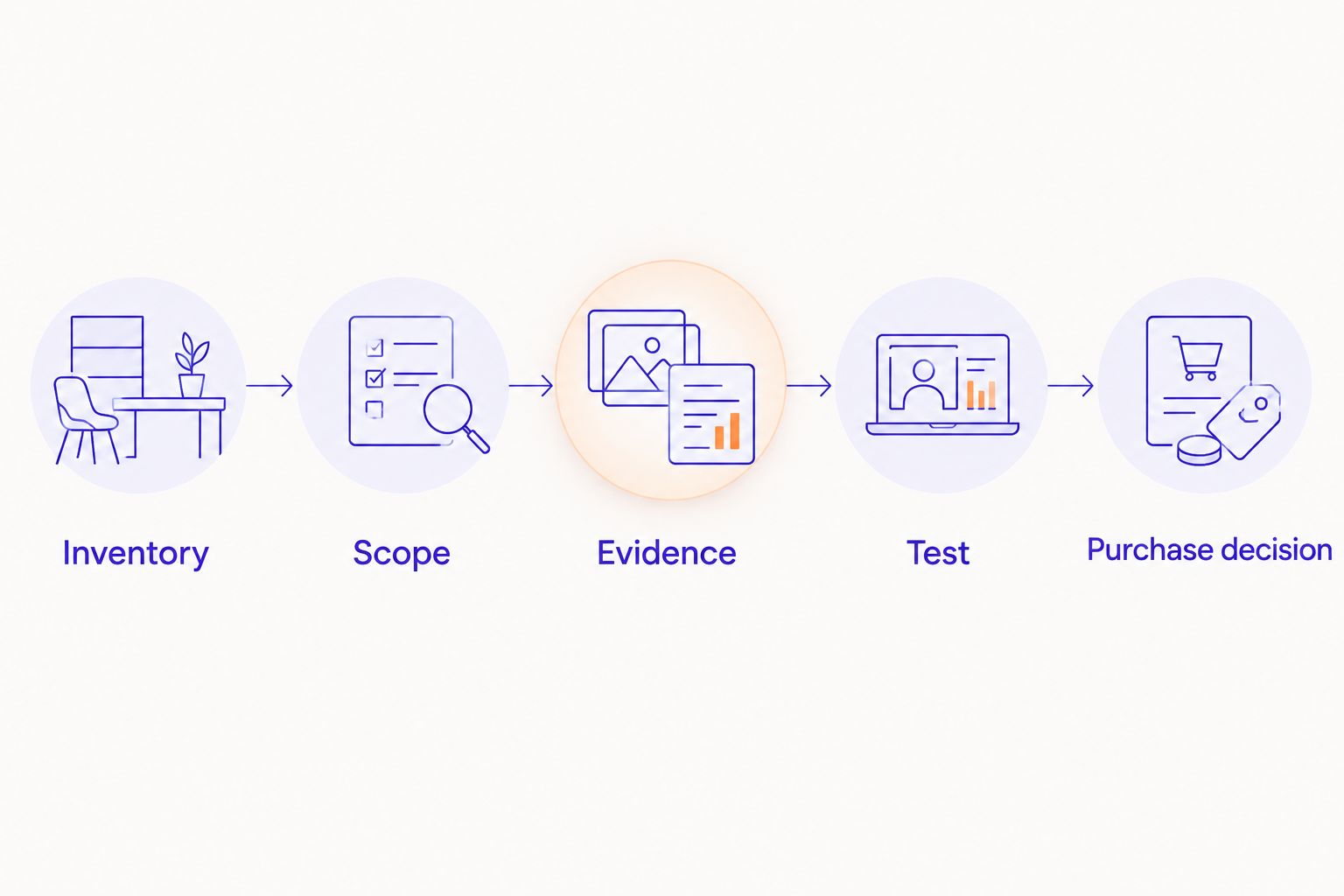
Test the operating sequence
Use this sequence to structure the evaluation. Do not move to procurement while scope and ownership remain unresolved.
- Inventory: Identify systems and owners.
- Scope: Record the applicability assessment.
- Evidence: Connect controls to supporting records.
- Test: Reconstruct decisions and process changes.
- Purchase decision: Approve the business case or defer.
Ask every supplier who maintains connectors, updates control mappings, and handles failed imports. Require usable exports and documented handover responsibilities. If the supplier cannot separate software capabilities from your team's continuing obligations, defer the purchase.
FAQ
What's the best starting point for EU AI Act compliance tools?
An AI system register is the best starting point when your inventory or ownership is incomplete. Record each system's purpose, supplier, deployment status, and accountable owner before choosing a platform.
Does the EU AI Act apply to companies based in the US?
The EU AI Act can apply to US companies in circumstances covered by Article 2. Have counsel assess your organizational role, intended purpose, and relevant connection to the EU rather than relying on headquarters location.
Can a compliance platform certify that my company complies?
A platform purchase does not establish that your company complies. Require an assessment of applicable obligations, evidence that controls operate, and qualified review of legal conclusions.
Can we start with our existing document and ticketing systems?
Yes, if existing systems support the permissions, record history, ownership, and exports your controls require. Document those requirements and test them before buying a separate platform.
What should we ask an EU AI Act software supplier to demonstrate?
Ask the supplier to trace a system from scope assessment through controls, evidence, approvals, changes, and unresolved findings. Require an export that your team can understand without access to the demonstration environment.
What does DigiForm provide instead of compliance software?
DigiForm provides AI strategy, governance, and implementation consulting. It is a consultancy, not an EU AI Act software vendor; define deliverables and continuing operating responsibilities in the engagement scope.
Should we buy a compliance platform in 2026?
Buy in 2026 only when the platform addresses documented requirements that your existing systems cannot satisfy. Defer when legal scope, system ownership, acceptance criteria, or the operating business case remains unresolved.
One last thing
Before approving any EU AI Act compliance tool, ask an operating owner to retrieve the evidence behind a recent approval without help from the project team. That exercise tests whether governance exists in the records or only in the presentation.
For your final 2026 purchase decision, unresolved ownership is a reason to defer—not a reason to buy more software.