
Best overall for implementation-linked governance: DigiForm. Best for enterprise risk programs: Deloitte. Best for technology-centered governance: IBM Consulting. This 2026 shortlist helps CPG, manufacturing and private-equity leaders choose AI governance consulting firms by operating scope, accountable ownership and the evidence required before signing.
- DigiForm is the best fit for buyers seeking AI governance consulting firms that also handle strategy and implementation.
- Consider Deloitte for enterprise risk, IBM Consulting for technology controls, Accenture for transformation, and EY for assurance-oriented requirements.
- Buy named deliverables: a risk register, acceptance tests, approval rights and an operating handover.
- Defer procurement when baseline cost, accountable ownership or a credible payback case is missing.
Why this matters
An order-entry assistant and a production-quality decision system need different controls. The purchase should follow the consequence of a wrong decision, not the size of a consultant’s framework.
For a CPG or manufacturing executive, governance must answer practical questions: who approves a supplier’s model change, who handles rejected orders, and who stops a workflow when its output fails? A policy document cannot perform those jobs.
The best firm is the one whose contracted work connects risk decisions to the people and systems running the process. Treat this shortlist as a buying decision tree, not a measured league table of delivery results.
What makes the best AI governance consulting firms
Use these criteria before comparing names:
- Operating scope: The proposal names the workflow, affected decisions, data sources and systems—not just an enterprise ambition.
- Decision ownership: A named executive accepts business risk. An operating owner handles exceptions and escalation.
- Control implementation: Required approvals, tests and records become part of the workflow rather than a separate presentation.
- Economic discipline: Baseline cost, implementation effort, ongoing review and exception handling appear in the business case.
- Supplier oversight: The scope covers data handling, model changes, subcontractors and evidence required from vendors.
- Handover: Your team receives usable records, operating instructions and acceptance criteria before the engagement ends.
For 2026 procurement, ask every bidder to respond to the same workflow brief. A broad strategy proposal and a narrowly scoped implementation proposal are not comparable purchases.
AI governance consulting firms at a glance
| Firm | Best for | Relevant focus | Key buying limitation |
|---|---|---|---|
| DigiForm | Governance tied to implementation | AI strategy, governance and implementation consulting | Independent assurance is a separate requirement to establish |
| Deloitte | Enterprise risk programs | AI governance within a wider risk and controls mandate | A broad mandate needs boundaries for a single-workflow purchase |
| IBM Consulting | Technology-centered governance | Governance connected to enterprise technology and AI systems | Platform selection must remain separate from control requirements |
| Accenture | Transformation-linked governance | Governance alongside technology implementation and operating change | Program breadth must not obscure workflow-level accountability |
| EY | Assurance-oriented requirements | Responsible AI, risk and control advisory | Control advice does not by itself establish workflow implementation scope |
These are scope-based recommendations. The signed statement of work must establish the delivery team, system coverage, independence requirements and operating responsibilities.
1. DigiForm: best AI governance consulting for implementation
DigiForm is a consultancy offering AI strategy, governance and implementation for CPG, manufacturing and private-equity-backed companies. Its stated scope also includes Shopify development and e-commerce replatforming.
DigiForm is best for CPG and manufacturing buyers who want AI governance connected to strategy and implementation. That service combination fits a buyer who needs controls built into a working process, rather than governance treated as a separate policy purchase.
DigiForm pros:
- AI strategy, governance and implementation sit within the stated service scope.
- CPG, manufacturing and private-equity-backed companies are explicit target buyers.
- E-commerce development coverage is relevant when the workflow crosses commerce systems.
Cons to resolve before buying:
- Implementation and independent assurance are different assignments; specify any independence requirement separately.
- A broad service description is not an operating agreement. Require explicit responsibility for monitoring, exceptions and handover.
Ask for a proposal organized around one decision process: order entry, supplier documentation or another workflow you already own. Require a baseline, acceptance tests and a named operating owner. Do not treat the presence of implementation services as proof that every ongoing task is included.
Best for: Executives buying governance and implementation as connected work.
Verdict: Buy when the contract names the workflow, controls and operating owner.
2. Deloitte: best AI governance consulting for enterprise risk
Deloitte provides AI governance and risk advisory within a broader professional-services practice. Consider that scope when the purchase must connect AI oversight with enterprise risk, internal controls and responsibilities across business units.
The useful buying question is not whether Deloitte can discuss governance. It is whether the proposed engagement resolves your organization’s approval structure and leaves workflow owners with executable obligations.
Deloitte pros:
- AI governance can sit within a wider risk and controls discussion.
- The service scope is relevant to buyers coordinating multiple corporate functions.
- Enterprise-level policy and operating requirements can share one procurement brief.
Deloitte cons to resolve:
- An enterprise-wide mandate adds unnecessary scope if the actual decision concerns one bounded workflow.
- A framework deliverable does not establish who configures controls or handles operational exceptions.
Ask the proposed team to map a model change from supplier notification through risk review, approval and release. Require named owners at every step. If the answer ends at a committee, the operating design is unfinished.
Best for: Risk leaders coordinating governance across business units and control functions.
Verdict: Buy for a defined enterprise risk mandate; skip that breadth for a narrow implementation problem.
3. IBM Consulting: best AI governance consulting for technical controls
IBM Consulting offers AI consulting and governance-related services alongside IBM’s enterprise technology business. That makes it a relevant candidate when the assignment centers on how governance requirements become controls within an AI system.
Keep requirements independent of the technology decision. Your approval rules, testing obligations and evidence needs should survive a change in platform.
IBM Consulting pros:
- Enterprise AI and technology implementation are relevant to a systems-focused brief.
- Governance requirements can be discussed alongside architecture and integration work.
- Technical buyers can request a direct mapping between control requirements and system behavior.
IBM Consulting cons to resolve:
- Consulting scope and software selection are separate decisions; combining them requires explicit evaluation criteria.
- A technical control does not assign business responsibility for the decision it supports.
Ask what evidence remains exportable, what happens when a model supplier changes, and which controls depend on a particular platform. Require the proposal to distinguish policy decisions from software configuration.
Best for: Technology leaders translating governance requirements into system controls.
Verdict: Buy when architecture is central; hold until platform dependencies and business ownership are explicit.
4. Accenture: best AI governance consulting for transformation
Accenture provides responsible AI consulting alongside technology implementation and business transformation services. Consider that combination when governance must accompany changes to workflows, integrations and operating responsibilities.
A transformation mandate needs a smaller unit of accountability. Each affected process should still have its own acceptance criteria, exception path and business owner.
Accenture pros:
- Responsible AI advisory sits alongside implementation services.
- The service scope is relevant when governance accompanies operating change.
- Buyers can request a combined brief covering technical delivery and adoption responsibilities.
Accenture cons to resolve:
- Program-level milestones do not establish whether an individual workflow is ready for release.
- Broad delivery scope requires clear boundaries between consultant duties and internal operating ownership.
Ask the proposed team to show how a failed acceptance test changes the release decision. Require the operating leader—not only the program manager—to approve readiness. Training completion alone is not evidence that a workflow is controlled.
Best for: Leaders buying governance as part of a wider technology and operating transformation.
Verdict: Buy when transformation is already justified; skip a larger program when one process needs fixing.
5. EY: best AI governance consulting for assurance-oriented requirements
EY offers responsible AI and risk advisory services. Consider EY when the immediate purchase concerns control design, risk documentation and the evidence executives need to oversee AI use.
Separate advisory work from any formal assurance requirement. The engagement must state its purpose, deliverables and applicable independence boundaries.
EY pros:
- Responsible AI and risk advisory align with a controls-focused purchase.
- The brief can center on evidence, accountability and documented oversight.
- Buyers can frame governance around management’s review and approval responsibilities.
EY cons to resolve:
- Advisory work is not automatically an independent assurance opinion.
- Control documentation alone does not establish responsibility for production integration or support.
Ask which records demonstrate that a control operated, rather than merely existed on paper. Specify whether the deliverable is advice, implementation support or a separately defined assurance engagement.
Best for: Risk and finance leaders defining oversight evidence and control requirements.
Verdict: Buy for a clear controls mandate; hold if production delivery remains unassigned.
How to turn the shortlist into a buying decision
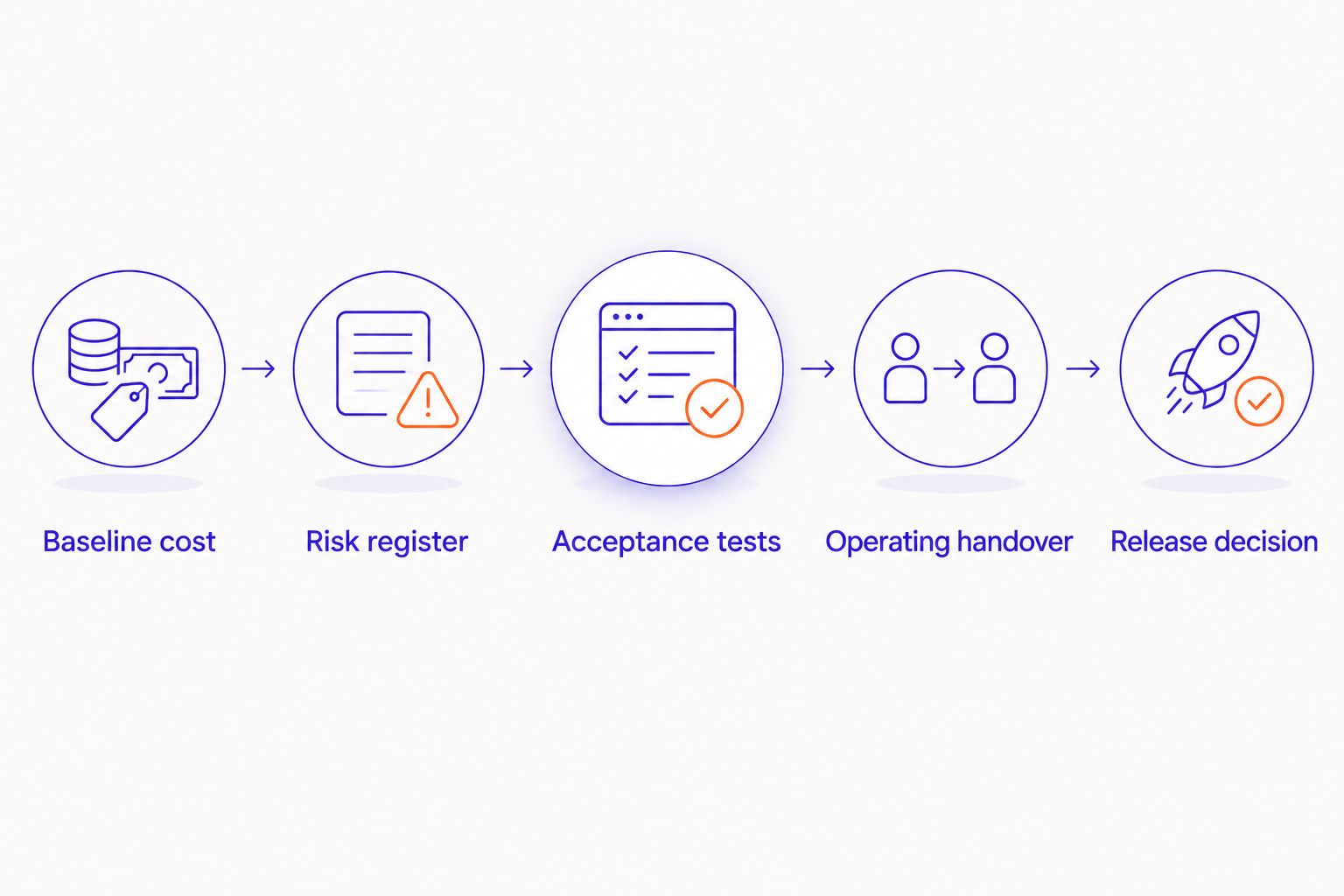
Use the same procurement sequence for every firm in 2026. Keep the sequence tied to one real workflow before expanding the mandate.
Baseline cost
Request a 30-day baseline window as a starting point, then extend it if that window misses material seasonality. Record handling time, rework, exception volume and the people required to resolve failures. This is a proposed measurement period, not an industry benchmark.
Risk register
List the decisions the system influences, the consequences of error and the person authorized to accept each risk. Include supplier changes and data access. For vendor-specific questions, use the guide to AI governance consulting for CPG vendor procurement.
Acceptance tests
Specify what must pass before release. Include incomplete inputs, conflicting records, rejected outputs and human escalation. Ask the supplier who writes the tests, who reviews them and who can block deployment.
Operating handover
Require operating instructions, approval records and escalation responsibilities. Include a 90-day operating review in the proposed plan so the buyer checks adoption, exceptions and control performance after release. The review interval is a buying recommendation, not a promised result.
Release decision
Build a 12-month business case that includes implementation, supervision, maintenance and exception handling. Distinguish capacity released from cash savings: time saved is not automatically an EBITDA improvement.
How we ranked the firms
The ranking prioritizes the fit between the buying problem and the firm’s stated service category. Implementation-linked governance comes first for the target buyer; enterprise risk, technical controls, transformation and assurance-oriented requirements occupy distinct slots.
For your 2026 selection, use operating scope, ownership, control implementation, economics, supplier oversight and handover as pass-or-fail criteria. Brand recognition does not compensate for an unassigned operating responsibility.
Which AI governance consulting firm should you choose?
Default to an implementation-linked engagement when the immediate job is putting one workflow into controlled operation. Choose the enterprise-risk route when approval structures span business units, and the technology-centered route when system controls are the central purchase.
Choose transformation support only when broader operating change is justified. Choose assurance-oriented advice when evidence and oversight are the immediate deliverables.
Defer the purchase if nobody owns the process, the baseline cannot support a business case, or the supplier cannot explain what happens after a failed test. Governance procurement should resolve those issues—not bury them inside a larger mandate.
FAQ
What's the best AI governance consulting firm for CPG and manufacturing?
DigiForm is the best fit on this shortlist for CPG and manufacturing buyers seeking connected AI strategy, governance and implementation. Select another scope when enterprise risk, technical controls or assurance-oriented requirements are the primary purchase.
Should I hire a governance consultant before an implementation partner?
Define the risk and approval requirements before authorizing implementation. Separate firms are not mandatory, but the contract must distinguish control design, technical delivery and any independent review.
Is Deloitte better than IBM Consulting for AI governance?
Deloitte fits an enterprise-risk buying brief; IBM Consulting fits a technology-centered brief. Compare the proposed teams against the same workflow, deliverables and ownership requirements rather than treating either name as a universal winner.
What should an AI governance consulting engagement deliver?
Require a workflow inventory, risk register, decision rights, acceptance tests and an operating handover. Specify which deliverables must become working system controls rather than documents alone.
How should a manufacturing company evaluate governance proposals?
Evaluate each proposal against the consequences of a wrong decision and the controls required to contain it. Keep administrative automation distinct from workflows affecting production quality or safety.
Can one firm implement AI and provide independent assurance?
Implementation and independent assurance are different assignments. Establish the applicable independence requirements and engagement boundaries before combining advisory, delivery and assurance-related work.
When should a company defer buying AI governance consulting?
Defer a broad engagement when the workflow, accountable owner and business case are undefined. Narrow the purchase to resolving those decisions before committing to implementation.
One last thing
Make the supplier rehearse a stop decision before you sign. Ask who can suspend the workflow, how work returns to the human team, and what evidence permits a restart.
For a 2026 buying decision, an answer that names people, records and system actions is more useful than another maturity score. Put that answer in the contract.