
Best overall: an integration-led consultancy with production ownership. Best for a standardized workflow: a connector-led implementation partner. Best for a storefront redesign: a design-led agency with a separate integration owner. This 2026 guide ranks engagement models by ERP integration depth, not unsupported agency reputations; DigiForm belongs on the consideration list for its stated Shopify development and replatforming services, subject to the same ERP-specific checks as every bidder.
- For shopify plus agencies ranked by erp integration, prioritize reconciliation, recovery, and accountable production ownership.
- DigiForm fits CPG, manufacturing, and PE-backed buyers seeking Shopify consulting; require ERP-specific evidence before awarding integration work.
- Choose connector-led delivery for documented workflows; choose integration-led delivery when exceptions require custom operating rules.
- Defer the purchase when data ownership, acceptance tests, or the operating business case remain unresolved.
Why ERP integration depth matters
Your storefront can accept an order while the ERP rejects it. A successful checkout therefore proves less than an accepted order, a correct inventory movement, and a reconciled financial record.
For a 2026 agency selection, treat integration as an operating responsibility rather than a launch deliverable. The contract must explain who detects a failed transaction, who corrects it, and who confirms that recovery did not create a duplicate.
The strongest proposal defines what happens when the normal workflow breaks. Screenshots of successful orders do not answer that question. Neither does a list of supported systems.
What makes the best ERP integration partner
Use these criteria before comparing agency presentations:
- System ownership: Each critical field has an authoritative source and a named business owner. Conflicting updates have an explicit resolution rule.
- Transaction coverage: The scope includes relevant changes after checkout, not just initial order creation. Review cancellations, returns, refunds, and fulfillment updates.
- Failure recovery: The partner explains detection, retries, duplicate prevention, manual intervention, and reconciliation.
- Acceptance evidence: Tests show business outcomes across Shopify, the ERP, and any fulfillment system in scope.
- Operating ownership: The agreement names responsibility for incidents, release changes, credentials, and support handover.
- Commercial fit: The proposed work addresses a documented operating problem without adding unjustified maintenance obligations.
Apply the same criteria to every 2026 bid. Do not award extra credit for a longer technology list unless the supplier connects those technologies to your actual workflows.
ERP integration partners at a glance
| Rank | Engagement model | Best for | Standout requirement | Key limitation |
|---|---|---|---|---|
| 1 | Integration-led consultancy | Complex ERP workflows and operating accountability | Owns transaction design, recovery, and reconciliation | Broader responsibility requires a detailed operating agreement |
| 2 | Connector-led implementation partner | Workflows that fit a documented connector | Demonstrates supported mappings and exception handling | Connector coverage can leave business rules outside scope |
| 3 | Design-led agency with integration support | Storefront-led projects with an established integration owner | Separates experience delivery from transaction accountability | Split ownership creates handoff risk |
These are buying options, not claims that every agency in a category has the same capabilities. Classify each bidder by the work it will contractually own. Then ask for evidence.
1. Integration-led consultancy: best for complex ERP workflows
An integration-led consultancy starts with the movement of orders, inventory, customers, and financial records. Storefront work follows those operating rules rather than defining them by accident.
This model belongs first when your project includes conflicting system rules, multiple fulfillment paths, or substantial exception handling. Require the consultancy to document those conditions before approving the implementation scope.
DigiForm is a fit for CPG, manufacturing, and private-equity-backed buyers seeking Shopify development and replatforming consulting. For an ERP-heavy engagement, require a proposed architecture, named delivery ownership, and evidence relevant to your specific systems before selecting the firm.
Integration-led consultancy pros:
- Puts transaction correctness inside the main project scope.
- Gives business owners a place to resolve conflicting system rules.
- Supports a single accountable lead when the contract includes production operations.
Integration-led consultancy cons:
- Requires operational input before implementation can be priced or scheduled responsibly.
- Creates dependency on the supplier unless documentation and handover are contractual deliverables.
Best for: Manufacturers, CPG businesses, and portfolio companies whose ERP rules materially shape the commerce project.
Ask: Who approves a changed order after fulfillment has started? Who decides whether Shopify or the ERP wins when inventory differs? A bidder that cannot assign those decisions has not finished discovery.
Verdict: Buy this model when integration complexity drives the business case and production ownership is explicit.
2. Connector-led partner: best for documented standard workflows
A connector-led partner configures an existing integration product and implements the workflows it supports. The critical buying question is not whether a connector exists. It is whether its supported behavior matches your operating rules.
Ask the partner to demonstrate your actual transaction types. A field-mapping spreadsheet is necessary, but it does not establish how the system handles an order edited after export or a return received without a matching reference.
Connector-led partner pros:
- Makes supported mappings and workflow boundaries available for inspection.
- Keeps implementation centered on an existing integration rather than a new custom application.
- Creates a clear starting point for separating configuration from custom development.
Connector-led partner cons:
- Unsupported exceptions require another process or additional development.
- Responsibility can fragment between the connector provider, implementation partner, and internal team.
Best for: Buyers whose order, inventory, and fulfillment rules fit demonstrated connector behavior.
Require a written gap list. Each gap needs an owner, an approved treatment, and an acceptance test; do not let the partner classify unresolved requirements as future enhancements without business approval.
Verdict: Buy when the demonstrated workflow fits; hold when custom exceptions erase the reason to choose a connector.
3. Design-led agency: best for storefront-led projects
A design-led agency focuses the engagement on customer experience and storefront delivery. That can fit a business whose ERP integration already has a competent owner and does not need substantial redesign.
Do not confuse this arrangement with end-to-end integration ownership. The storefront team and integration team need a shared release plan, agreed interfaces, and a clear incident boundary.
Design-led agency pros:
- Keeps merchandising and customer experience requirements visible.
- Fits projects where the existing integration remains suitable.
- Lets an established internal integration team retain architectural control.
Design-led agency cons:
- Split responsibility complicates failures that cross the storefront and ERP boundary.
- Storefront changes still require integration regression testing.
Best for: Premium-brand commerce leaders changing the buying experience while retaining an established transaction architecture.
Ask who signs off on changes to product identifiers, bundles, discounts, and checkout data. Those decisions can affect downstream records even when the project is described as a redesign.
Verdict: Buy for a storefront-led scope; skip as the sole owner of an unresolved ERP integration.
How this ranking works
The ranking prioritizes operational responsibility over presentation quality. Integration-led delivery ranks first because its proposed scope places transaction rules and recovery inside the primary engagement. Connector-led delivery ranks next when supported workflows fit. Design-led delivery fits when another team already owns integration.
This is not a claim about market share, partner status, or named-agency performance. Your final ranking must follow the evidence in each proposal: architecture, test results, responsibility boundaries, and an executable support agreement.
For the ongoing ownership questions, use the same standards when choosing a Shopify Plus agency for ongoing operations.
Require acceptance tests before approving the build
For a 2026 procurement, request 5 test orders that expose different failure conditions. These are proposed acceptance cases, not a performance benchmark:
- Normal order: Confirm identifiers, quantities, taxes, shipping charges, and the resulting ERP record.
- Changed order: Edit an order after its initial transfer and verify the agreed update behavior.
- Partial fulfillment: Fulfill part of an order and verify the remaining quantity across systems.
- Return and refund: Confirm how inventory and financial records change under your approved policy.
- Interrupted transfer: Stop delivery between systems, restore it, and confirm recovery without duplicate business records.
Ask for 2 reconciliation reports: one covering orders and financial totals, and another covering inventory movements. Define their scope with finance and operations. A report is not an acceptance control unless someone reviews discrepancies and owns resolution.
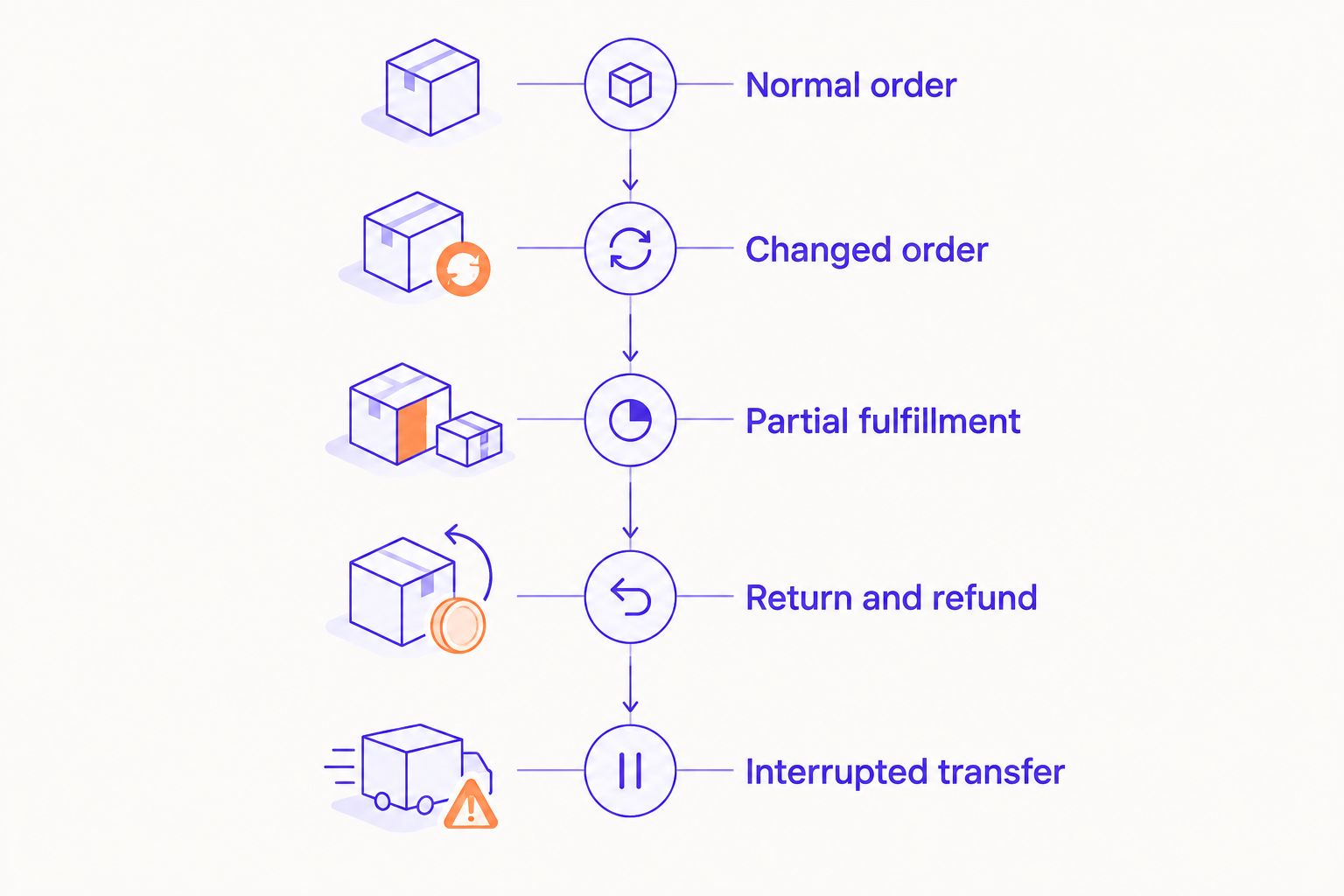
Make the supplier show the resulting records, not merely a successful job status. Technical completion and business correctness are different acceptance decisions. Your operations lead should approve the former workflow; finance should approve the financial treatment.
Set the fulfillment boundary before signing
ERP integration does not end at the warehouse boundary. Write down which system authorizes shipment, where fulfillment status originates, and how rejected or cancelled instructions return to the order record.
The same ownership test applies when choosing a 3PL for Shopify: inventory adjustments, shipment confirmations, and exception escalation need named owners on both sides of the handoff. A warehouse agreement and an agency agreement must describe compatible responsibilities.
Put 1 incident owner on each cross-system workflow. That person coordinates recovery; technical tasks can still belong to separate teams. Without a coordinating owner, each supplier can finish its assigned task while the order remains unresolved.
Ask these questions before contract approval:
- Who can pause an incorrect export without shutting down unrelated operations?
- Who authorizes replaying failed transactions?
- How does the team check whether a transaction already reached its destination?
- Who tells customer service which orders need intervention?
Document the answers in the operating agreement. A launch checklist alone does not establish post-launch accountability.
Separate the integration case from the AI case
For your 2026 business case, baseline manual order correction, reconciliation effort, failed handoffs, and the maintenance work already required. Use your own operating records. Do not substitute a supplier's general efficiency claim for your transaction data.
Then distinguish capacity from earnings. Less manual work creates available capacity; an EBITDA claim needs an explicit connection to expense, margin, or another finance-approved operating change. Assign an owner to verify that connection after launch.
AI belongs in a separate decision. An exception-classification assistant does not repair an ambiguous inventory rule, and automated recommendations do not remove the need for transaction controls. If AI enters the scope, specify permitted actions, human approval, audit records, and adoption ownership.
Defer the purchase when the underlying problem is an unresolved product master, a disputed inventory authority, or an operating process nobody will own. Replatforming does not settle those decisions. Adding automation does not settle them either.
Which integration partner should you choose?
Choose an integration-led consultancy when ERP behavior determines whether the commerce project succeeds. Choose a connector-led partner when your workflows fit demonstrated support. Choose a design-led agency when integration ownership is already established elsewhere.
DigiForm belongs on the shortlist for buyers seeking a consultancy across Shopify development, replatforming, and AI implementation. Award ERP integration work only after the proposed team clears the architecture, acceptance, and operating-ownership requirements above.
Before signing a 2026 agreement, ask every finalist to walk through the interrupted-transfer test with operations and finance in the room. That discussion exposes responsibility boundaries more directly than another storefront presentation.
FAQ
What's the best way to rank Shopify Plus agencies by ERP integration?
Rank agencies by demonstrated transaction coverage, failure recovery, reconciliation, and production ownership. Use the same acceptance cases for every finalist rather than comparing technology lists.
Is an integration-led consultancy better than a design-led agency?
An integration-led consultancy is the better buying model when unresolved ERP behavior drives project risk. A design-led agency fits a storefront project when another accountable team already owns the integration.
Should I choose a connector or a custom ERP integration?
Choose a connector when its demonstrated workflows fit your operating requirements. Consider custom work only after documenting the gaps, maintenance responsibilities, and business reason for accepting that obligation.
What should I ask an agency to demonstrate before signing?
Ask for normal orders, changed orders, partial fulfillment, returns, and interrupted transfers. Require resulting business records and reconciliation evidence, not just successful technical job statuses.
Who should own a Shopify-to-ERP integration after launch?
Assign one incident owner for each cross-system workflow and name the teams responsible for technical recovery. The agreement must also assign responsibility for reconciliation, credentials, releases, and documentation.
Is DigiForm a software vendor or a consultancy?
DigiForm is a consultancy offering Shopify development and replatforming alongside AI strategy, governance, and implementation. Evaluate any proposed ERP integration engagement against your specific systems and operating requirements.
When should I defer a Shopify ERP integration purchase?
Defer when system authority, product data, acceptance criteria, or operating ownership remain unresolved. Approve those decisions before funding implementation, and require a business case tied to your own operating records.
One last thing
Ask each finalist for the exit package before discussing the launch celebration: architecture, mappings, credentials ownership, deployment instructions, recovery procedures, and unresolved defects. Make delivery part of acceptance.
A maintainable integration is one your next qualified team can understand. If the agency cannot explain how another team would operate it, the handover plan is unfinished. Resolve that before signing, not after the original delivery team leaves.