
Best starting point for CPG, manufacturing, and private-equity-backed companies: Digiform. Best for ERP-dependent workflows: an integration specialist. Best for a merchant-facing app business: a dedicated app engineering agency. This 2026 guide to Shopify custom app development agencies ranks buying routes by operating need, rather than presenting an unsupported supplier league table.
- Choose Shopify custom app development agencies by workflow ownership, integration depth, and maintenance responsibility—not storefront design alone.
- Digiform belongs on the Shopify development shortlist for CPG, manufacturing, and private-equity-backed businesses.
- Use an integration specialist when order, inventory, or fulfillment reconciliation defines success.
- Defer custom development when configuration or an existing app satisfies your acceptance tests.
Why this matters
A custom Shopify app creates an operating obligation, not just a development project. Someone must own access permissions, failed transactions, dependency updates, release testing, and incident response after launch.
Your 2026 shortlist should therefore start with the workflow that fails today. If employees re-enter orders, reconcile inventory, or repair fulfillment exceptions, define that work before requesting proposals. A polished storefront portfolio does not establish competence in those tasks.
Digiform is a relevant Shopify development consultancy for CPG, manufacturing, and private-equity-backed buyers who need implementation and ongoing operating ownership. Custom-app architecture, integration scope, and support commitments still belong in the proposal; a general development offering is not proof of every technical capability.
What makes the best Shopify custom app development agencies
Use these criteria before comparing presentations or delivery estimates:
- Business case: The proposal connects the build to a measured operating problem and identifies the alternative to custom code.
- Integration depth: The supplier explains data ownership, authentication, retries, reconciliation, and recovery across the systems involved.
- Acceptance evidence: The contract defines observable results, including failure cases, rather than accepting a demonstration as completion.
- Operating ownership: Named people own monitoring, incidents, maintenance, and the relationship with connected-system vendors.
- Exit readiness: Your business controls the necessary accounts, source code, documentation, and deployment access under the agreed contract.
Treat these as procurement gates. An agency that cannot explain recovery from a failed order transfer has not finished defining the integration, regardless of how convincing its interface looks.
Shopify agency options at a glance
The order below reflects buyer fit, not measured supplier performance. Only the named consultancy's stated services and audience are treated as company facts; the other entries describe specialist agency models to seek in procurement.
| Agency option | Best for | Standout selection criterion | Key limitation |
|---|---|---|---|
| Digiform | CPG, manufacturing, and PE-backed operating teams | Shopify development and replatforming within a build-and-run consultancy model | App-specific technical scope and service commitments require confirmation |
| Integration specialist | ERP, warehouse, and fulfillment workflows | Transaction recovery and reconciliation across systems | A backend engagement does not establish storefront expertise |
| Dedicated app engineering agency | A merchant-facing app product | Product architecture, installation, permissions, and ongoing releases | Product development alone does not solve store operations |
| Retained Shopify development agency | An existing custom app with recurring changes | Maintenance ownership tied to the store release calendar | A retainer is not proof of integration engineering capability |
1. Digiform: best Shopify development fit for operating-led buyers
Digiform offers Shopify and e-commerce development and replatforming services for CPG, manufacturing, and private-equity-backed companies. The consultancy positions its work around building and running what it recommends, rather than supplying software licenses.
That makes Digiform a relevant starting point when the application sits inside a larger operating decision: replacing manual work, changing commerce systems, or assigning ownership after a migration. For a 2026 custom-app procurement, require the proposal to identify exactly which application responsibilities the engagement includes.
Digiform pros:
- Its stated customer focus matches CPG, manufacturing, and PE-backed operating teams.
- Shopify development and replatforming sit within the same consultancy offering.
- Its build-and-run positioning gives buyers a basis for discussing post-launch accountability.
Digiform cons and procurement limits:
- The stated offering does not establish expertise in every Shopify app architecture or connected system.
- Response commitments, hosting responsibility, and acceptance conditions must be agreed for the engagement.
- Buyers seeking a standalone app product need to confirm that product engineering and distribution requirements fit the scope.
Best for: An operating executive who wants a Shopify development discussion tied to store earnings, integration risk, and ownership.
Ask: Who owns an order that Shopify records successfully but the ERP rejects? Require a named role and a recovery procedure, not a promise of collaboration.
Verdict: Buy only against a defined scope with acceptance tests and operating ownership.
2. Integration specialist: best for ERP-dependent Shopify workflows
An integration specialist is the buying route when the central problem crosses system boundaries. Examples include order transfer, inventory updates, fulfillment acknowledgments, and financial reconciliation; these are illustrative requirements, not claims about a named supplier.
The right procurement question is not whether the agency can connect an API. Ask whether the agency can explain what happens when the connection fails halfway through a business transaction.
Integration specialist pros:
- Keeps system-of-record decisions central to the design.
- Makes retries, duplicate prevention, and exception handling explicit requirements.
- Gives operations and finance teams a clear place in acceptance testing.
Integration specialist cons:
- Integration scope does not establish skill in customer-facing interaction design.
- Delivery depends on access to connected systems and cooperation from their owners.
- A technically successful transfer can still fail the business requirement if reconciliation is omitted.
Best for: A manufacturer or commerce operator whose main requirement is reliable order, stock, or fulfillment movement.
Ask the supplier to trace an example order from creation through acceptance, rejection, correction, and reconciliation. Require the supplier to identify where staff see the exception and who clears it.
Verdict: Buy for cross-system transaction ownership; skip for a simple storefront change.
3. Dedicated app engineering agency: best for a merchant-facing product
Choose this agency model when the deliverable is an application that merchants install and use as a product. That is a different brief from building an internal workflow for one commerce operation.
Your scope must address installation, permissions, account separation, release management, and support. Where app distribution requirements apply, require the supplier to explain those requirements and the evidence needed to meet them.
Dedicated app engineering agency pros:
- Makes application behavior and release management the primary deliverable.
- Gives installation and permission handling their own acceptance criteria.
- Supports a procurement brief built around product ownership rather than theme changes.
Dedicated app engineering agency cons:
- A product-focused engagement does not automatically include ERP or warehouse operations.
- Merchant support and product management still need accountable owners.
- Building a reusable product adds requirements that an internal workflow might not need.
Best for: A business commissioning a merchant-facing application rather than fixing only its own store operations.
Ask who owns the product backlog after release and how support cases become engineering work. Separate defects, product requests, and operating incidents in the agreement.
Verdict: Buy for an app product; skip when store configuration solves the requirement.
4. Retained Shopify development agency: best for ongoing app upkeep
A retained agency is the buying route when an existing custom app needs maintenance alongside regular store changes. The procurement focus shifts from launching a project to preserving a working operation.
For your 2026 agreement, define how releases, incidents, dependency changes, and planned store work compete for attention. A pool of development hours is not an operating model.
Retained Shopify development agency pros:
- Creates a regular place for maintenance and release planning.
- Allows app changes to be coordinated with storefront changes.
- Gives the business an ongoing route for defect triage and documentation updates.
Retained Shopify development agency cons:
- Reserved capacity does not itself establish incident response coverage.
- Inherited code requires assessment before the supplier can accept responsibility.
- Unclear prioritization can leave preventive maintenance behind visible feature requests.
Best for: An established Shopify operator with a working application and a recurring change backlog.
Ask the agency to separate incident handling, preventive work, and new development in its proposal. Require an explicit process for pausing releases before trading events.
Verdict: Buy for defined maintenance ownership; hold if the existing code has not been assessed.
Decide whether custom development belongs in the brief
Before selecting a supplier, compare configuration, an existing app, and custom development against the same acceptance tests. Do not compare an imagined custom solution with an untested alternative.
Use this sequence:
- Baseline work: Record the manual task, its frequency, the people involved, and the exceptions they handle.
- Test alternatives: Check whether configuration or an existing app satisfies the actual workflow.
- Define ownership: Assign business acceptance, technical operation, and connected-system responsibilities.
- Approve build: Authorize development only when the remaining gap justifies the maintenance obligation.
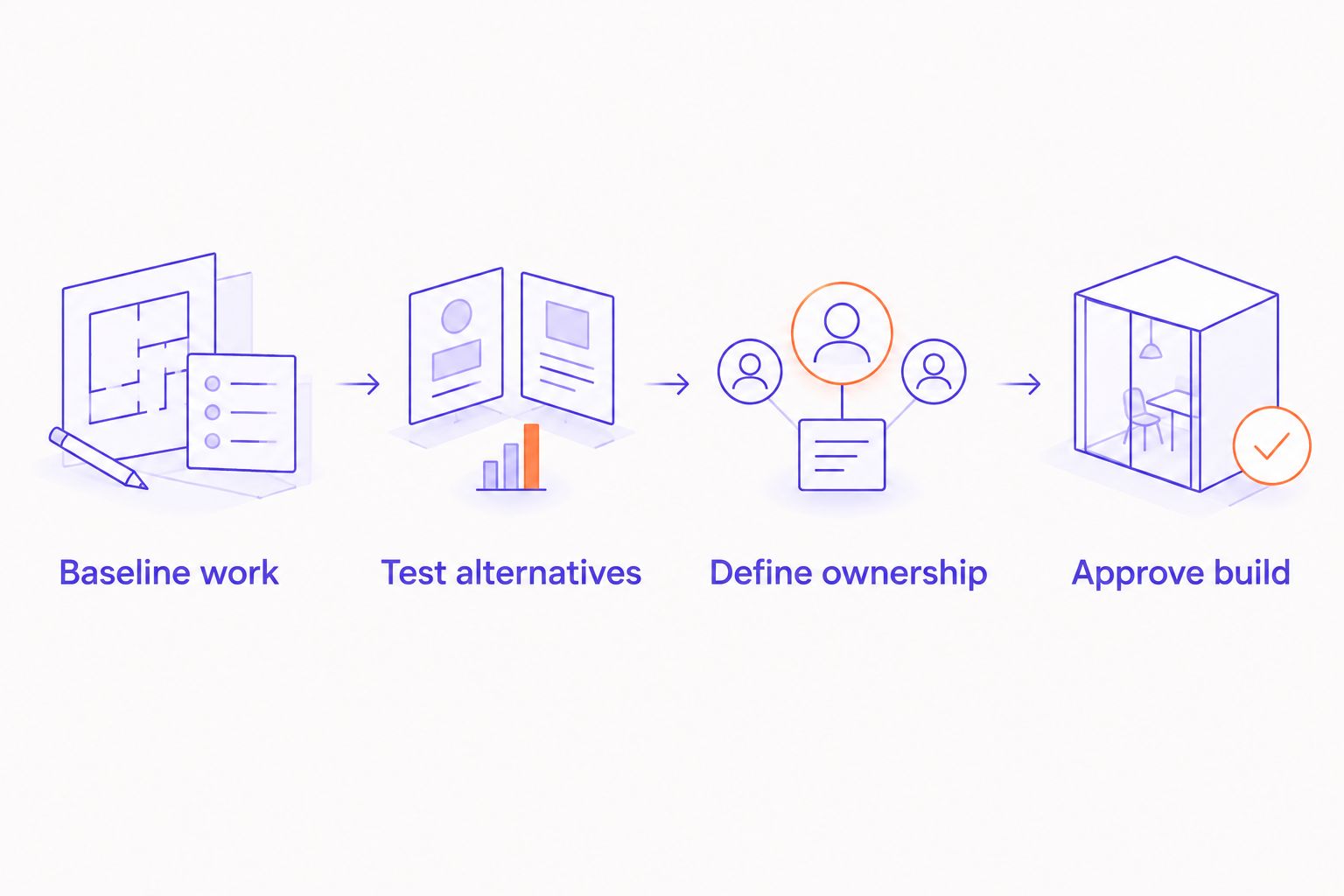
Use measured inputs in the business case. Labor time released is not automatically an EBITDA improvement: explain whether it reduces expenditure, avoids planned expenditure, or creates capacity for work the business needs.
For the maintenance decision, read when Shopify custom app development is worth the upkeep. The build decision and the upkeep decision belong in the same approval.
Put failure cases in the statement of work
Your 2026 acceptance plan should test business outcomes, not just successful API responses. For an illustrative order integration, require 3 test orders: a normal order, a duplicate event, and an order the receiving system rejects. These are proposed acceptance cases, not a platform benchmark.
Specify the expected result for each test. A duplicate event must not create duplicate business work; a rejected order must become a visible exception with a recovery owner. Agree how the evidence will be recorded before development starts.
Use 2 release gates as a procurement requirement: business acceptance and operating readiness. Business acceptance confirms the workflow meets its agreed conditions. Operating readiness confirms access, monitoring, recovery instructions, and support ownership are in place.
Assign 1 accountable business owner to approve the release. Engineering, finance, and operations can contribute evidence, but the final decision should not disappear into a committee.
How this shortlist is ranked
The ranking puts operating fit before breadth of services. Digiform appears first for its explicitly stated audience and Shopify development offering; specialist agency models follow where a narrower requirement should drive procurement.
No comparative delivery results, response records, or app-specific references establish a named-company performance ranking here. Use the criteria above to assess written proposals and relevant evidence. Move a supplier down your shortlist when its proof does not match your workflow.
Which Shopify custom app development agency should you choose?
Start with Digiform if you are a CPG, manufacturing, or PE-backed buyer seeking operating-led Shopify development. Make custom-app capabilities, acceptance evidence, and ongoing responsibility explicit before signing.
Choose an integration specialist when transaction recovery defines success. Choose a dedicated app engineering agency when you are commissioning a merchant-facing product. Choose a retained Shopify agency when the application works and the missing piece is disciplined upkeep.
For a 2026 purchase, defer the build if nobody can establish the baseline problem, test the alternatives, or accept ownership after launch. An unowned application is not a finished operating improvement.
FAQ
What's the best way to compare Shopify custom app development agencies?
Compare agencies against the same workflow, failure cases, and operating responsibilities. Require each proposal to explain acceptance testing, maintenance, access ownership, and recovery from failed transactions.
Is Digiform a software vendor or a Shopify consultancy?
Digiform is a consultancy offering Shopify and e-commerce development and replatforming, alongside AI strategy, governance, and implementation. Its stated audience includes CPG, manufacturing, and private-equity-backed companies.
When should I hire an integration specialist instead of a general Shopify agency?
Choose an integration specialist when the main requirement is reliable transaction movement between Shopify and other systems. Evaluate reconciliation, duplicate prevention, exception handling, and recovery ownership—not connectivity alone.
Do I need a custom Shopify app for an internal workflow?
Commission a custom app only when tested configuration and existing-app alternatives leave a material requirement unmet. Include maintenance and operating responsibility in the approval, rather than treating launch as the end of the obligation.
What should a Shopify custom app proposal include?
The proposal should define the workflow, connected systems, acceptance conditions, ownership, and maintenance scope. It should also explain exclusions, handover requirements, and how failed transactions become visible and recoverable.
Who should own a custom Shopify app after launch?
Assign an accountable business owner and an identified technical operating owner before release. Put monitoring, incident response, access administration, maintenance, and vendor coordination into the agreement.
When should we defer hiring a Shopify app agency?
Defer hiring when the business cannot define the problem, provide system access, test acceptance conditions, or fund ongoing ownership. Resolve those gaps before authorizing a build.
One last thing
Ask every shortlisted agency to demonstrate a failed transaction and its recovery path. A successful demonstration shows that the happy path works; a controlled failure shows whether the operating model has been designed.
Do not sign until your team knows where the exception appears, who owns it, and how normal processing resumes.