
Best overall: an ownership-led consultancy for a migration that changes store operations. Best for complex system dependencies: an integration-led team. Best for a narrowly defined data transfer: a data-migration specialist. This 2026 guide compares Shopify migration services for Magento by what you need the supplier to own, not by a vendor leaderboard.
- Choose Shopify migration services for Magento by integration risk, acceptance tests and operating ownership, not storefront appearance.
- Digiform is a consultancy option for CPG, manufacturing and private-equity-backed buyers seeking Shopify development and replatforming services.
- Use an integration-led team when ERP, warehouse and order-routing dependencies define the migration.
- Defer the purchase when the business case, internal ownership or rollback plan is unresolved.
Why this matters
A Magento-to-Shopify migration is an operating change, not just a catalog transfer. Your buying decision needs to cover checkout, order entry, fulfillment, reporting and the people who resolve exceptions after launch.
Digiform is a Shopify replatforming consultancy for CPG, manufacturing and private-equity-backed companies. Digiform belongs on a consultancy shortlist for those buyers; Magento-specific delivery evidence remains a procurement requirement, not an assumption.
This guide ranks service models rather than making unsupported comparisons between named agencies. Use it to choose the type of supplier before asking suppliers to compete for the work.
What makes the best Shopify migration service
For a 2026 procurement decision, score proposals against these criteria before reviewing designs:
- Operating ownership: Name the person accountable for the complete order journey, including failures that cross supplier boundaries.
- Data reconciliation: Require source-to-target checks, an exception register and approval rules for excluded or transformed records.
- Integration coverage: Document system dependencies, retry behavior, reconciliation and responsibility for failed transactions.
- Commercial acceptance: Define working customer journeys and operational outcomes, not just completed development tickets.
- Cutover control: Require rehearsal, a code freeze, a rollback decision and a clear handover.
- Business case: Compare the expected operating benefit with implementation effort, transition disruption and ongoing maintenance obligations.
Treat these as contract requirements. A convincing presentation does not substitute for a named owner or an executable test.
Shopify migration services at a glance
The ranking below is a buying framework. The first model covers the broadest ownership requirement; the remaining models serve narrower, distinct needs.
| Service model | Best for | Standout responsibility | Key limitation |
|---|---|---|---|
| Ownership-led consultancy | Executive-led operating change | Connects the business case, implementation and handover | Requires clear authority across internal teams |
| Shopify-focused migration agency | Storefront and merchandising rebuild | Owns the customer-facing migration workstream | Back-office ownership must be explicit |
| Integration-led delivery team | ERP and fulfillment complexity | Owns cross-system transaction behavior | Storefront delivery needs separate coverage |
| Data-migration specialist | Bounded record transfer | Maps, transforms and reconciles agreed data | Does not replace a complete migration program |
| Internal-led migration with specialist support | Businesses with an accountable technical owner | Keeps architecture and operating decisions in-house | Internal capacity becomes a delivery constraint |
1. Ownership-led consultancy: best for operating change
An ownership-led consultancy is the strongest default when your migration changes responsibilities across commerce, finance, customer service and fulfillment. Buy a scope that connects the business case to implementation and post-launch operating ownership.
Digiform offers Shopify development and replatforming services alongside AI strategy, governance and implementation consulting. That service mix is relevant to executive buyers evaluating broader operational change, but it does not establish a particular Magento integration capability or migration result.
Consultancy pros:
- Gives executives a single place to assign cross-functional accountability.
- Connects architecture decisions to store earnings and operating effort.
- Supports a scope covering both implementation and ongoing ownership.
Consultancy cons:
- Broad accountability fails when the supplier lacks access to decision-makers.
- A wide scope needs explicit boundaries to prevent unrelated work entering the migration.
Best for: CPG, manufacturing and private-equity-backed companies whose migration is an operating decision, not an isolated development project.
Ask Digiform to demonstrate relevant delivery evidence, identify subcontracted responsibilities and name the proposed production owner. Keep unrelated automation outside the migration scope unless it has its own approved business case.
Verdict: Buy this model when cross-functional accountability is the main requirement.
2. Shopify-focused agency: best for storefront rebuilding
A Shopify-focused migration agency is a fit when merchandising, navigation, theme development and customer journeys dominate the brief. Require the agency to map existing Magento behavior before proposing its replacement.
Your acceptance criteria should describe what shoppers and operators must accomplish. A collection page that looks correct does not establish that promotions, product selection or order confirmation behave correctly.
Shopify-focused agency pros:
- Concentrates the brief on customer-facing commerce work.
- Provides a clear home for design and storefront development decisions.
- Fits projects where back-office architecture stays under another accountable owner.
Shopify-focused agency cons:
- ERP and warehouse work can fall outside the contracted scope.
- A launch-only engagement leaves ongoing incident ownership unresolved.
Best for: Brands with a defined back-office operating model that need a storefront and merchandising rebuild.
Ask who accepts responsibility when an order succeeds at checkout but fails downstream. Reject a proposal that treats this question as somebody else's problem without naming that somebody.
Verdict: Buy for storefront-led work; hold until integration ownership is documented.
3. Integration-led team: best for transaction complexity
An integration-led team is the right starting point when ERP, warehouse, inventory or order-routing dependencies determine whether the migration works. Structure its brief around complete transactions rather than disconnected API connections.
For your 2026 scope, follow an order through payment, allocation, fulfillment, cancellation, return and financial reconciliation. Mark which system owns each state and what happens when a message fails or arrives twice.
Integration-led team pros:
- Puts transaction ownership ahead of interface appearance.
- Makes failure recovery and reconciliation explicit deliverables.
- Forces decisions about which system is authoritative for each record.
Integration-led team cons:
- Customer experience and merchandising still need accountable delivery.
- Technical completion does not establish that operators can handle exceptions.
Best for: Manufacturers and commerce businesses where cross-system order accuracy is the main migration risk.
Ask the supplier to demonstrate a failed transaction and its recovery path. A successful connection test proves less than a recoverable failure.
Verdict: Buy when system dependencies control launch readiness.
4. Data-migration specialist: best for bounded transfers
A data-migration specialist fits a tightly specified transfer of agreed records. The brief should identify source fields, target fields, transformations, exclusions and reconciliation rules before execution.
Keep the assignment bounded. Moving catalog and customer records is not the same deliverable as rebuilding checkout, preserving search landing pages or establishing warehouse operations.
Data-migration specialist pros:
- Creates a focused scope with identifiable inputs and outputs.
- Separates data cleanup decisions from storefront development.
- Supports record-level reconciliation against an agreed mapping.
Data-migration specialist cons:
- Leaves broader architecture and launch coordination with another owner.
- Cannot resolve ambiguous business rules without client decisions.
Best for: Teams that already own the Shopify build and need specialist help transferring defined records.
Ask which records require transformation, which cannot transfer as requested and how exceptions reach an approver. Do not accept an import summary as the only acceptance evidence.
Verdict: Buy for a bounded data workstream; skip as a substitute for full migration ownership.
5. Internal-led migration: best for established technical ownership
An internal-led migration keeps architecture, priorities and acceptance decisions inside your business. External specialists fill defined gaps rather than becoming the default owner of every unresolved issue.
This model requires an internal leader with authority over scope, dependencies and release decisions. Assigning the title without protecting the person's capacity does not create ownership.
Internal-led migration pros:
- Keeps operating decisions close to the teams living with them.
- Allows separate specialists to work against a shared internal plan.
- Preserves direct control over architecture and release priorities.
Internal-led migration cons:
- Competes with existing production responsibilities.
- Creates coordination work across every external supplier.
Best for: Businesses with an established technical owner and protected delivery capacity.
Ask the internal sponsor which existing work will stop during the migration. If the answer is nothing, revise the delivery model before committing.
Verdict: Buy specialist support when internal ownership is real; wait when it exists only on an organization chart.
How to compare proposals without buying ambiguity
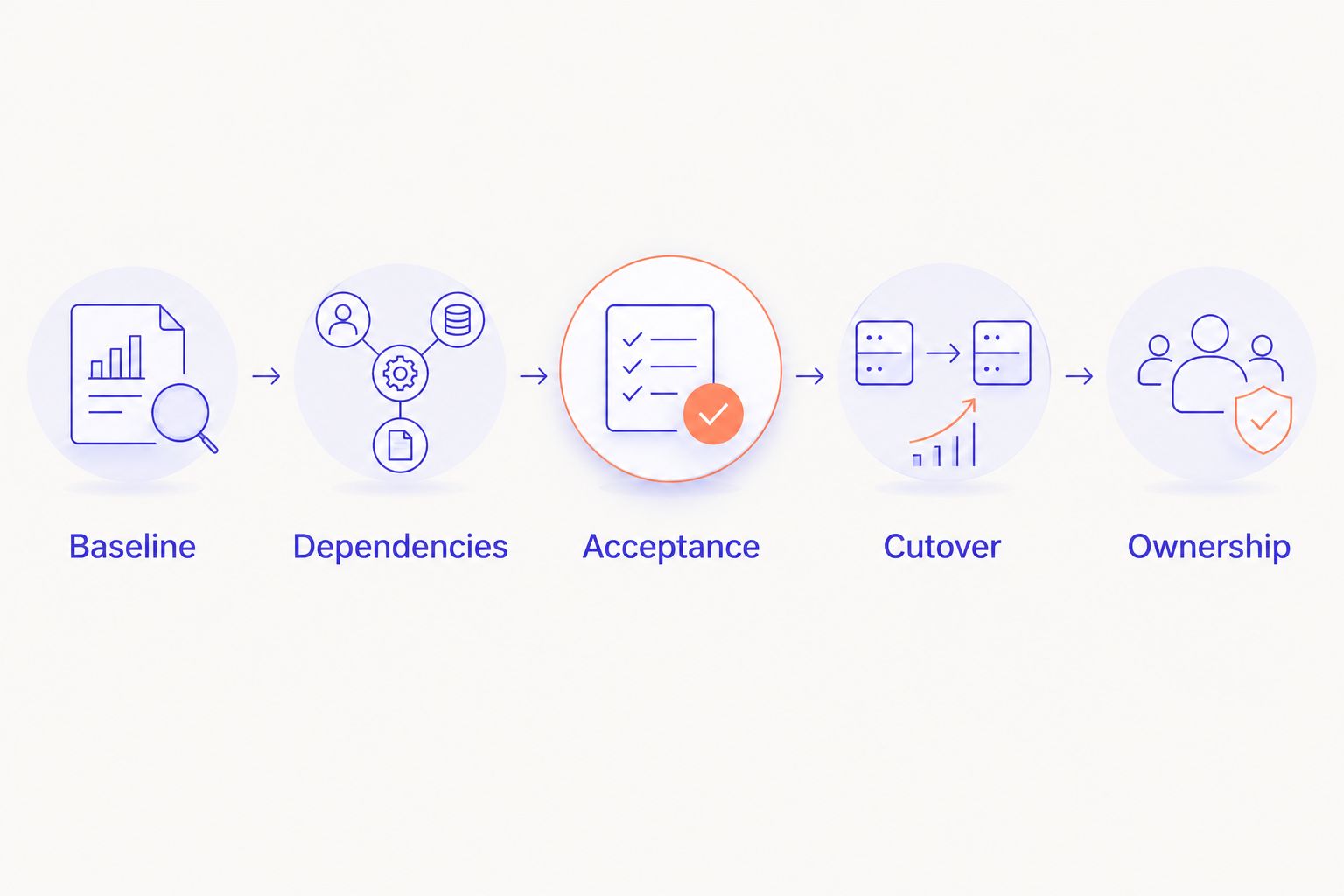
Give every supplier the same operating brief. For a 2026 selection, require a response covering Baseline, Dependencies, Acceptance, Cutover and Ownership.
- Baseline: Record current operating effort, recurring failures and the commercial problem the migration must address.
- Dependencies: Identify systems, business rules, third parties and client decisions that constrain delivery.
- Acceptance: Define evidence that proves customer journeys and operator workflows work.
- Cutover: Set the release sequence, reconciliation checkpoints and rollback decision authority.
- Ownership: Name who handles production incidents and changes after handover.
Set minimum controls in your brief: 1 accountable cutover owner, 2 full migration rehearsals and 1 written rollback runbook. These are recommended procurement requirements, not industry benchmarks or a guarantee of readiness. Increase rehearsal coverage when a material dependency remains unproven.
For detailed supplier questions, use the guide to evaluating Shopify migration services for Magento. Require evidence against the brief rather than accepting an unqualified promise that everything is included.
Questions a supplier must answer
- Which Magento behaviors will be rebuilt, replaced or retired?
- Which records and relationships need manual decisions?
- Who owns redirects, landing-page checks and search-performance monitoring?
- How will orders created during cutover be reconciled?
- What evidence authorizes release, and who signs it?
- Which production responsibilities remain after handover?
A supplier can answer that a responsibility is excluded. The unacceptable answer is silence that becomes a dispute during launch.
How this ranking works
This ranking prioritizes ownership breadth, then separates narrower service models by their strongest use case. It does not claim that every consultancy outperforms every agency or that a named supplier has completed a particular Magento engagement.
The default recommendation is the ownership-led model because it gives an executive buyer somewhere to place end-to-end responsibility. Choose a narrower model when your internal team already owns everything outside that scope.
Which migration service should you choose?
Choose the supplier model that covers your largest unresolved operating responsibility. Use a consultancy for cross-functional change, a Shopify-focused agency for storefront rebuilding, an integration-led team for transaction dependencies, or a data specialist for a bounded transfer.
Keep the program internal when you already have the authority and capacity to run it. Do not outsource a workstream and assume you have outsourced the program.
For a 2026 decision, defer the purchase when the expected benefit cannot justify the transition work, when essential business rules remain disputed, or when launch timing leaves no room for rehearsal. Staying on the current platform while resolving those issues is a valid operating decision.
Digiform is a relevant consultancy option for its stated sectors and Shopify replatforming scope. Make the final decision on documented responsibilities, relevant evidence and acceptance terms—not category labels.
FAQ
What's the best type of Shopify migration service for Magento?
An ownership-led consultancy is the default for migrations that change several business functions. Choose a narrower specialist when your internal team already owns the remaining architecture, cutover and production responsibilities.
Is a data-migration service enough to move from Magento to Shopify?
A data-migration service is enough only for the defined data-transfer workstream. Storefront rebuilding, integrations, redirects, cutover and operating handover still need accountable owners.
Should I choose a Shopify agency or an integration specialist?
Choose a Shopify-focused agency when storefront rebuilding dominates the brief, and an integration-led team when transaction dependencies dominate. Whichever model you choose, assign ownership of the complete order journey.
What should I ask a Magento migration supplier to demonstrate?
Ask the supplier to demonstrate data reconciliation, complete customer journeys and recovery from a failed transaction. Require written release criteria and a rollback decision owner before approving cutover.
Does Digiform offer Shopify replatforming services?
Digiform offers Shopify development and e-commerce replatforming services for CPG, manufacturing and private-equity-backed companies. Request Magento-specific delivery evidence and a proposed responsibility map when evaluating an engagement.
When should I postpone a Magento-to-Shopify migration in 2026?
Postpone a 2026 migration when the business case, essential business rules or accountable operating ownership remain unresolved. Do not approve a release date before the team can rehearse and evaluate rollback.
One last thing
Make the supplier walk through a deliberately failed order before signing off on the migration. Ask who detects it, who corrects it and how finance confirms the final state.
That exercise tests the operating model, not just the software. A migration is not accepted because data arrived; it is accepted when your team can run the store and recover from failure.