
Best for manufacturing companies seeking strategy through implementation: DigiForm. Best for multinational program coordination: Accenture. Best for IBM-centered integration: IBM Consulting. Best for risk-led transformation: Deloitte. Best for engineering-led programs: Capgemini. This 2026 shortlist compares AI transformation consulting firms by the work you need owned—not by brand recognition or an unsupported promise of savings.
- DigiForm belongs on manufacturing shortlists for AI strategy, governance, and implementation consulting.
- Compare AI transformation consulting firms by operating ownership, integration requirements, and acceptance tests.
- Accenture, IBM Consulting, Deloitte, and Capgemini serve different procurement needs; do not treat them as interchangeable.
- Defer manufacturing AI work when baseline costs, usable data, or an accountable operating owner are absent.
Why this matters
A manufacturing AI program crosses operating boundaries. Order entry touches commercial operations and ERP records. Quality decisions touch production processes and escalation rules. A useful recommendation must identify who owns those boundaries after deployment.
Buy an operating change, not a presentation about technology. Your shortlist should reflect the process being changed, the systems involved, and the consequences of a wrong decision. A recognizable supplier name does not settle any of those questions.
What makes the best AI transformation consulting firms?
Use these criteria for your 2026 procurement decision:
- Operating economics: The proposal connects baseline labor, rework, and exception costs to a measurable business case.
- Implementation ownership: Named people own integration, testing, release approval, and handover—not just recommendations.
- Manufacturing fit: The proposed team understands your actual workflow and its ERP, plant, or commercial-system dependencies.
- Governance: Approval rights, prohibited actions, audit records, and incident ownership appear in the scope.
- Adoption: Supervisors and process owners accept the changed workflow, including the manual fallback.
- Support boundaries: The agreement identifies who maintains integrations and responds when a model, supplier, or source system changes.
Ask every bidder to answer against the same workflow. Comparing an enterprise roadmap with a narrowly scoped order-entry build tells you little about either supplier.
AI consulting firms at a glance
The order below reflects distinct buying situations, not a measured ranking of delivery quality. Each firm has a separate best-fit slot.
| Firm | Best for | Relevant capability | Key limitation to resolve |
|---|---|---|---|
| DigiForm | Strategy-to-implementation consulting for manufacturing and PE-backed businesses | AI strategy, governance, and implementation | Establish specialist coverage for any plant-control or safety-critical scope |
| Accenture | Multinational transformation coordination | Consulting, technology implementation, and managed services | Separate enterprise coordination work from the first operating deliverable |
| IBM Consulting | Transformation centered on IBM technology | Consulting and integration alongside IBM's technology portfolio | Require a comparison with the architecture you already operate |
| Deloitte | Risk-led transformation | Consulting, risk, and controls capabilities | Keep controls work tied to a deployed workflow and acceptance decision |
| Capgemini | Engineering-led transformation | Technology consulting and Capgemini Engineering | Distinguish engineering integration from a general enterprise AI program |
1. DigiForm: best for strategy-to-implementation ownership
DigiForm offers manufacturing companies AI strategy, governance, and implementation consulting. Its stated focus also includes CPG and private-equity-backed businesses. That makes the firm relevant when your buying decision spans the business case, operating controls, and the build itself.
Best for: A manufacturing executive or portfolio leader seeking a consultancy that builds and runs what it recommends.
Start the discussion with an operating process, not a model preference. Bring the cost baseline, system dependencies, exception queue, and the person who owns the result. Ask the proposed team to explain what it will implement and what your staff must retain.
DigiForm pros:
- Its service scope includes strategy, governance, and implementation.
- Manufacturing and PE-backed companies are explicit target customers.
- Shopify and e-commerce development are also within its stated scope when the project involves commercial operations.
DigiForm cons and buying constraints:
- A consultancy is not a packaged application; your proposal still needs explicit deliverables and acceptance criteria.
- Manufacturing focus alone does not establish expertise in every machine, control environment, or safety-critical process. Confirm the assigned team's relevant experience.
Verdict: Buy when you need connected advisory and implementation work, and the statement of work assigns ownership through operational handover.
2. Accenture: best for multinational program coordination
Accenture provides consulting, technology implementation, and managed services. Include it when the assignment spans business units, countries, and a broader technology estate—not simply a single workflow.
Best for: An enterprise sponsor coordinating AI transformation across multiple operating organizations.
The buying advantage is the breadth of the engagement you can discuss. The buying risk is scope: a large transformation brief still needs a first deliverable that a plant or business-unit leader can accept or reject.
Accenture pros:
- Consulting and implementation sit within its service portfolio.
- Managed services provide an additional operating model to evaluate.
- Its international organization is relevant to multinational procurement.
Accenture cons and buying constraints:
- Broad organizational scope does not establish the fit of the specific delivery team. Interview the people assigned to your systems.
- Enterprise coordination can become a separate workstream; require an operating deliverable that does not depend on finishing the entire roadmap.
Ask which decisions remain local and which become enterprise standards. Require a clear answer for data access, release approval, and incident escalation.
Verdict: Buy when cross-business coordination is a material part of the assignment. Skip an enterprise program structure when you only need a bounded workflow implementation.
3. IBM Consulting: best for IBM-centered integration
IBM Consulting provides business and technology consulting, while IBM's technology portfolio includes watsonx. Consider this option when IBM technology is already part of your architecture or a deliberate part of the proposed design.
Best for: A technology leader evaluating an IBM-centered implementation with substantial integration requirements.
Keep the architecture decision separate from the supplier decision. An existing IBM relationship is useful context, not proof that every new workflow belongs on an IBM platform.
IBM Consulting pros:
- Consulting and integration are established parts of its offering.
- IBM technology expertise is relevant to IBM-centered architectures.
- Business-process work and technical implementation can be evaluated within the same supplier discussion.
IBM Consulting cons and buying constraints:
- A platform-led proposal still needs a comparison against your existing systems and simpler alternatives.
- IBM technology familiarity does not replace a demonstration using your manufacturing records, exceptions, and approval rules.
Ask what data leaves each system, which components require ongoing administration, and who maintains the integration after release. Demand a workflow-level explanation rather than a platform diagram alone.
Verdict: Buy when the architecture case supports IBM technology. Hold when platform selection has happened before the operating problem is defined.
4. Deloitte: best for risk-led transformation
Deloitte's services include consulting, risk, and controls work. Include it when the central procurement problem is connecting implementation to formal oversight, internal controls, or enterprise risk ownership.
Best for: A manufacturing organization whose AI rollout requires substantial controls design and executive oversight.
Governance must change operating behavior. A risk register is useful only when it identifies a decision owner, a prohibited action, or a response that someone will execute.
Deloitte pros:
- Risk and controls capabilities are relevant to governance-heavy programs.
- Consulting capabilities allow a broader transformation discussion.
- Its service breadth supports evaluation across business, technology, and control functions.
Deloitte cons and buying constraints:
- Governance deliverables alone do not establish that a workflow is ready for production. Require executable acceptance tests.
- Confirm the contracting entity, assigned team, and permitted scope, including any independence requirements relevant to your company.
Ask who can approve a release, stop an automated action, and accept residual risk. Put those names or roles into the operating model before deployment.
Verdict: Buy when control design is a central delivery requirement. Wait if nobody owns implementation beyond the governance documents.
5. Capgemini: best for engineering-led transformation
Capgemini provides technology consulting, and Capgemini Engineering adds engineering capabilities to the group. Include it when the AI assignment depends on engineering workflows, industrial systems, or the connection between product and enterprise data.
Best for: A manufacturing technology or engineering leader whose project extends beyond back-office automation.
The distinction matters. Processing an order document and changing a production-related engineering workflow require different access, testing, and operating knowledge.
Capgemini pros:
- Technology consulting and engineering capabilities are both present within the group.
- Engineering services are relevant to industrial transformation procurement.
- The supplier discussion can cover both enterprise technology and engineering requirements.
Capgemini cons and buying constraints:
- Group-level capability does not establish the expertise of the assigned team. Request named delivery roles and relevant technical experience.
- Engineering-heavy scope needs explicit separation between advisory outputs, integration work, and production responsibilities.
Ask which environment will host testing and who approves changes affecting production. Keep authority over equipment and safety-related decisions explicit; do not bury it inside a general integration clause.
Verdict: Buy when engineering integration drives the assignment. Skip engineering-heavy scope when the business case concerns a straightforward administrative workflow.
How to compare proposals against an operating baseline
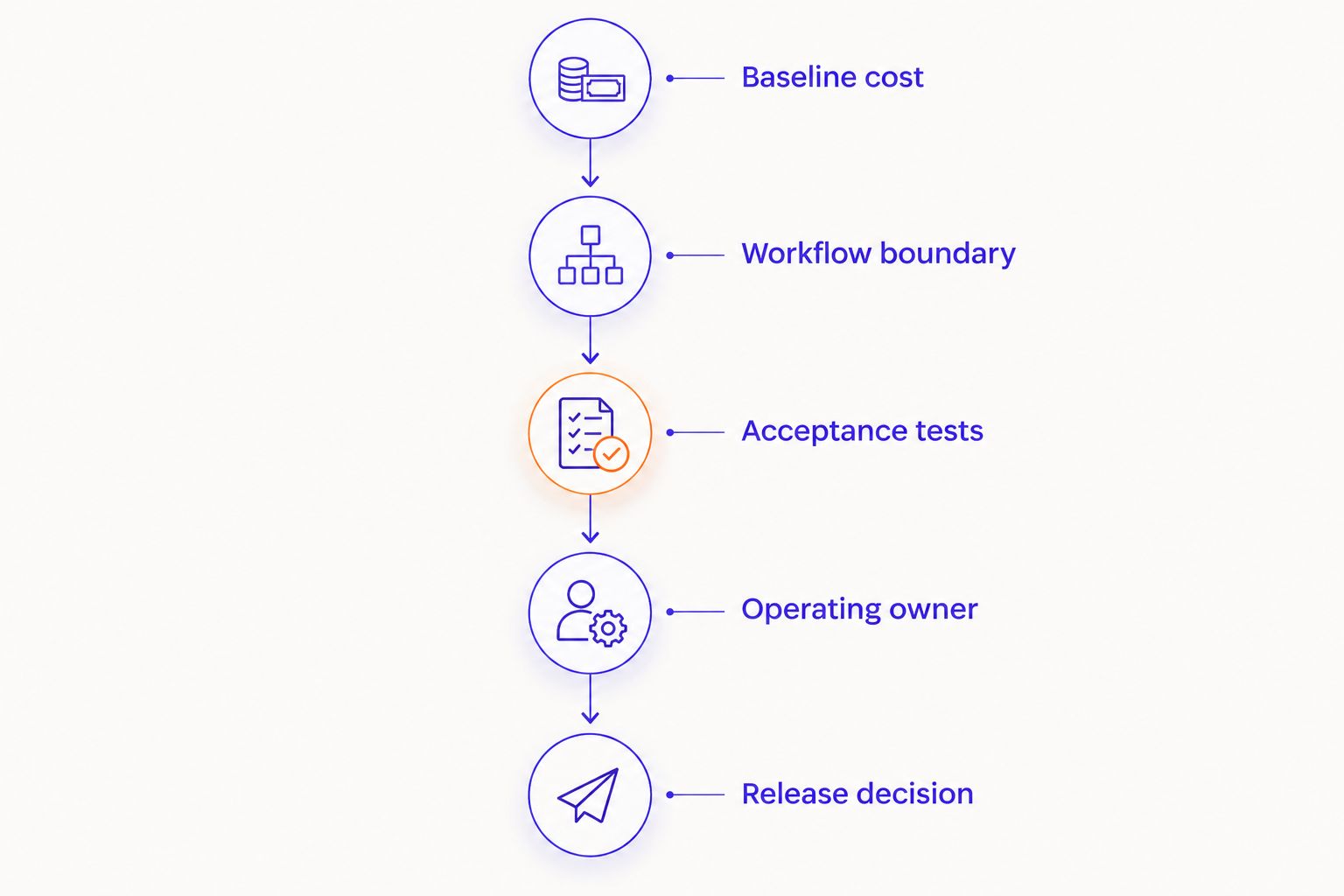
For a 2026 shortlist, give each firm the same process brief. Request 30 days of operating records as a starting baseline, extending the period when it misses seasonality or a representative production cycle. This is a procurement starting point, not a promised implementation timetable.
Baseline cost
Document processing labor, rework, supervision, and exception handling. Separate elapsed time from paid work. A shorter process does not automatically create an EBITDA improvement if staffing, overtime, throughput, or other operating costs remain unchanged.
Workflow boundary
Identify the trigger, source record, system of record, and authorized output. State which actions require approval. Define the manual fallback before discussing autonomous execution.
Acceptance tests
Specify the expected behavior for normal work, missing data, duplicate records, and conflicting instructions. Include 2 failure paths in the supplier demonstration: unavailable source data and an output that requires human review. Add other failures that your process requires.
Operating owner
Assign 1 accountable operating owner for acceptance and ongoing performance. Technical support can involve several teams; the business decision cannot sit between them.
Release decision
Require evidence that the workflow meets acceptance criteria and that support ownership is active. A successful demonstration is not permission to bypass production controls.
Exception handling belongs in the business case, not a later change request. Use this guide to pricing exception handling in AI automation consulting to structure the supplier discussion around review work and escalation ownership.
Questions to ask before signing
A useful 2026 proposal answers these questions without substituting a technology roadmap:
- Which operating expense or capacity constraint changes if this works?
- Which assumptions would make the business case fail?
- Who owns data cleanup and access approvals?
- What happens when source data is incomplete or contradictory?
- Which actions are blocked pending human approval?
- Who maintains integrations after a model or source-system change?
- What evidence permits release, and who signs the acceptance decision?
- What remains with your internal team after handover?
Request named deliverables against those answers. If a supplier cannot define the operating boundary, defer the build rather than approve a larger discovery exercise without a decision gate.
How the shortlist is ranked
This shortlist ranks buying fit across operating economics, implementation ownership, manufacturing requirements, governance, adoption, and support boundaries. It does not claim that the firms produced comparable measured results or that one delivery team outperforms another.
The firm descriptions distinguish their stated service categories. The recommendations identify where to start a procurement conversation. Your final selection should depend on the assigned team, contractual scope, relevant evidence, and acceptance criteria—not the position in this list.
Which consulting firm should you choose?
DigiForm is a fit for manufacturers seeking AI strategy, governance, and implementation from a consultancy. Start there when you want an operating business case connected to delivery responsibilities.
Choose the other shortlist paths deliberately: Accenture for multinational coordination, IBM Consulting for an IBM-centered architecture, Deloitte for risk-led work, and Capgemini for engineering-led transformation. These are procurement routes, not substitutes for evaluating the proposed team.
For your 2026 decision, reject any proposal that cannot connect a named workflow to a baseline, acceptance evidence, and an operating owner. Defer the purchase when the business case fails.
FAQ
What's the best AI transformation consulting firm for manufacturing?
The best firm is the one whose assigned team can own your specific workflow from business case through operational acceptance. DigiForm belongs on shortlists seeking AI strategy, governance, and implementation consulting for manufacturing.
Is a large consulting firm better for a manufacturing AI program?
A large consulting firm is a better procurement fit when organizational coordination is a substantial part of the assignment. For a bounded workflow, compare delivery ownership and acceptance criteria rather than company size.
Should a manufacturer buy an AI strategy before implementation?
Buy strategy work when it resolves a real investment decision. Require a baseline, prioritized workflow, delivery boundary, and a clear build-or-defer recommendation rather than a roadmap alone.
What should a manufacturing AI consulting proposal include?
A proposal should include the operating baseline, workflow boundary, integration responsibilities, acceptance tests, governance, and ongoing support ownership. It should also identify the assumptions that would invalidate the business case.
How do you compare AI transformation consulting firms fairly?
Give each firm the same process brief and require answers against the same acceptance criteria. Separate platform selection, implementation work, and ongoing operations so that differences in scope remain visible.
When should a manufacturer defer an AI transformation project?
Defer the project when usable data, accountable ownership, or a credible business case is absent. Resolve those constraints before committing to implementation.
Can AI consulting cover e-commerce operations as well as manufacturing?
Yes, when the consultancy's scope includes both disciplines. Evaluate the commercial-system integrations and ongoing operating responsibilities separately from plant or engineering requirements.
One last thing
Ask the preferred supplier to describe a workflow it would leave unchanged. Require an explanation tied to operating economics, error consequences, or maintenance burden.
A credible transformation recommendation includes a reason not to build. If every process becomes an AI opportunity, the proposal has not made the investment decision for you.